


Why Your Business Needs a Modern Power Management Company: A Guide to Energy Resilience
In today's world, reliable and intelligent power isn't just a utility; it's the backbone of any successful business. Yet, many companies across Europe and the US face a common challenge: managing escalating energy costs, increasing grid instability, and the pressing need to meet sustainability goals. This is where the expertise of a dedicated power management company becomes indispensable. Moving beyond simple energy procurement, a modern power management partner provides integrated solutions that control, optimize, and future-proof your energy infrastructure. This article explores how strategic power management, particularly through advanced battery energy storage systems (BESS), is transforming commercial and industrial operations.
Table of Contents
- The Problem: Rising Costs and Unreliable Grids
- The Data: Quantifying the Energy Challenge
- The Solution: Integrated Power Management
- How Highjoule Delivers Intelligent Power Management
- Case Study: A European Manufacturing Plant The Future of Power: Proactive, Not Reactive
- What's Your Energy Resilience Score?
The Problem: Rising Costs and Unreliable Grids
a mid-sized food processing plant in Germany. Their operations are energy-intensive, running refrigeration and production lines 24/7. Suddenly, a grid alert warns of potential peak demand charges, or worse, a local fault causes a brief outage. The result? Spoiled inventory, halted production, and a massive, unexpected cost hit on the next utility bill. This isn't a rare scenario. For many businesses, energy management remains a passive, reactive expense. You pay the bill when it arrives, maybe switch some lights off, but lack the tools and expertise to truly take control. The traditional grid connection is a one-way street, leaving you vulnerable to its price fluctuations and reliability issues.
The Data: Quantifying the Energy Challenge
Let's look at the numbers that make a compelling case for proactive power management. According to the U.S. Energy Information Administration, commercial electricity prices have seen significant volatility, influenced by fuel costs and grid modernization investments (EIA, 2023). In Europe, the situation is amplified by geopolitical factors and the rapid integration of intermittent renewable sources. A key financial pain point is demand charges—fees based on your highest power draw (in kW) during a billing period, which can constitute up to 50% of a commercial electricity bill. Furthermore, the cost of unplanned downtime is staggering. Studies by the U.S. Department of Energy suggest that power outages cost the U.S. economy billions annually, with commercial and industrial facilities bearing the brunt.
| Pain Point | Typical Impact | Financial Consequence |
|---|---|---|
| Peak Demand Charges | Short periods of high energy use | Can double utility bills |
| Grid Outages & Interruptions | Production stoppages, data loss | $10,000s to $100,000s per hour |
| Time-of-Use Rate Volatility | High prices during peak evening hours | Unpredictable monthly costs |
| Carbon Footprint Goals | Regulatory pressure & ESG commitments | Potential fines & lost market opportunities |
The Solution: Integrated Power Management
So, what's the answer? It's shifting from being a passive energy consumer to an active power manager. A contemporary power management company doesn't just sell you hardware; it provides a holistic strategy. This strategy typically revolves around a smart Battery Energy Storage System (BESS) acting as the central nervous system for your site's energy. Here’s what intelligent power management delivers:
- Peak Shaving: The BESS automatically discharges during your short periods of highest grid demand, capping your peak draw and slashing demand charges.
- Backup Power: Provides seamless, instantaneous backup during grid outages, keeping critical operations online.
- Energy Arbitrage: Charges the batteries when grid electricity is cheap (e.g., at night) and uses that stored energy when prices are high.
- Renewable Integration: Stores excess solar or wind power generated on-site for use when the sun isn't shining or the wind isn't blowing, maximizing self-consumption.
- Grid Services: In some markets, aggregated systems can provide services to stabilize the grid, creating a potential new revenue stream.

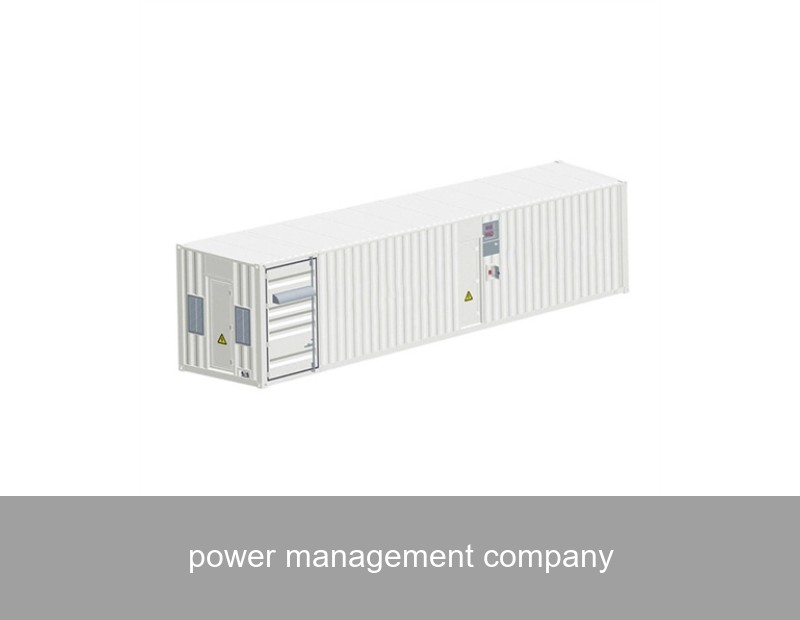
A modern BESS installation is compact, safe, and forms the core of intelligent power management. (Image for representation)
How Highjoule Delivers Intelligent Power Management
This is where Highjoule's nearly two decades of expertise come into play. As a global leader in advanced energy storage, we function as your comprehensive power management company. We provide end-to-end solutions, from initial consultancy and system design to installation, commissioning, and long-term performance monitoring. Our flagship product, the Highjoule H-Series Commercial BESS, is engineered for intelligence and durability. It features:
- Advanced Lithium Iron Phosphate (LFP) battery chemistry for superior safety and long cycle life.
- Integrated, AI-driven energy management software (Highjoule Horizon OS) that continuously learns your load patterns and optimizes for cost and efficiency.
- Scalable architecture, allowing you to start with a needed capacity and expand as your business grows.
- Grid-forming inverter technology that can create a stable "microgrid" during outages, something traditional generators cannot do.
Our services extend beyond the hardware. The Highjoule Horizon platform gives you a real-time dashboard into your energy flows, savings, and carbon reduction, putting actionable insights at your fingertips. We partner with you for the lifecycle of the system, ensuring it adapts to changing tariffs and continues to deliver maximum ROI.
Case Study: A European Manufacturing Plant
Let's make this concrete with a real-world application. A major automotive component manufacturer in Bavaria, Germany, approached Highjoule with three clear objectives: reduce energy costs, ensure production continuity against grid instability, and lower their carbon footprint. Their facility had a significant, variable load with high peaks during shift changes and heavy machinery startup.
The Highjoule Solution: We designed and installed a 1.2 MWh / 600 kW H-Series BESS, integrated with their existing rooftop solar PV array. The system was configured for peak shaving and solar self-consumption optimization.
The Results (12-month period):
- Demand Charge Reduction: Peak grid draw was reduced by 22%, leading to a €48,000 annual saving on demand charges alone.
- Increased Solar Self-Consumption: The portion of solar energy used directly on-site rose from 35% to over 80%, reducing grid purchases.
- Reliability: The system has already provided three seamless backup events during short grid dips, preventing an estimated €150,000 in production line stoppages.
- Carbon Impact: The combined solar+storage solution reduced the facility's scope 2 emissions by approximately 185 tonnes of CO2e annually.
This case exemplifies the multi-faceted value a strategic partnership with a power management company like Highjoule can bring. It's not just a battery; it's a financial, operational, and sustainability asset.
The Future of Power: Proactive, Not Reactive
The energy landscape is evolving at a breakneck pace. With the rise of electric vehicles, electrification of heat, and increasing climate-driven weather events, grid pressures will only intensify. Regulations, like the EU's Green Deal and various state-level incentives in the US, are also shaping the market. The businesses that will thrive are those that view energy not as a cost center, but as a strategic resource to be managed and optimized. Proactive power management provides a hedge against volatility and a tangible step toward decarbonization goals. As noted by the International Renewable Energy Agency, flexibility through storage is key to a cost-effective clean energy transition (IRENA, 2023).

The future grid relies on distributed resources like storage to balance renewables. (Image for representation)
What's Your Energy Resilience Score?
Now, consider your own operation. Can you accurately predict your next electricity bill? How much would a 30-minute power outage cost you? What is your plan to meet evolving sustainability mandates? The first step toward resilience is understanding your current position. We invite you to assess your needs: analyze your utility bills for demand charges and consumption patterns, evaluate your critical load, and define your sustainability targets. The journey to intelligent power management begins with a single question: Is your business ready to take control of its power, or will you remain at the mercy of the grid?
 Inquiry
 Online Chat