


Perovskite Solar Panels in Japan: The Next Frontier for Renewable Energy
Imagine a solar panel that is not only highly efficient but also lightweight, flexible, and potentially cheaper to produce. This isn't science fiction; it's the promise of perovskite solar technology. In Japan, a nation with limited land area and a strong commitment to a carbon-neutral future, these next-generation perovskite solar panels are generating significant excitement. As Japan accelerates its energy transition, integrating such innovative generation with equally advanced storage solutions becomes critical. This is where companies like Highjoule, a global leader in intelligent energy storage since 2005, contribute by ensuring every kilowatt-hour of this cutting-edge solar power is captured, managed, and utilized effectively.
Table of Contents
- The Japan Context: Why Perovskite is a Perfect Fit
- How Do Perovskite Solar Panels Work? A Simple Breakdown
- A Japanese Case Study: From Lab to Real-World Application
- The Storage Imperative: Why Smart ESS is Non-Negotiable
- Highjoule's Role: Integrating Innovation with Reliability
- The Road Ahead: Challenges and Collaborative Solutions
The Japan Context: Why Perovskite is a Perfect Fit
Japan's energy landscape presents unique challenges: high population density, mountainous terrain, and frequent natural disasters. Traditional silicon solar panels, while effective, require significant space and rigid installation. Perovskite solar cells, often fabricated as thin films, offer transformative advantages:
- Lightweight & Flexible: They can be applied to curved surfaces, building facades, and even vehicle roofs, maximizing energy generation in space-constrained urban environments.
- High Performance in Low Light: They perform better than silicon in diffuse light and cloudy conditions, common in many parts of Japan.
- Potential for Lower Cost: The manufacturing process can be simpler and less energy-intensive than purifying silicon, promising lower costs at scale.
For a country targeting 36-38% renewable energy in its power mix by 2030, perovskite technology is a strategic piece of the puzzle.
How Do Perovskite Solar Panels Work? A Simple Breakdown
Let's demystify the technology. Perovskite refers to a specific crystal structure that can be created using abundant, low-cost materials. When layered into a solar cell, this material excels at absorbing sunlight and generating electrical charge.

Image: A perovskite solar cell module, showcasing its thin-film design. (Source: NREL, public domain)
Think of it like this: if a traditional silicon panel is a heavy, solid book, a perovskite panel is like a few pages of a lightweight, highly absorbent magazine. This fundamental difference in material science opens the door to new applications and economies.
The Efficiency Race: Data That's Turning Heads
The progress has been staggering. In just over a decade, perovskite solar cell efficiency in lab settings has skyrocketed from around 3.8% to over 25% today, rivaling the performance of silicon cells that have had 60 years of development. Even more compelling are perovskite-silicon tandem cells, which layer perovskite on top of silicon to capture a broader spectrum of sunlight. These have already achieved certified efficiencies above 33%, a figure once thought impossible for standard solar technology. You can explore the latest certified records on the National Renewable Energy Laboratory (NREL) efficiency chart.
A Japanese Case Study: From Lab to Real-World Application
Japan is not just watching this revolution; it's leading parts of it. A compelling example comes from Panasonic Holdings and its work on perovskite-silicon tandem modules. In 2023, the company announced a large-area prototype (approximately 700 cm²) achieving a world-leading conversion efficiency of 22.2% for a practical-sized module. They are actively moving towards commercialization, targeting applications in residential roofs and beyond.
But what happens after the sun sets or during a peak generation hour? This high-efficiency, potentially variable generation demands intelligent management. This is the critical link between groundbreaking solar technology and reliable, usable power for homes and businesses.
The Storage Imperative: Why Smart ESS is Non-Negotiable
Solar panels, whether perovskite or silicon, generate power intermittently. To truly achieve energy independence and grid stability, this power must be stored. This is especially true for maximizing the value of high-efficiency panels. An advanced Energy Storage System (ESS) does more than just hold power; it:
- Maximizes Self-Consumption: Stores excess solar energy for use in the evening, reducing reliance on the grid.
- Provides Backup Power: Crucial for resilience in areas prone to grid outages from natural disasters.
- Optimizes Financial Returns: Allows users to participate in energy trading or avoid peak-time tariffs.
Without a sophisticated storage partner, even the most efficient solar panel cannot reach its full potential.
Highjoule's Role: Integrating Innovation with Reliability
At Highjoule, we've spent nearly two decades perfecting the other half of the renewable equation. As pioneers in advanced energy storage, our solutions are designed to seamlessly integrate with the solar technologies of today and tomorrow, including high-output perovskite systems.
Our H-Series Commercial & Industrial ESS and Voltstream Residential Storage Systems are built with intelligence at their core. They feature:
| Feature | Benefit for Advanced Solar Integration |
|---|---|
| AI-Powered Energy Management | Dynamically learns energy patterns to optimize charging from high-efficiency solar arrays and discharging to loads or the grid. |
| High Round-Trip Efficiency (>96%) | Minimizes energy loss, ensuring more of your valuable perovskite-generated electricity is available for use. |
| Scalable & Modular Design | Storage capacity can grow alongside your solar installation, future-proofing your investment. |
| Robust Safety Protocols | Multi-layer protection for lithium-ion battery systems, ensuring long-term, safe operation. |
For a microgrid project in Hokkaido or a manufacturing facility in Osaka pairing perovskite panels with a Highjoule ESS means creating a self-sustaining, efficient, and resilient energy asset. We ensure the groundbreaking power generated is never wasted.

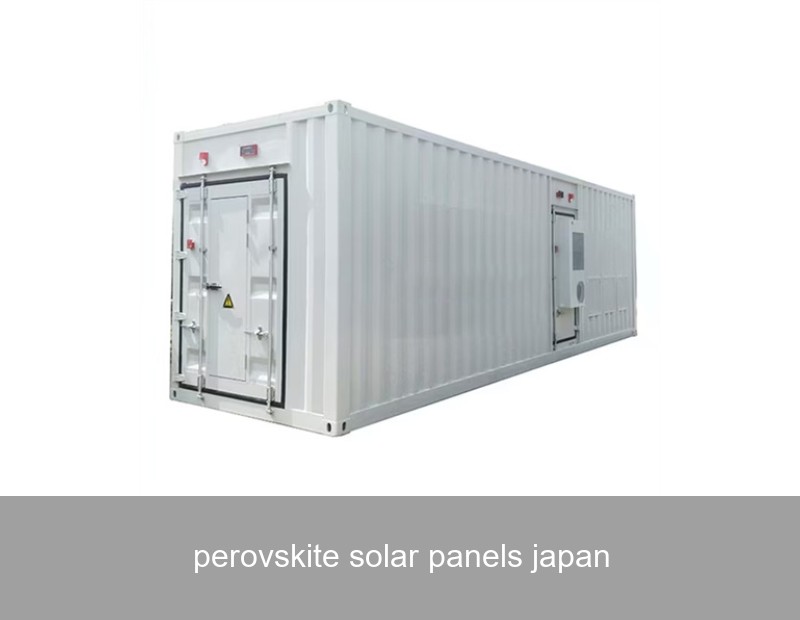
Image: A modern, scalable energy storage system installation. (Source: Unsplash, representative image)
The Road Ahead: Challenges and Collaborative Solutions
For perovskite solar panels in Japan, the path to mass adoption involves overcoming hurdles like long-term durability in humid climates and scaling up manufacturing. Ongoing research, such as that highlighted by Nature Reviews Materials, is rapidly addressing stability. The synergy between solar innovators and storage experts will be key. As solar technology becomes more advanced and site-adaptive, storage systems must evolve in intelligence and flexibility to match.
As Japan continues to pioneer these remarkable materials, we leave you with this question: How is your organization preparing to integrate next-generation renewable generation with the smart storage infrastructure required to make it truly transformative?
 Inquiry
 Online Chat