


PERC, TOPCon, HJT: How Much Efficiency Do These Solar Technologies Really Offer?
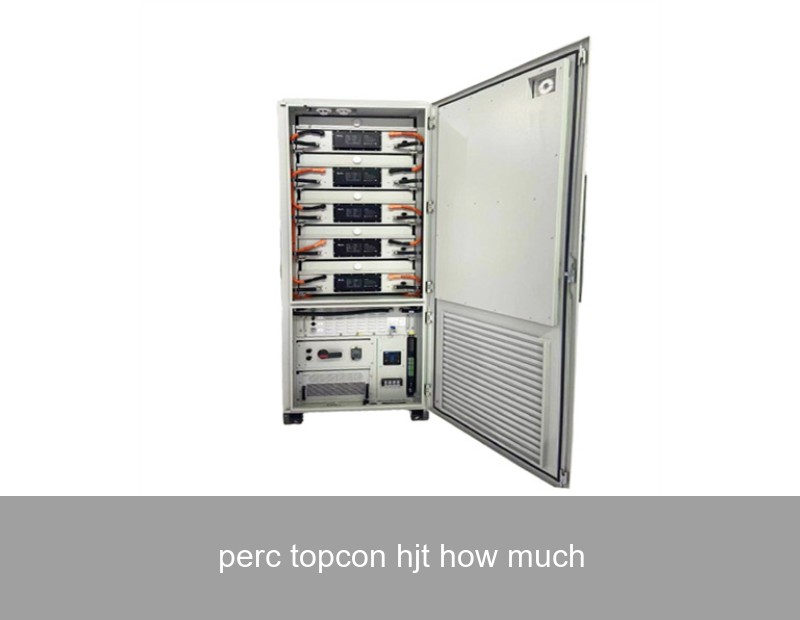
If you're researching solar panels for your home or business, you've likely encountered a confusing alphabet soup: PERC, TOPCon, HJT. Promises of higher efficiency and better performance abound, but the ultimate question remains: How much of a difference do these technologies actually make for your energy bill and sustainability goals? The answer isn't just about a percentage point on a spec sheet. It's about real-world energy yield, long-term reliability, and—critically—how that harvested solar power is stored and managed. Let's demystify these technologies and see how they translate into tangible value, especially when paired with intelligent energy storage from a leader like Highjoule.
Table of Contents
The Evolution: From PERC to TOPCon to HJT
Solar panel technology is in a constant state of refinement. Understanding this progression helps clarify the "how much" question.
PERC: The Established Workhorse
Passivated Emitter and Rear Cell (PERC) technology has been the industry standard for years. By adding a dielectric passivation layer to the rear of the cell, it reflects light back into the silicon, capturing more energy and boosting efficiency. Typical modern PERC panels offer efficiencies between 21% and 22.5%. They are cost-effective and proven, but are approaching their theoretical efficiency limit.
TOPCon: The High-Performance Successor
Tunnel Oxide Passivated Contact (TOPCon) cells take passivation further. They feature an ultra-thin silicon oxide layer topped with doped polysilicon on the entire rear surface. This design minimizes electrical losses, significantly improves performance in high temperatures, and pushes lab efficiencies well over 25%. Commercial TOPCon panels now readily achieve 22.5% to 23.5% efficiency.

Image source: Fraunhofer ISE (illustrative efficiency chart)
HJT: The Premium Hybrid
Heterojunction Technology (HJT) is a game-changer in structure. It layers amorphous silicon around a crystalline silicon wafer. This hybrid approach achieves exceptional passivation, delivers very high efficiencies (commercial panels at 23% to 24.5%), and boasts superior temperature coefficient and bifaciality. However, it often comes with a higher manufacturing cost.
How Much Better? A Side-by-Side Comparison
Let's quantify the differences. Assume a standard residential rooftop with 10 kW of DC capacity.
| Technology | Typical Module Efficiency | Estimated Annual Yield (Sunny Region, e.g., California) | Key Advantage | Temperature Coefficient (Typical) |
|---|---|---|---|---|
| PERC | 21.5% | ~16,500 kWh | Lowest Cost per Watt | -0.34% / °C |
| TOPCon | 23.0% | ~17,600 kWh (+1,100 kWh vs PERC) | Best Value: Higher Efficiency & Better Heat Tolerance | -0.29% / °C |
| HJT | 24.0% | ~18,400 kWh (+1,900 kWh vs PERC) | Highest Efficiency & Performance in Heat | -0.24% / °C |
As you can see, the jump from PERC to TOPCon can yield roughly 6-7% more energy annually. Moving to HJT can mean 10-12% more. In financial terms, that extra 1,100 to 1,900 kWh can translate to significant savings or more power available for storage, depending on your local electricity rates and net metering policies. For a deeper dive into the physics behind these numbers, research institutions like the National Renewable Energy Laboratory (NREL) provide invaluable resources.
Beyond the Panel: Why Your Storage System Matters Just as Much
Here's the critical insight many miss: A high-efficiency panel's true value is only unlocked with an equally intelligent storage system. What good is generating extra kilowatt-hours if they're exported to the grid at a low rate, or if your system can't handle the panel's unique output profile? This is where Highjoule's expertise becomes pivotal.
Highjoule's advanced battery energy storage systems (BESS) are engineered to complement high-performance solar arrays. Our systems feature:
- High Round-Trip Efficiency (RTE): We ensure that the extra energy your TOPCon or HJT panels produce isn't wasted in storage conversion losses.
- Advanced DC Coupling Options: For new installations, our solutions can be DC-coupled, allowing high-efficiency panels to charge batteries directly with less power conversion, maximizing the harvest from every sunbeam.
- Smart, Adaptive Inverters: Our inverters are optimized to handle the different voltage and current characteristics of modern cell technologies, ensuring stable and efficient operation across all conditions.
- AI-Driven Energy Management: The Highjoule Energy OS doesn't just store power; it learns your consumption patterns and solar production, intelligently deciding when to store, when to use, and when to export to maximize the financial return on your premium solar investment.
A Real-World Case: Maximizing TOPCon Output in Bavaria
Let's look at a concrete example. A medium-sized manufacturing facility in Bavaria, Germany, upgraded its existing 250 kW PERC array by adding a new 150 kW TOPCon section. Their goal was to increase self-consumption and reduce reliance on the volatile grid.
The Challenge: The new TOPCon strings had a higher voltage and different peak power profile. Their old storage system struggled with the integrated input, leading to occasional clipping (loss of peak power) and inefficient charging.
The Highjoule Solution: The facility installed a Highjoule C&I StackPower 200 system. Its multi-MPPT (Maximum Power Point Tracking) solar inverter was specifically configured for the hybrid PERC/TOPCon setup, ensuring each technology operated at its ideal point. The system's 215 kWh storage capacity was sized to capture the additional 8% yield from the TOPCon panels.
The Data-Driven Result: After one year:
- Overall Solar Self-Consumption Rate: Increased from 35% to 82%.
- Additional Energy Captured from TOPCon Gain: Approximately 18,000 kWh/year.
- Payback Period: Reduced by an estimated 1.5 years due to the combined effect of higher generation and superior storage arbitrage managed by the Highjoule AI.
This case, documented in a broader industry report on PV performance, shows that the "how much" question is answered not just by panel specs, but by the synergy between generation and storage technology.

Image source: Unsplash (representative image of commercial solar installation)
Making the Choice: Factors Beyond Peak Efficiency
So, should you choose PERC, TOPCon, or HJT? The answer depends on more than just the highest efficiency number.
- Budget & Value: PERC offers the lowest upfront cost. TOPCon currently presents the best balance of performance and price. HJT commands a premium for top-tier performance.
- Climate: If you live in a very hot climate, the superior temperature coefficient of TOPCon and HJT will mean a larger real-world advantage over PERC.
- Roof Space Constraints: Limited space favors higher-efficiency panels (TOPCon/HJT) to maximize generation per square meter.
- Your Storage Partner: This is crucial. Can your chosen storage system handle the nuanced output of advanced cell tech? A generic, low-RTE storage system can erode the gains from your premium panels.
At Highjoule, we provide more than just industry-leading storage hardware. Our technical consultants work with you and your solar installer to model the expected yield from PERC, TOPCon, or HJT panels specific to your location and then design a storage solution that captures and leverages every possible kilowatt-hour. Our systems are future-proof, ready to integrate with tomorrow's even more efficient solar technologies.
Given the rapid pace of innovation in both solar and storage, what specific energy independence or financial target is driving your decision to explore these high-efficiency solar options today?
 Inquiry
 Online Chat