


Demystifying the Operation of Solar Panels: From Sunlight to Socket
You see them on rooftops and in fields, silently glinting under the sun. But have you ever stopped to wonder about the precise operation of solar panels? It's a common sight, yet the sophisticated dance of physics and engineering happening within those sleek, glassy surfaces remains a mystery to many. For homeowners and business leaders across Europe and the US considering the switch to solar, understanding this operation isn't just academic—it's key to maximizing your investment, ensuring system health, and truly embracing energy independence. Let's pull back the curtain.
Anatomy of an Operation: From Photon to Power
The operation of a solar panel system is a seamless four-act play. It’s a coordinated process where each component must perform flawlessly for the final act—powering your home or business—to succeed.
Step 1: The Photovoltaic Effect – The Core Principle
At the heart of every panel are photovoltaic (PV) cells, typically made of silicon. When photons (light particles) from the sun strike these cells, they transfer their energy to electrons in the silicon, knocking them loose. This creates a flow of electrical current. This fundamental process, discovered over a century ago, is what makes the entire operation of solar panels possible. You can explore the deep scientific history of this effect through resources like the U.S. Department of Energy.
Step 2: DC Generation & The Panel's Output
The freed electrons are directed by an internal electric field within the cell, creating a Direct Current (DC). A single cell doesn't produce much power—typically only 2-3 watts. That's why they're wired together in series and parallel within a panel (usually 60 or 72 cells) to boost voltage and current. A typical residential panel might output 300 to 400 watts of DC power under ideal conditions.
Step 3: Power Conditioning (The Unsung Hero)
Here’s where a critical conversion happens. Our homes and the grid run on Alternating Current (AC). The DC power from your panels travels via wiring to an inverter. This device is the maestro of your system's operation, rapidly converting DC into usable AC power. Modern systems often use module-level power electronics (MLPEs) like microinverters or DC optimizers, which maximize output from each individual panel, especially useful if part of your roof is shaded.

Image source: Unsplash. A modern solar inverter, the brain of the power conversion process.
Step 4: Integration & Usage
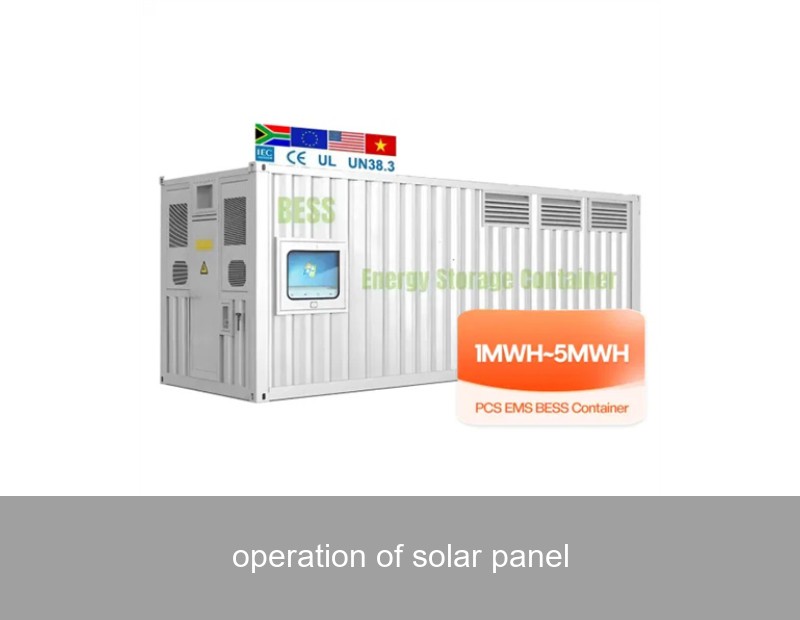
The freshly minted AC power is now ready for action. It first supplies your immediate property's electrical demand. Any excess power not instantly consumed doesn’t go to waste. In grid-tied systems, it is fed back into the public grid (often earning you credits via net metering). This is where the story evolves for maximum self-sufficiency. Companies like Highjoule enhance this stage by integrating advanced battery energy storage systems (BESS). Instead of sending all surplus energy out, a Highjoule system intelligently stores it in high-density lithium-ion batteries for use when the sun isn’t shining—turning a time-shift operation into a 24/7 energy solution.
Key Factors Impacting Your Solar Panel's Daily Operation
Understanding the ideal operation of solar panels requires knowing what influences their performance. It's not just about having them installed; it's about their environment and management.
| Factor | Impact on Operation | Mitigation Strategy |
|---|---|---|
| Sunlight Intensity & Angle | Low light (clouds, dawn/dusk) reduces output. Optimal angle maximizes photon capture. | Professional site assessment, seasonal tilt adjustments (where feasible). |
| Temperature | Counterintuitively, high panel temperatures (above 25°C/77°F) can decrease voltage and efficiency. | Installation with airflow clearance, choosing panels with a low temperature coefficient. |
| Shading | Even partial shading (from a chimney, tree) on one cell can disproportionately reduce a whole string's output. | Use of MLPEs (microinverters/optimizers), careful array design. |
| Soiling & Dirt | Dust, pollen, and bird droppings create a barrier, blocking sunlight. | Periodic cleaning, especially in arid or high-pollution areas. |
| System Aging | Panels naturally degrade, losing a small percentage of output capacity each year (typically 0.5-0.8%). | Selecting panels with a strong performance warranty (e.g., 90% output after 25 years). |
The Data Behind the Downtime
According to a study by the National Renewable Energy Lab (NREL), soiling alone can cause average annual energy losses of up to 7% in parts of the United States, with spikes over 20% in extremely dusty regions. This isn't just dirt; it's a direct hit on your return on investment.
From Theory to Reality: A Bavarian Case Study
Let's ground this in a real-world example. A medium-sized dairy farm in Bavaria, Germany, installed a 100 kW rooftop solar array in 2020. Their goal was to offset high energy costs from round-the-clock milking and cooling operations.
The Phenomenon: Despite a good initial yield, the farmers noticed unpredictable dips in afternoon production, especially in summer.
The Data & Diagnosis: Monitoring data from their inverter revealed specific panels were underperforming precisely when the sun was highest. A site audit found that the farm's own ventilation chimneys were casting small, moving shadows across parts of the array during peak sun hours. This "partial shading" was crippling the output of entire panel strings due to their series configuration.
The Solution & Outcome: In 2023, they partnered with Highjoule for a system upgrade. Highjoule engineers retrofitted the array with DC power optimizers on every panel, isolating the impact of shading. More crucially, they integrated a 40 kWh Highjoule IntelliStore battery system. Now, peak midday power that was previously lost is captured and stored. This stored energy is then used to power the energy-intensive evening milking sessions. The result? A 33% increase in on-site energy consumption and a reduction in grid dependence from 45% to under 20% during evening operations. The operation of their solar panels became not just about generation, but about intelligent, time-shifted consumption.
Maximizing Output: The Role of Intelligent Energy Management
As the Bavarian case shows, modern solar panel operation is about more than the panels themselves. It's about the ecosystem. This is Highjoule's core expertise. Our Energy Management System (EMS) acts as the brain of your entire energy setup. It doesn't just passively watch; it actively learns your consumption patterns, weather forecasts, and utility rate schedules.
- Predictive Charging/Discharging: The EMS can charge your batteries with excess solar or from the grid when rates are low, and discharge when rates are high or solar production drops.
- Microgrid Readiness: For commercial and industrial clients, Highjoule systems can be configured to "island" – meaning if the grid goes down, your critical operations can continue seamlessly powered by solar and storage.
- Holistic Monitoring: Our platform provides a single pane of glass to view not just solar production, but battery status, home consumption, and grid interaction, giving you unprecedented control over your energy operation.
Image source: Unsplash. A modern energy management dashboard monitoring production and consumption.
Future Horizons in Solar Operation
The fundamental operation of solar panels is set to become even more efficient and integrated. We're looking at bifacial panels capturing light from both sides, perovskite-silicon tandem cells pushing conversion efficiencies beyond 30%, and even more sophisticated AI-driven energy management that can trade with the grid in real-time. The line between energy consumer and prosumer is blurring. The International Energy Agency (IEA) consistently highlights solar as the cornerstone of future energy grids, with storage as its essential partner (IEA Renewables 2023 Report).
So, as you look at those panels on your neighbor's roof or consider them for your own business, ask yourself: Is your goal merely to generate green power, or is it to achieve true energy resilience and intelligence? How will you manage the power your panels produce when the sun sets or clouds roll in?
 Inquiry
 Online Chat