


How Much Does an Off-Grid System Cost? A Realistic Breakdown for Energy Independence
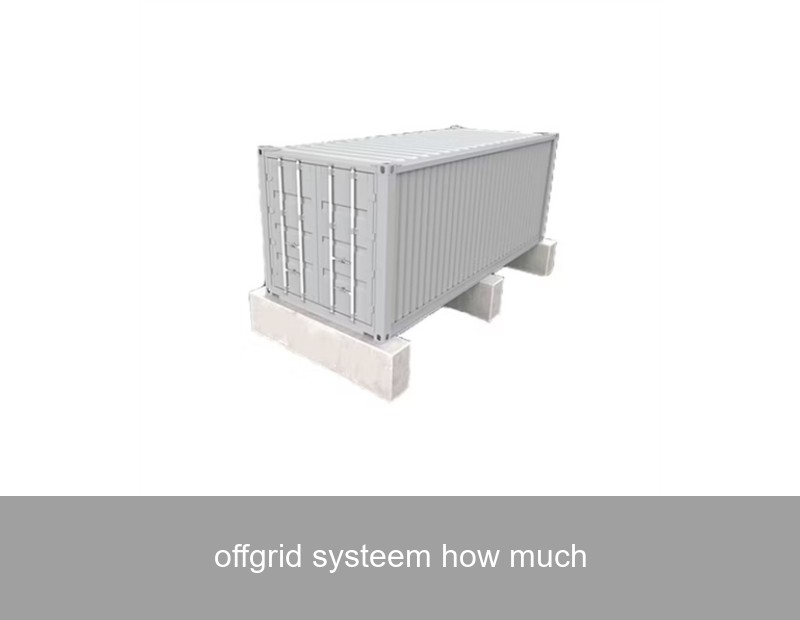
Dreaming of energy freedom, away from rising utility bills and grid outages? You're not alone. More homeowners and businesses across Europe and the US are asking the critical question: "Off-grid systeem how much?" The answer isn't a single number, but an investment in resilience and sustainability. Let's demystify the true cost of going completely off-grid, moving beyond the sticker shock to understand the value of true energy independence.
Table of Contents
- The Real Phenomenon: Why "Off-Grid" is More Than a Trend
- The Cost Breakdown: Where Your Investment Goes
- A Real-World Case Study: The Bavarian Mountain Farm
- Key Insights: What Truly Drives Your System's Cost & Performance
- The Highjoule Solution: Precision-Engineered for Off-Grid Reliability
- Your Next Step Towards Energy Independence
The Real Phenomenon: Why "Off-Grid" is More Than a Trend
The shift towards off-grid living isn't just for remote cabins anymore. It's a strategic response to increasing grid instability, volatile energy prices, and a growing desire for environmental stewardship. In 2023, the US Energy Information Administration noted a significant rise in customer-reported power interruptions[1]. Similarly, European households faced record-high electricity prices following geopolitical tensions. This phenomenon pushes the "off-grid systeem how much" question from curiosity into necessity for many.
The Cost Breakdown: Where Your Investment Goes
An off-grid system is a sophisticated ecosystem. Its total cost hinges on one factor above all: your energy needs. Asking "how much" without assessing consumption is like asking the price of a car without specifying the model. Let's break down the core components.
1. Solar PV Array: Your Power Plant
This is your fuel source. Size is determined by your daily kilowatt-hour (kWh) usage and your location's solar insolation. A typical European or North American off-grid home using 20-30 kWh per day may need a 8-12 kW solar array.
- Cost Range: $12,000 - $30,000+ (including mounts, wiring, and installation).

Image Source: Unsplash - A properly sized solar array is the foundation of any off-grid system.
2. The Heart of the System: Battery Energy Storage
This is where the "off-grid" magic happens—storing solar energy for use at night and on cloudy days. Battery capacity (measured in kWh) is your most significant cost variable and the key to reliability.
- Technology: Modern Lithium Iron Phosphate (LFP) batteries are the standard for safety, longevity, and performance.
- Cost Range: $15,000 - $50,000+ for a robust 20-40 kWh battery bank. This is the critical investment that Highjoule specializes in.
3. The Brain: Inverter/Charger & System Balance
This includes the inverter (converts DC battery power to AC for your home), the charge controller, and often a backup generator interface. Quality here ensures efficiency and system longevity.
- Cost Range: $5,000 - $15,000+ for a robust, generator-compatible setup.
4. Installation, Permits, and "Soft Costs"
Professional design, electrical work, permits, and potential structural reinforcements can add 20-30% to the component costs. Never underestimate this phase—it's what turns a box of parts into a safe, code-compliant power system.
| System Component | Key Function | Estimated Cost Range (USD) | Highjoule's Role |
|---|---|---|---|
| Solar Panels & Mounting | Energy Generation | $12,000 - $30,000+ | System Design & Integration |
| Battery Storage System | Energy Storage & Dispatch | $15,000 - $50,000+ | Core Product & Technology |
| Inverter/Charger & Balance of System | Power Conversion & Management | $5,000 - $15,000+ | Integrated Smart Energy Management |
| Installation & Soft Costs | Professional Implementation | $7,000 - $20,000+ | Partner Network & Technical Support |
| Estimated Total System Cost | Fully Installed Off-Grid Power | $39,000 - $115,000+ | End-to-End Solution Provider |
A Real-World Case Study: The Bavarian Mountain Farm
Let's ground these numbers in reality. A working agritourism farm in the Bavarian Alps, Germany, needed a reliable year-round power solution. Grid connection was prohibitively expensive. Their load: a farmhouse, guest quarters, and small dairy processing equipment, averaging 35 kWh/day with winter peaks.
- Solution: A custom off-grid system featuring a 14 kW solar array and a Highjoule HES-40 battery storage system with 40 kWh of LFP capacity, paired with a intelligent inverter and a legacy diesel generator as a seasonal backup.
- System Cost (2022): Approximately €85,000 (fully installed).
- Outcome: The system provides >95% energy autonomy annually. The generator runs less than 50 hours per year, primarily in deep winter. The farm eliminated a projected €15,000 grid connection fee and saves €4,500+ annually on what diesel costs would have been. The Highjoule system's advanced thermal management ensures reliable battery performance even in sub-zero Alpine temperatures.

Image Source: Unsplash - Off-grid systems are vital for remote agricultural and tourism businesses.
Key Insights: What Truly Drives Your System's Cost & Performance
Understanding these levers will help you ask the right "how much" questions.
Insight 1: Your "Load List" is Your Budget Blueprint
Every appliance matters. Switching to LED lighting, an efficient heat pump, and an induction cooktop can dramatically reduce the required size—and cost—of your solar array and battery bank. An energy audit is non-negotiable.
Insight 2: Battery Chemistry & Depth of Discharge Are Key
Not all batteries are equal. High-quality LFP batteries, like those in Highjoule systems, offer a 95%+ usable depth of discharge and a lifespan of 6,000+ cycles. Cheaper batteries might only offer 50-80% usable capacity and half the lifespan, making them more expensive in the long run. The National Renewable Energy Laboratory (NREL) emphasizes lifecycle cost analysis for storage[2].
Insight 3: Professional Design Beats a Cheap Price Every Time
A system sized for a sunny California summer will fail in a German winter. Professional design accounts for "days of autonomy" (how many cloudy days you must weather) and seasonal load variations. This expertise prevents costly undersizing or wasteful oversizing.
The Highjoule Solution: Precision-Engineered for Off-Grid Reliability
At Highjoule, with nearly two decades of experience, we understand that "off-grid systeem how much" is fundamentally a question about value and peace of mind. Our approach is not just to sell components, but to deliver guaranteed energy independence.
Our HES Series battery energy storage systems are built for the rigors of off-grid life. With industry-leading cycle life, robust built-in battery management (BMS) and thermal management, they are the reliable core we design around. Our smart energy management system seamlessly orchestrates solar production, battery charging/discharging, and backup generator control to maximize efficiency and component life.
For the customer, this translates to a system where the battery is not the weak link. It means predictable performance, lower long-term cost of ownership, and a single point of responsibility. We partner with a network of certified installers across Europe and North America to ensure your system is designed perfectly for your site and installed flawlessly.
Your Next Step Towards Energy Independence
So, "off-grid systeem how much"? For a robust, professionally installed system in Europe or the US, a realistic range is $40,000 to $120,000+. It's a significant investment, but one that buys you decades of energy security, fixed energy costs, and environmental contribution.
The most productive question to ask now isn't just about cost, but about fit: "What would a customized, resilient off-grid energy plan look like for my specific home or business?" What's the one critical load you couldn't afford to lose power to, and how can we build a system that ensures it never does?
 Inquiry
 Online Chat