


Moving Solar Panels for Extension: A Smart Strategy for Maximizing Your Solar Investment
You installed a solar array a few years ago, and it's been performing beautifully, slashing your energy bills. But now, you're planning a home extension, a new workshop, or an EV charging station. The first thought that might strike you is, "My roof is about to be obstructed!" or "My energy needs are about to jump, but my solar system can't." This is a common challenge, and the solution isn't always adding more brand-new panels. A powerful, yet often overlooked, strategy is moving solar panels for extension projects. It's a process of carefully relocating and potentially expanding your existing solar PV system to accommodate structural changes and increased energy demand. For homeowners and businesses across Europe and the US, this approach can be the key to maintaining energy independence and financial returns while upgrading your property. Let's explore how intelligent panel repositioning, coupled with modern battery storage, can turn a potential headache into a major opportunity for optimization.
Table of Contents
- The Challenge: Growth vs. Green Energy
- The Data: Why Extension Projects Demand a Rethink
- The Solution: Moving and Enhancing, Not Just Adding
- Case Study: A Bavarian Farmhouse Renovation
- The Highjoule Advantage: Integrated Smart Energy Management
The Challenge: Growth vs. Green Energy
Property extensions are signs of progress—a growing family, a thriving business, or a valuable investment. However, they can directly clash with a pre-existing solar installation. The new structure might cast shade on existing panels, drastically reducing their output. Even if shading isn't an issue, the expanded building space will inevitably increase your total electricity consumption. Your once perfectly-sized solar system may now only cover 50-60% of your new needs, pushing you back towards the grid and higher bills. Simply installing a few extra panels might not be feasible due to space constraints or roof design changes. This is where the concept of a strategic solar panel relocation and system extension comes into play. It's a holistic energy audit and redesign process.
Common Scenarios Requiring Panel Movement
- Home Additions: Adding a second story, a sunroom, or a garage.
- Commercial Upgrades: Expanding warehouse space or office facilities.
- Infrastructure Additions: Installing pool heaters, electric vehicle (EV) chargers, or advanced HVAC systems.
- Roof Maintenance/Re-roofing: An ideal time to re-evaluate and optimize panel layout.
The Data: Why Extension Projects Demand a Rethink
Let's talk numbers. According to the National Renewable Energy Laboratory (NREL), shading on even a single solar panel can reduce the output of an entire string significantly. Meanwhile, the average home addition in the US can increase energy consumption by 20-40%. In Europe, with rising electrification of heating (via heat pumps) and transport, the load increase can be even more pronounced. A system sized five years ago likely didn't factor in an EV or a heat pump. This creates an energy gap. The knee-jerk reaction is to buy a completely new, larger system. But financially and sustainably, it often makes more sense to relocate your existing panels to a more optimal area (like a newly available section of roof or a ground-mount system), then supplement with a few new, higher-efficiency panels and—critically—a battery storage system to manage the new, more complex load profile.

Credit: Unsplash / Andreas Gücklhorn. A home extension project creates the perfect moment to reassess solar panel placement and system capacity.
The Solution: Moving and Enhancing, Not Just Adding
The process of moving solar panels for an extension is a technical dance that should be led by certified professionals. It involves more than just unbolting and re-bolting. Here’s a logical step-by-step approach:
- Energy Audit & 3D Modeling: A professional assesses your new energy consumption patterns and uses software to model sun exposure on your modified property, identifying the optimal new locations for panels.
- System Decommissioning & Hardware Check: The existing system is safely shut down, panels are removed, and all components (panels, inverters, wiring) are inspected for wear or upgrade potential.
- Strategic Relocation & Expansion: Viable existing panels are moved to the new, optimal site. This is often the perfect time to add a few new, higher-wattage panels that are compatible with your existing ones to boost total capacity.
- System Integration & Storage: This is the most critical modern upgrade. A new hybrid inverter or an AC-coupled battery system is integrated. This allows you to store excess solar energy for use during peak evening hours or when the new extension is drawing heavy power.
Key Components in a Modernized System
| Component | Role in Extension Project |
|---|---|
| Relocated/New Panels | Generate the fundamental kWh, now positioned for maximum yield post-extension. |
| Hybrid Inverter | The brain. Manages solar production, battery charging/discharging, and grid interaction seamlessly. |
| Battery Storage (BESS) | The heart of resilience. Stores daytime solar for use during high-demand periods, ensuring your extension doesn't spike your grid imports. |
| Energy Management System (EMS) | The nervous system. Intelligently directs energy flows, potentially prioritizing charging an EV or powering a heat pump based on algorithms and weather forecasts. |
Case Study: A Bavarian Farmhouse Renovation
Let's look at a real-world example from Southern Germany. A family-owned agritourism business with a 10kW rooftop solar system (installed 2018) planned a major extension: a new wing with 5 guest rooms, each with electric underfloor heating and heat pump mini-splits. The existing roof space was compromised, and energy demand was projected to rise by 65%.
- All existing panels were carefully moved to the new, larger south-facing barn roof.
- The system was expanded with an additional 4kW of high-efficiency bifacial panels.
- The core of the upgrade was the integration of a Highjoule H2 Series Hybrid Inverter and two Highjoule H-Cell 10 battery modules, creating a 20kWh storage capacity.
- The Highjoule Energy Management Platform was installed to dynamically control the heat pumps and a new EV charger based on solar forecast and occupancy.
The Results (12-month post-installation):
- Self-Consumption Rate: Increased from 35% to 82% despite much higher total consumption.
- Grid Dependence: Reduced by over 70%, protecting the business from volatile European energy prices.
- ROI: The combined savings and increased guest appeal (marketed as a "near-off-grid eco-retreat") projected a payback period of under 7 years for the entire upgrade.

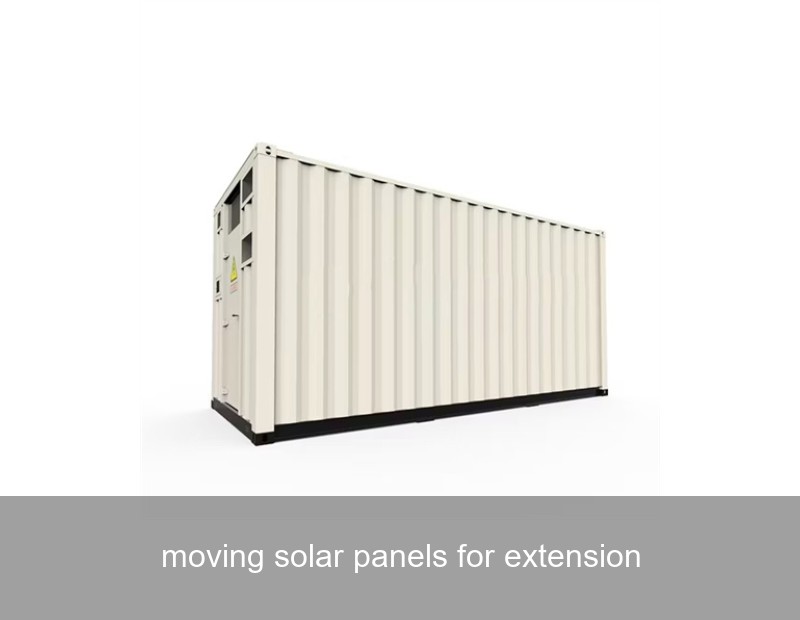
Credit: Unsplash / Kindel Media. A modern Battery Energy Storage System (BESS), like those from Highjoule, is the cornerstone of maximizing a relocated and expanded solar array.
The Highjoule Advantage: Integrated Smart Energy Management
As a global leader in advanced energy storage since 2005, Highjoule understands that moving solar panels for extension is about more than hardware—it's about designing a resilient, adaptive energy ecosystem. Our products are engineered for such scenarios. The Highjoule H2 Series Hybrid Inverter is designed for easy integration with both old and new solar panels, offering multiple MPPT trackers to handle different roof orientations that might result from a relocation. Our H-Cell modular lithium iron phosphate (LFP) batteries can be scaled over time—you can start with 10kWh for your new needs and easily add more later if you add another EV.
Most importantly, the Highjoule Energy Platform provides the intelligence. It doesn't just store energy; it learns your new consumption patterns in the extended property and optimizes dispatch. Should it power the new heat pump now or save energy for the evening peak? It makes these decisions in real-time, ensuring every kilowatt-hour from your moved and new panels is used in the most economical way possible. For commercial and microgrid applications, this level of control is indispensable for managing demand charges and ensuring operational continuity.
The Future: Your Energy Ecosystem
An extension project is a disruption, but it's also a clean slate for your energy infrastructure. It forces you to ask fundamental questions: Are you just patching an old system, or are you building a smart, flexible foundation for the next 20 years? With technologies like vehicle-to-home (V2H) and advanced grid services on the horizon, the system you design today should be ready for tomorrow.
So, as you finalize the blueprints for your new space, have you also mapped out the blueprint for your future energy independence? What role could a smart, scalable storage solution play in making your newly extended property not just bigger, but smarter and more sustainable?
 Inquiry
 Online Chat