


Understanding the Most Common Solar Panels for Your Home or Business
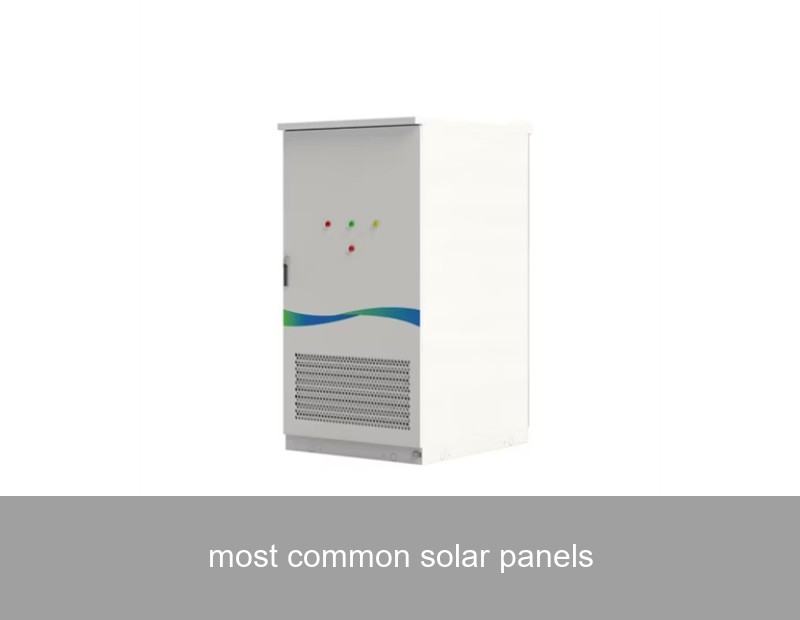
If you're considering solar power, you've likely encountered a dizzying array of options. From sleek all-black designs to those with visible grid lines, the choice can be overwhelming. But what are the most common solar panels on the market today, and more importantly, which one is the right fit for your energy goals and budget? This guide will demystify the technology, compare the key players, and show you how pairing the right panels with a smart battery system, like those from Highjoule, unlocks the true potential of your solar investment.
Table of Contents
- The Dominance of Crystalline Silicon
- Mono vs. Poly: A Side-by-Side Comparison
- The Efficiency Factor: Why It Matters for Your Roof
- Beyond the Panel: The Critical Role of Energy Storage
- Case Study: Maximizing ROI with the Right Tech Combo
- Future Horizons and Your Next Step
The Dominance of Crystalline Silicon
When we talk about the most common solar panels, we're primarily discussing panels made from crystalline silicon (c-Si). This material dominates over 95% of the global market, and for good reason. It offers a reliable, well-understood, and continually improving balance of efficiency, durability, and cost. Think of it like the internal combustion engine of the solar world—iteratively perfected over decades. Within this category, two main types battle for your rooftop: monocrystalline and polycrystalline.

Image: A modern monocrystalline solar array. Source: Unsplash
Mono vs. Poly: A Side-by-Side Breakdown
Let's break down the two champions. Monocrystalline panels are made from single, pure silicon crystals. This uniform structure allows electrons to flow more easily, resulting in higher efficiency. They are typically black in appearance and have a sleek, uniform look. Polycrystalline panels, on the other hand, are made from fragments of silicon melted together. This process is less wasteful, making them historically more cost-effective, but the crystal boundaries slightly hinder electron movement, leading to lower efficiency. They often have a blue, speckled look.
| Feature | Monocrystalline Panels | Polycrystalline Panels |
|---|---|---|
| Material | Single, pure silicon crystal | Multiple silicon fragments melted together |
| Efficiency | Higher (Typically 18-22%+) | Lower (Typically 15-18%) |
| Appearance | Uniform black cells | Blue, speckled cells |
| Space Efficiency | Excellent (More power per sq. ft.) | Good (Requires more space for same output) |
| Cost | Historically higher, but gap is narrowing | Historically more budget-friendly |
| Lifespan & Warranty | Often 25+ years | Often 25+ years |
The Efficiency Factor: Why It Matters for Your Roof
Efficiency isn't just a technical spec sheet number; it has real-world implications for your installation. Higher efficiency means you can generate the same amount of power with fewer panels. This is a game-changer if you have limited roof space, a complex roof layout, or simply want a minimalist aesthetic. In recent years, the price premium for high-efficiency monocrystalline panels has shrunk significantly, making them the go-to choice for most residential and commercial installations in Europe and the US. According to the U.S. Department of Energy, ongoing research continues to push the boundaries of silicon cell efficiency.
But here's a crucial insight many miss: The most efficient solar panel is only as good as the energy you can actually use. Solar production peaks in the middle of the day, often when homes are empty and businesses are in a lull. Without a way to capture that surplus, it gets fed back to the grid for minimal compensation.
Beyond the Panel: The Critical Role of Energy Storage
This is where the conversation evolves from just choosing the most common solar panels to designing a holistic energy system. Pairing your solar array with a battery energy storage system (BESS) is the key to true energy independence and maximizing financial return. A high-quality BESS, like the Highjoule H-Series for homes or the scalable Highjoule GridStack for commercial use, stores your excess solar energy for use when you need it most: during the evening peak, during power outages, or when grid electricity rates are at their highest.
Think of it this way: solar panels are your energy generators, but a battery is your energy bank account. You wouldn't let your paycheck instantly flow out to the utility company; you'd save some for later. Highjoule's intelligent systems do precisely that, with advanced software that learns your consumption patterns and optimizes storage and discharge to give you the greatest control and savings. This integration is what transforms a simple solar installation into a resilient, smart power asset.

Image: A home battery storage system installation. Source: Unsplash
Case Study: A German Bakery's Recipe for Energy Resilience
Let's look at a real-world example from Bavaria, Germany. A mid-sized family bakery with high energy needs for ovens and refrigeration installed a 50 kW rooftop array using high-efficiency monocrystalline panels. While this covered their daytime load, they were still vulnerable to evening price spikes and grid instability.
Their solution was to integrate a Highjoule GridStack 50 battery system. The results over 12 months were telling:
- Self-Consumption Boost: Increased the direct use of their solar power from 35% to over 80%.
- Cost Savings: Reduced their electricity bill by an additional 40% by avoiding peak grid purchases.
- Reliability: Provided seamless backup power during two brief grid outages, preventing spoilage of perishable goods.
This case, mirrored by many across Europe and North America, illustrates that the real value isn't just in generating cheap energy, but in having intelligent control over when and how you use it. Data from the International Energy Agency underscores the accelerating adoption of storage to complement renewable sources.
Future Horizons: Perovskite, Bifacial, and What's Next
The world of solar doesn't stand still. While monocrystalline silicon is king today, exciting technologies like perovskite tandem cells promise even higher efficiencies in the future. Bifacial panels, which capture light from both sides, are gaining traction in large-scale ground-mounted installations. However, these advancements reinforce the core principle: the panel technology must be matched with a flexible, future-ready storage solution. Highjoule's systems are designed with this interoperability in mind, ensuring your investment remains optimized as new panel technologies emerge.
Your Energy, Your Control
Choosing between the most common solar panels is a foundational decision, but it's just the first step in a longer energy journey. The ultimate goal is to create a system that not only generates power but also empowers you—giving you resilience, independence, and smart control over your energy costs. So, as you evaluate those panel quotes, we leave you with this question to ask your installer: "How will this system store and manage my solar energy to ensure I get the maximum value from every ray of sunshine, day and night?"
 Inquiry
 Online Chat