


Unlocking Resilience and Savings: The Essential Guide to a Modern Microgrid Management System
Imagine a small community, a hospital, or a factory that can keep the lights on seamlessly during a widespread blackout. It's not just a dream; it's the reality enabled by a sophisticated microgrid management system. As extreme weather events and grid instability become more frequent, the question for businesses and communities is no longer if they need a backup plan, but how sophisticated that plan should be. At its heart, a microgrid management system is the intelligent brain that orchestrates diverse energy resources—solar panels, battery storage, generators—to ensure reliable, efficient, and increasingly independent power. This guide will delve into why this technology is critical, how it delivers tangible value, and what you should consider for your own energy resilience strategy.
Table of Contents
- What is a Microgrid Management System?
- The Growing Pain: Grid Instability and Energy Costs
- The Data: Why Intelligent Control is Non-Negotiable
- Case Study: A Real-World Test in California
- The Highjoule Approach: Intelligence Meets Hardware
- Key Features of a Future-Proof System
- Is Your Energy Infrastructure Ready for the Next Decade?
What Exactly is a Microgrid Management System (MMS)?
Think beyond a simple backup generator. A modern microgrid is a localized, interconnected energy network that can operate both connected to the main utility grid and, crucially, in isolation as an "island." The microgrid management system is the software and hardware platform that makes this dual-mode operation possible and intelligent. It continuously monitors, controls, and optimizes all assets within the microgrid:
- Distributed Generation: Solar PV arrays, wind turbines, combined heat and power (CHP) units.
- Energy Storage: Battery energy storage systems (BESS), which are the linchpin for stability.
- Critical Loads: The essential equipment, servers, or production lines that must stay online.
- Grid Connection Point: The interface with the public utility, managing import/export.
In essence, the MMS makes real-time, automated decisions: Should we store solar power now or use it? Should we discharge the battery to avoid a peak demand charge from the utility? When the grid fails, how do we seamlessly disconnect and re-power critical loads within milliseconds? This is the high-stakes coordination a robust MMS provides.

Image Source: Unsplash - A visualization of advanced energy management control.
The Growing Pain: Why Grid-Only Reliance is a Risky Strategy
Let's talk about the "why now." For decades, a reliable public grid was a given for most in Europe and North America. The phenomenon has shifted. Intensifying climate events—from wildfires in California to severe winter storms in Texas—have exposed grid vulnerabilities. Concurrently, the electrification of transport and heating is increasing demand, while the integration of variable renewables, though essential, adds complexity to grid balancing.
The result? More frequent and longer outages, coupled with volatile and often rising electricity prices. For a commercial or industrial entity, a single outage can mean millions in lost revenue, spoiled inventory, or compromised safety. For a community, it can be a matter of public health. The reactive strategy of relying on a diesel generator is becoming less viable due to fuel cost volatility, emissions concerns, and often slow response times.
The Data: Quantifying the Need for Intelligent Control
The case for microgrids with advanced management isn't just anecdotal; it's backed by compelling data. According to the U.S. Department of Energy, power outages cost the American economy an estimated $150 billion annually. On the economic opportunity side, a well-designed MMS can deliver significant savings through:
| Savings Mechanism | How the MMS Enables It | Potential Impact |
|---|---|---|
| Peak Shaving | Discharges batteries during periods of highest grid demand to reduce peak demand charges. | Can reduce electricity bills by 10-30% for commercial users. |
| Arbitrage | Stores energy when prices are low (e.g., at night) and uses it when prices are high. | Maximizes ROI on battery assets in deregulated markets. |
| Renewable Self-Consumption | Optimizes consumption of on-site solar/wind, minimizing export of low-value surplus. | Increases the value of solar PV investment by up to 50%. |
These aren't hypotheticals. They are daily, automated functions of a capable microgrid management system.
Case Study: Weathering the Storm in Northern California
Consider the real-world challenge faced by a winery in Sonoma County, California—a region repeatedly threatened by Public Safety Power Shutoffs (PSPS) to prevent wildfires. Their vulnerability? A multi-day grid outage during harvest or fermentation could ruin an entire year's product.
Solution: The winery implemented a 750 kW solar canopy, a 1 MWh battery energy storage system, and integrated a sophisticated microgrid management system. The MMS was programmed with specific priorities: first, keep fermentation tanks and critical cooling online; second, power essential hospitality operations; third, manage state of charge to ensure days of autonomy.
The Data-Driven Outcome: During a 60-hour PSPS event in 2023, the microgrid successfully islanded. The MMS autonomously:
- Maintained 100% uptime for all critical production loads.
- Reduced diesel generator runtime by 95% compared to a generator-only scenario, saving thousands in fuel and maintenance.
- Allowed the business to remain open to the public, generating unexpected revenue while neighboring businesses were closed.
This case underscores that the value lies not just in the assets, but in the intelligence that ties them together.
The Highjoule Difference: Integrated Intelligence from the Core
This is where Highjoule's nearly two decades of expertise becomes pivotal. We understand that a microgrid management system cannot be an afterthought or a generic software layer. It must be designed in concert with the hardware it controls. Since 2005, Highjoule has been pioneering integrated solutions where our proprietary energy management system (EMS) is the native brain for our battery storage and overall system architecture.
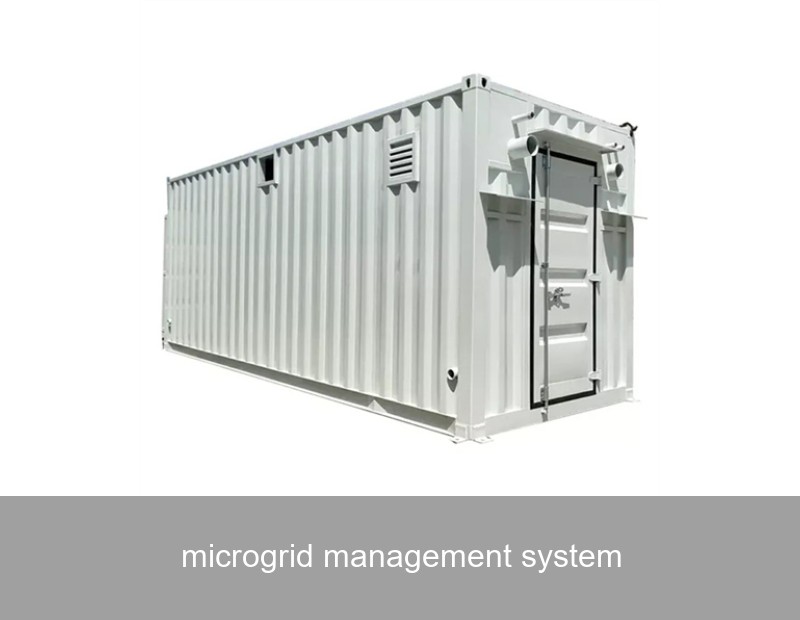
For a commercial or industrial client, Highjoule delivers a turnkey solution: our high-density, containerized Battery Energy Storage Systems (BESS) are paired from day one with our advanced Microgrid Controller. This controller doesn't just react; it forecasts using weather and load data, runs economic simulations, and executes strategies for resilience and savings automatically. Whether the goal is to participate in grid services markets in the UK, achieve net-zero operations in Germany, or ensure a hospital's resilience in Texas, our system is built to adapt.

Image Source: Unsplash - Representative image of a modern containerized battery storage system.
What to Look for in a Future-Proof Microgrid Management System
Not all management platforms are created equal. As you evaluate options, ensure the system offers:
- Open but Secure Architecture: The ability to integrate third-party assets (legacy generators, different solar inverters) via standard protocols like Modbus, DNP3, or SunSpec, while maintaining robust cybersecurity—a top concern for utilities and regulators.
- True Grid-Forming Capability: Can the system create a stable voltage and frequency "grid" from scratch when islanded? This is essential for starting sensitive motor loads and is a key feature of Highjoule's inverter-based systems.
- Scalability and Modularity: The platform should allow you to start with a core resilience project and later add more solar, storage, or EV charging without a "rip-and-replace" overhaul.
- Actionable Analytics: Moving beyond simple dashboards to provide prescriptive insights: "Your transformer is forecast to be overloaded next summer; here's a dispatch strategy to mitigate it."
A study by the National Renewable Energy Laboratory (NREL) highlights that the control strategy is the single largest factor in determining a microgrid's financial and technical performance.
Is Your Energy Infrastructure Ready for the Next Decade?
The transition from a passive consumer to an active, resilient energy producer and manager is no longer a niche concept. A microgrid management system is the enabling technology that makes this transition reliable, profitable, and sustainable. It transforms capital expenditures on solar and storage from pure cost centers into strategic investments that pay dividends in uptime, savings, and sustainability.
We at Highjoule are having daily conversations with facility managers, sustainability officers, and community planners who are grappling with these very decisions. The question we leave you with is this: When the next major grid disruption occurs, will your operations be in the dark, or will they be illuminated, powered, and protected by your own intelligent energy ecosystem?
 Inquiry
 Online Chat