


Max Power On-Grid Energy Storage Cabinet: The Key to Grid Resilience and Energy Independence
Imagine your local electricity grid as a busy highway. For decades, traffic flowed predictably. But now, there's a surge of new electric vehicles (EVs), heat pumps, and data centers merging onto the on-ramps, while the exit ramps—our traditional power plants—are becoming less reliable. The result? Congestion, unpredictable slowdowns, and a system straining at its seams. This isn't just an analogy; it's the reality facing grids across Europe and North America. The solution? Intelligent, grid-connected energy storage that acts like a dynamic traffic management system. This is where the max power on-grid energy storage cabinet becomes a critical asset, transforming how businesses and communities interact with their power supply.
The Grid Under Pressure: A Modern Energy Dilemma
Let's look at the data. In the U.S., the Energy Information Administration (EIA) forecasts that data center electricity consumption could nearly double by 2030, constituting up to 9% of total U.S. demand. Meanwhile, Europe is aggressively integrating volatile renewable sources; Germany, for instance, already sees moments where renewables cover over 100% of its instantaneous demand. This creates a dual challenge: managing massive, unpredictable peaks in consumption while also absorbing excess renewable generation that would otherwise be curtailed (wasted).
The traditional response—building new peaker plants or reinforcing transmission lines—is slow, expensive, and often environmentally contentious. There's a smarter, faster, and more sustainable tool in the modern energy toolkit: the max power on-grid energy storage cabinet.
Unlocking Grid Potential with Max Power
Think of "max power" not just as a technical specification, but as a capability. It's the system's ability to deliver its full rated power output instantaneously. Why does this matter? Because grid problems—a sudden drop in frequency, a transformer overload, a cloud covering a solar farm—happen in seconds. A storage system that can ramp up to its maximum discharge power in milliseconds is like a sprinter poised at the starting block, ready to inject stability exactly when and where it's needed most. This high-power, grid-synchronized response is the cornerstone of modern grid services and a pathway to significant revenue and savings for asset owners.

This capability moves storage beyond simple backup. It becomes an active participant in the energy market, providing what grid operators call "ancillary services."
What is a Max Power On-Grid Energy Storage Cabinet?
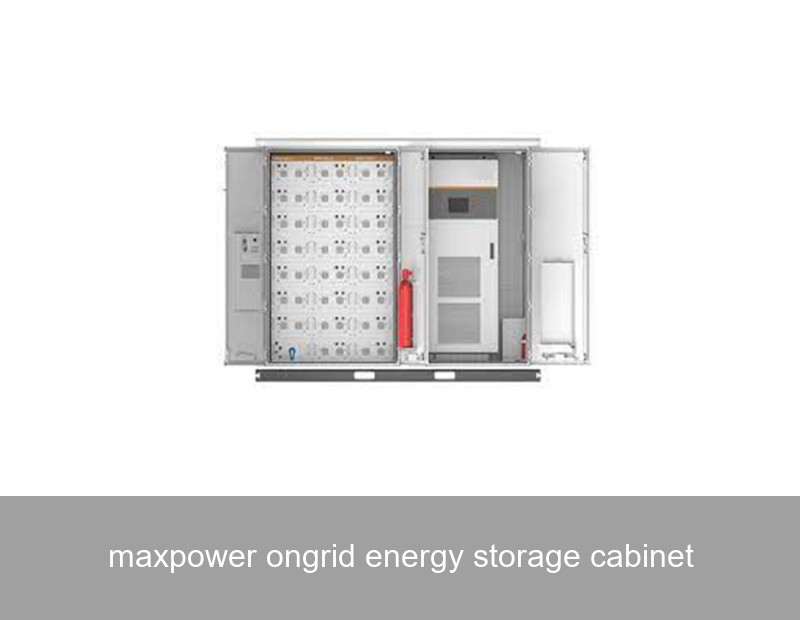
In essence, a max power on-grid energy storage cabinet is a fully integrated, containerized battery system designed for seamless connection to the utility grid or a private microgrid. Unlike off-grid systems that operate in isolation, an on-grid (or grid-tied) system works in concert with the grid. The "cabinet" or containerized format means all critical components—battery racks, battery management system (BMS), power conversion system (PCS), thermal management, and fire suppression—are pre-assembled in a robust, weatherproof enclosure. This allows for rapid deployment, scalability, and simplified maintenance.
Its primary functions are dynamic:
- Peak Shaving: Discharging during periods of high electricity prices or demand to cut costly peak charges.
- Frequency Regulation: Automatically injecting or absorbing power to maintain the grid's stable 50Hz (EU) or 60Hz (US) frequency.
- Renewables Integration: Storing excess solar or wind energy for use when generation is low, smoothing out the "duck curve."
- Voltage Support: Providing reactive power to stabilize voltage levels on local distribution lines.
Key Components and How It Works
To understand its reliability, let's break down the core components inside a high-performance cabinet like those engineered by Highjoule.
| Component | Function | Highjoule's Approach |
|---|---|---|
| Battery Rack (Li-ion NMC or LFP) | The core energy storage medium. Lithium Iron Phosphate (LFP) is increasingly favored for its safety and long cycle life. | Uses UL9540A certified LFP cells for enhanced safety and longevity, with modular racks for easy capacity expansion. |
| Power Conversion System (PCS) | The "brain" of power flow. Converts DC battery power to AC grid power and vice versa. Defines the system's "max power" capability. | Integrates bi-directional inverters with >98.5% efficiency and sub-20ms response time for grid service signals. |
| Battery & Energy Management Systems (BMS/EMS) | BMS monitors cell health and safety. EMS is the strategic controller, deciding when to charge/discharge based on algorithms and market signals. | Features a proprietary, AI-driven EMS that can optimize for multiple value streams (e.g., peak shaving + frequency response) simultaneously. |
| Thermal Management | Maintains optimal battery temperature for performance, safety, and lifespan. Critical for max power output. | Employs a liquid cooling system for superior temperature uniformity and quiet operation, even at full load. |
The process is a continuous loop of monitoring, forecasting, and automated action. The EMS receives data on site consumption, grid frequency, and weather forecasts. When a peak demand period is predicted or a frequency dip is detected, it commands the PCS to discharge the battery at its maximum power, fulfilling the need within fractions of a second.
Tangible Benefits: Beyond Just Backup Power
- Direct Cost Reduction: Commercial and industrial users can slash demand charges by 20-40%. A study by the National Renewable Energy Lab (NREL) highlights the significant savings potential from demand charge management.
- New Revenue Streams: In markets like PJM (US) or National Grid (UK), storage assets can earn contracts for frequency response services, creating a steady income.
- Enhanced Sustainability: Maximizes the self-consumption of on-site renewables, reducing carbon footprint and moving closer to net-zero goals.
- Infrastructure Deferral: Utilities can use distributed storage cabinets to postpone costly upgrades to substations and transformers, a benefit that can be shared with the host site.

A Real-World Case Study: Stabilizing a German Industrial Park
Consider the challenge faced by a mid-sized manufacturing park in Bavaria. The site had a 2 MW solar carport but faced two issues: 1) Solar overproduction at midday was being fed back to the grid at low feed-in tariffs, and 2) Simultaneous operation of heavy machinery created sharp, expensive power peaks.
The Solution: A 500 kW / 1 MWh max power on-grid energy storage cabinet was installed at the point of common coupling. The system's EMS was programmed with a dual objective.
The Results (12-month period):
- Demand Charge Reduction: Peak power draw from the grid was reduced by 28%, saving over €45,000 annually.
- Renewable Self-Consumption: Increased from 35% to 79%, effectively doubling the value of their solar generation.
- Grid Services: The system's spare capacity was enrolled in the German Primary Control Reserve market, generating approximately €15,000 in ancillary service revenue.
- Payback Period: The combined savings and revenue streams led to a projected simple payback period of under 7 years, well within the system's 15-year design life.
This case exemplifies the multi-stack value proposition a modern storage cabinet delivers.
Highjoule's Solution: The H-Series MaxPower Cabinet
At Highjoule, with nearly two decades of deep expertise in grid-edge storage, we've engineered our H-Series MaxPower Cabinet specifically to meet these complex challenges. Our philosophy is that hardware must be robust, but intelligence defines the return on investment.
Our cabinet is built around LFP battery technology for ultimate safety and cycle life. What truly differentiates it is the Highjoule Neuron™ EMS platform. This cloud-connected intelligence doesn't just react; it learns and forecasts. By analyzing historical consumption data, weather patterns, and real-time market prices (where applicable), the Neuron™ platform dynamically optimizes the battery's operation to always pursue the highest-value application—whether that's shaving your peak, participating in a grid service, or storing your solar energy.
We provide a complete turnkey service: from initial feasibility analysis and financial modeling to grid connection approval support, installation, and ongoing performance monitoring. For businesses and microgrid developers, this means a seamless path to unlocking the full potential of a max power on-grid energy storage cabinet without the technological headache.

Is Your Business Ready for Grid-Interactive Storage?
The energy landscape is shifting from a one-way street to a dynamic, interactive network. The question is no longer if energy storage will become a standard part of commercial and industrial infrastructure, but when. Are you simply watching your energy costs fluctuate, or are you ready to take control, turn your energy profile into an asset, and build resilience for the future? What would the ability to instantly deploy your own max power do for your operational costs and sustainability targets this year?
 Inquiry
 Online Chat