


Low Power Consumption Inverter: The Unsung Hero of Your Energy-Efficient Home
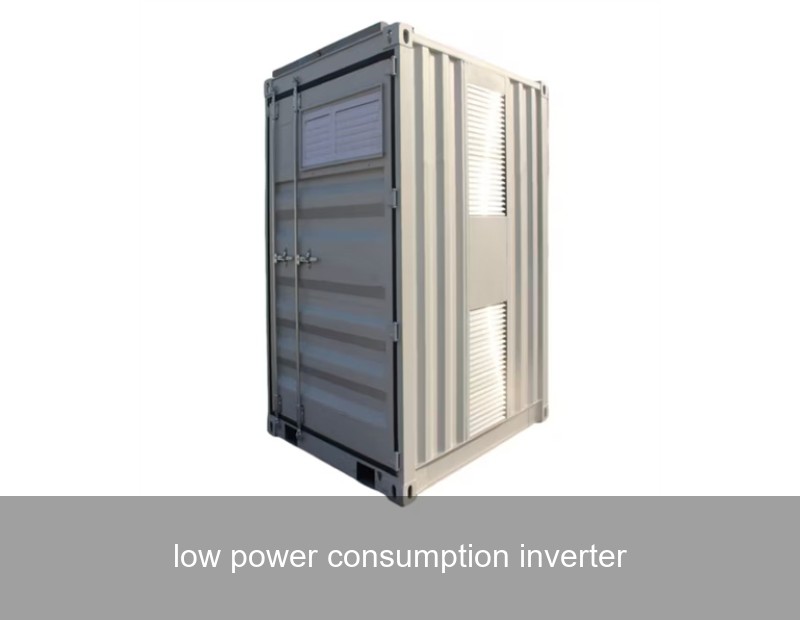
Have you ever noticed a quiet hum from your solar system even after the sun goes down? That subtle sound might be your inverter, still sipping power. In the quest for a truly efficient renewable energy setup, every watt counts. This is where the low power consumption inverter steps into the spotlight. Far from just a technical spec, it's a critical component that ensures the energy you generate doesn't get wasted on the very system designed to save it. For homeowners and businesses across Europe and the U.S., understanding this technology is key to maximizing the return on their green investment.
Table of Contents
- What is a Low Power Consumption Inverter?
- The Hidden Cost of Standby Power
- Technology Behind the Efficiency
- Real-World Impact: A European Case Study
- Choosing the Right Inverter for Your System
- Highjoule's Commitment to Advanced Efficiency
What is a Low Power Consumption Inverter?
At its core, an inverter converts the direct current (DC) electricity from your solar panels or battery into the alternating current (AC) that powers your home. But it needs a small amount of power to do its job—to run its internal electronics, monitor the grid, and stay ready to convert energy at a moment's notice. This is known as standby consumption or self-consumption. A low power consumption inverter is specifically engineered to minimize this parasitic drain, often using advanced semiconductors and intelligent sleep modes to achieve remarkably low standby power draws, sometimes as low as 0.5 watts compared to the 10-50 watts of older models.

Image Source: Unsplash - A modern, efficient inverter is key to system performance.
The Hidden Cost of Standby Power
Let's talk numbers. Imagine an inverter with a standby consumption of 30 watts. It doesn't sound like much, but it's always on, 24 hours a day, 365 days a year.
| Inverter Standby Power | Daily Energy Use | Annual Energy Use | Annual Cost (€0.25/kWh) |
|---|---|---|---|
| 30 Watts | 0.72 kWh | 262.8 kWh | €65.70 |
| 2 Watts (Low Consumption) | 0.048 kWh | 17.52 kWh | €4.38 |
As the table shows, the difference is staggering. Over a system's 15-20 year lifespan, a high-standby inverter can waste over €1,000 worth of self-generated electricity. This is energy that could have been used to charge your EV, run your appliances, or be exported to the grid for a feed-in tariff. In essence, an inefficient inverter acts like a constant, silent leak in your energy bucket.
Technology Behind the Efficiency
So, how do manufacturers like Highjoule achieve such low consumption figures? It's a blend of hardware and software innovation:
- Advanced Topology & Components: Utilizing highly efficient, wide-bandgap semiconductors (like Silicon Carbide or GaN) that have lower switching losses and can operate at higher frequencies, reducing the need for large, lossy magnetic components.
- Intelligent Power Management: The inverter isn't running at full capacity when not needed. Sophisticated algorithms power down non-essential circuits and enter deep sleep modes during long periods of no generation (like at night), waking up periodically to check for solar input or grid signals.
- Integrated Design: In hybrid or storage inverters, tight integration between the PV conversion, battery management, and grid interaction circuits eliminates redundant components and reduces overall internal losses.
These features are not just add-ons; they are fundamental to the design philosophy of a modern, high-performance inverter.
Real-World Impact: A European Case Study
The theory is compelling, but what does this look like on the ground? Let's consider a real-world scenario from Germany, a leader in residential solar adoption.
Project: A family home in Munich with a 8kWp solar array and a 10kWh battery storage system. The goal was to achieve the highest possible degree of self-sufficiency (Autarkiegrad).
Challenge: The initial system proposal used a standard hybrid inverter with a nocturnal standby consumption of around 20 watts. The homeowner, being detail-oriented, was concerned about losing nearly 175 kWh per year just to keep the system "idling." That energy could power their high-efficiency refrigerator for months!
Solution: The installer recommended and installed a Highjoule H-Energy Hub 8.0, a hybrid inverter renowned for its ultra-low standby power of less than 1 watt in eco-sleep mode. The system was commissioned with precise monitoring.
- Measured Inverter Standby Loss: 8.4 kWh for the year (an average of just 0.96 watts).
- Energy Saved vs. Standard Inverter: Approximately 166 kWh.
- Financial Value: Saved ~€50 (based on a mix of avoided grid purchase and lost feed-in tariff). More importantly, it increased their calculated self-consumption rate by 2.1%, making their system more resilient against rising energy prices.
This case, mirrored by many of our clients, proves that low power consumption inverter technology directly translates to more usable, bill-slashing clean energy. You can explore more on the importance of system efficiency from the U.S. Department of Energy.

Image Source: Unsplash - Real-time monitoring reveals true system efficiency.
Choosing the Right Inverter for Your System
When evaluating inverters, don't let the standby consumption spec be an afterthought. Here's what to look for:
- Specification Sheets: Look for "Night-time Consumption," "Standby Losses," or "Self-Consumption." The best-in-class are now below 1 watt. Be wary of specs that only list "maximum efficiency" (e.g., 98%), as this is measured under ideal, high-load conditions and doesn't reflect 24/7 operation.
- System Integration: For battery systems, a DC-coupled design where the inverter and battery charger are one unit often has lower overall losses than using separate AC-coupled inverters and batteries.
- Smart Features: Inverters with intelligent, predictive sleep modes that sync with your typical solar production curve offer the best real-world savings.
Remember, the inverter is the brain and heart of your power system. Its efficiency sets the ceiling for the performance of your entire investment.
Highjoule's Commitment to Advanced Efficiency
Since 2005, Highjoule has engineered efficiency into the DNA of every product. We understand that a sustainable future is built on technologies that waste nothing. Our H-Energy Hub Series of hybrid inverters and the dedicated H-Stor Battery Systems are designed as cohesive, intelligent units.
For instance, our flagship H-Energy Hub uses a proprietary "Zero-Night-Loss" circuit design, which actively routes minute amounts of power from the battery to maintain essential functions while keeping the main conversion circuits in deep sleep. This isn't just a marketing term; it's a measurable outcome that our installers and end-users consistently report on. Paired with our AI-driven energy management software, the system doesn't just react—it predicts consumption patterns to optimize when to be ultra-efficient and when to deliver full power. It's this holistic approach, from silicon to software, that defines the Highjoule advantage for commercial, industrial, and residential applications.
For further independent research on inverter technologies and their grid impact, resources like the National Renewable Energy Laboratory (NREL) provide valuable insights.
A Final Thought to Power Your Decision
As you plan your journey to energy independence, the details make the difference. The choice of inverter is a long-term commitment. When reviewing your next solar or storage proposal, will you ask the critical question about standby consumption and uncover the true efficiency of your future system?
 Inquiry
 Online Chat