


Understanding the Trend: Why Are Lithium Solar Batteries Prices Dropping?
If you're considering solar power for your home or business, you've likely noticed a significant shift: the cost of the crucial component that makes solar energy usable around the clock—the lithium solar battery—has been on a steady decline. This isn't just a temporary sale; it's a fundamental transformation reshaping renewable energy. For homeowners in California, businesses in Germany, and communities everywhere, this price evolution is unlocking unprecedented energy independence and financial savings. But what's driving this change, and what does it mean for your energy future? Let's explore the forces behind falling lithium solar batteries prices and how this trend is making sustainable power more accessible than ever.
Table of Contents
The Price Plunge Phenomenon: From Luxury to Mainstream
Just a decade ago, adding a battery to a solar installation was a premium upgrade, often doubling the system's cost. Today, it's a standard consideration. The primary driver is the dramatic reduction in lithium-ion battery pack costs, which have fallen over 90% since 2010. This isn't magic; it's a combination of massive scale in manufacturing (primarily for electric vehicles), advancements in battery chemistry like Lithium Iron Phosphate (LFP), and relentless innovation in production efficiency. For you, the consumer, this means the payback period for a solar-plus-storage system has shortened dramatically, making it a sound financial investment, not just an environmental one.

Image Source: Unsplash - A modern, compact lithium solar battery system integrated into a home.
Data Driving the Decline: A Look at the Numbers
To understand the scale, let's look at some concrete figures. According to BloombergNEF, the volume-weighted average price for a lithium-ion battery pack was $132 per kilowatt-hour (kWh) in 2021. By the end of 2023, that price was trending significantly lower, with some leading manufacturers reporting costs below $100/kWh. For a typical home battery with 10-15 kWh of capacity, this translates to thousands of dollars in savings compared to just five years ago. But the story isn't just about the raw battery cell. System integration, power electronics, and smart software—areas where companies like Highjoule excel—have also become more efficient, further reducing the overall installed cost for the end-user.
| Year | Average Price Range (USD/kWh, installed) | Key Market Drivers |
|---|---|---|
| 2018 | $700 - $1,000 | Early adoption, niche manufacturing |
| 2021 | $500 - $700 | EV scale production, policy support in EU/US |
| 2024 | $400 - $600 | LFP dominance, streamlined installation, high competition |
| 2027 (Projection) | $300 - $450 | Next-gen solid-state advances, gigafactory output |
Case Study: A Bavarian Business Powers Through Price Volatility
Let's make this real. Consider a mid-sized bakery in Munich, Germany. Facing high and unpredictable energy costs, they installed a 100 kW solar array in 2020 but were still exporting excess power at low rates. In early 2023, they added a 120 kWh lithium solar battery system from Highjoule. The total cost for the storage system was approximately 25% lower than a comparable quote they received in 2020.
The results? The bakery now:
- Cuts Grid Consumption by 80%: They use their own solar energy day and night.
- Leverages Peak Shaving: The Highjoule Energy Management System automatically avoids drawing power during expensive peak tariff hours.
- Secures a 4.5-Year ROI: Due to lower battery prices and high German electricity rates, their investment will pay for itself in under five years.
- Ensures Business Continuity: The system provides backup power during grid outages, protecting perishable goods.
Beyond the Sticker Price: The Total Value of Ownership
Focusing solely on upfront lithium solar batteries prices can be misleading. The true value lies in total cost of ownership and the system's intelligence. A cheaper battery with poor efficiency (say, 85% round-trip efficiency) will lose more of your precious solar energy as heat, effectively making your stored power more expensive. Similarly, a battery with a shorter cycle life (e.g., 3,000 cycles vs. 6,000+) will need replacement sooner.
This is where engineering excellence matters. Highjoule's systems, for instance, are built with high-cycle-life LFP chemistry and feature industry-leading >95% round-trip efficiency. Our integrated AI-powered energy management platform doesn't just store energy; it learns your consumption patterns, weather forecasts, and utility rate schedules to autonomously optimize every kilowatt-hour for maximum savings. When you calculate value over a 15-20 year lifespan, the intelligence and durability of the system often outweigh a minor upfront price difference.

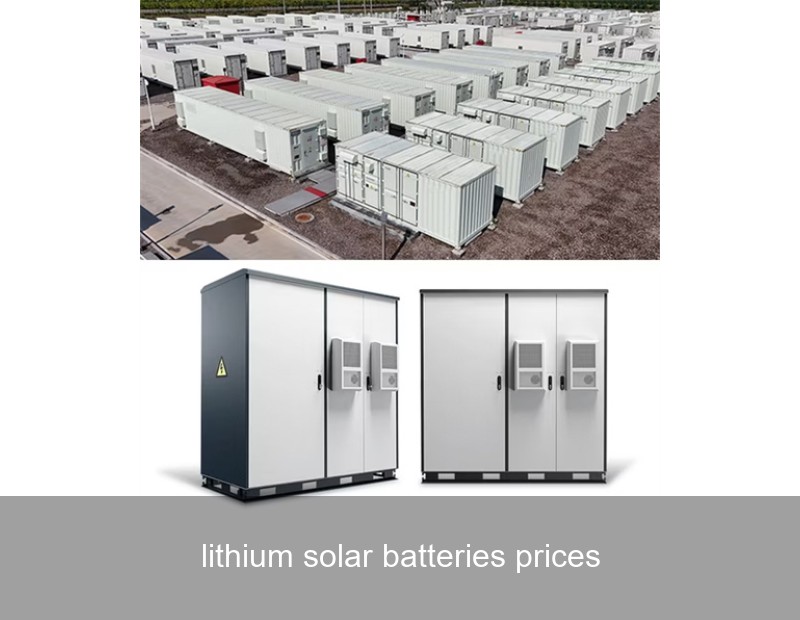
Image Source: Unsplash - A utility-scale battery storage system co-located with renewable generation.
Highjoule's Smart Solutions in an Affordable Market
At Highjoule, we view the declining cost curve as an opportunity to deliver unparalleled value, not just cheaper products. Founded in 2005, we've navigated this entire price evolution, refining our technology to maximize customer benefit.
Our product suite is designed to leverage today's attractive lithium solar batteries prices to deliver comprehensive solutions:
- Residential EverHome Series: Scalable from 10 to 30 kWh, these sleek, safe LFP batteries integrate seamlessly with new or existing solar. Their modular design lets you start small and expand as your needs—or as prices continue to improve.
- Commercial & Industrial PowerHub: For businesses like our Bavarian bakery, these containerized or rack-mounted systems offer from 100 kWh to multi-megawatt scale. They feature advanced grid-support functions and are engineered for the highest duty cycles.
- Microgrid Controller: The true brain of the operation. This software-hardware suite can orchestrate solar arrays, battery banks, and backup generators into a resilient, independent energy network for campuses, communities, or remote industrial sites.
Why Battery Chemistry is a Key Price Factor
The shift towards Lithium Iron Phosphate (LFP) chemistry is a major contributor to better lithium solar batteries prices and safety. Unlike older NMC chemistries, LFP doesn't use costly cobalt and nickel. It's inherently more stable, has a longer lifespan, and performs well across a wider temperature range. While its energy density is slightly lower, this is a perfect trade-off for stationary storage. Highjoule's commitment to LFP across our product lines means we deliver durable, safe, and cost-effective storage that is perfectly suited for daily solar cycling.
The Future Outlook: Where Do Lithium Solar Battery Prices Go From Here?
Experts project prices will continue to fall, but at a slower, more incremental rate. The next frontier is not just cost, but performance: solid-state batteries, sodium-ion alternatives, and even more intelligent software. The International Energy Agency highlights that energy storage is a critical pillar for net-zero goals, ensuring continued innovation and policy support.
For you, this means the opportunity is now. Current prices offer fantastic value, and waiting indefinitely for a hypothetical future price drop means missing out on years of energy savings and increased property resilience. The right question is no longer "Can I afford it?" but "Which system delivers the best long-term value for my specific needs?"
Given your energy goals and local utility rates, what would a 70% or higher self-consumption rate of your solar power do for your monthly budget and peace of mind?
 Inquiry
 Online Chat