


Unlocking Legacy Value: The Kyocera KC200GT Solar Panel in Modern Energy Systems
If you've been in the solar world for a while, you might remember the Kyocera KC200GT. Launched in the mid-2000s, this 200-watt polycrystalline panel was a workhorse of its era, known for remarkable durability and a price point that helped democratize solar. But in an age of 400W+ monocrystalline PERC modules, what role can these "classic" panels play? The answer is more significant than you might think. This isn't just about nostalgia; it's about leveraging proven reliability within modern, intelligent energy systems. By integrating legacy panels like the KC200GT with advanced battery storage and energy management, we can build resilient, cost-effective power solutions that stand the test of time.
The Enduring Legacy of the Kyocera KC200GT
To understand the KC200GT's potential today, we must look at its original strengths. In a market then dominated by less efficient and more expensive options, this panel offered a robust balance. Its polycrystalline cells, while not setting efficiency records, were known for stable long-term performance. Many installers and early adopters, particularly in Europe and North America, chose them for their proven track record of withstanding harsh weather conditions. Decades later, a significant number of these installations are still operational, often producing 80-85% of their original rated output. This longevity is a testament to the quality engineering of its time. As the National Renewable Energy Laboratory (NREL) has documented, the degradation rate of well-manufactured panels from that era can be impressively low.

However, the energy landscape has transformed. Today's systems aren't just about generating kilowatt-hours; they're about intelligent control, storage, and maximizing self-consumption. The KC200GT, like many panels of its generation, lacks the voltage and current optimization features of modern modules. This is where the real conversation begins: how do we bridge the gap between durable legacy hardware and cutting-edge energy management?
The Modern Challenge: Pairing Legacy with Innovation
The phenomenon is clear: thousands of property owners with functioning KC200GT arrays face a dilemma. The panels still work, but the system feels "old." It might not communicate with modern inverters optimally, and without storage, excess solar energy is exported to the grid for minimal compensation. The data tells a compelling story: in markets like Germany and California, feed-in-tariff schemes that made these installations profitable have largely expired. According to industry analyses, the value of self-consumed solar energy is now typically 2-3 times higher than the rate paid for exported power.
This creates a powerful economic and practical driver. The question shifts from "Should I replace my old panels?" to "How can I modernize my entire energy system around my existing assets?" The goal is to add intelligence and storage, not to discard perfectly good, durable generation capacity.
Case Study: A German Farm's Journey to Energy Independence
Consider the real-world example of a dairy farm in Bavaria, Germany. In 2008, they installed a 10kW rooftop array using 50 Kyocera KC200GT panels. For years, they benefited from a generous feed-in tariff. By 2022, that tariff had ended, and their system's economics changed overnight. Furthermore, increasing grid instability threatened their critical cooling systems for milk storage.
Their solution was not a full panel replacement. Instead, they partnered with a system integrator to deploy a comprehensive retrofit:
- Legacy Preservation: The existing KC200GT array was kept in place and thoroughly tested.
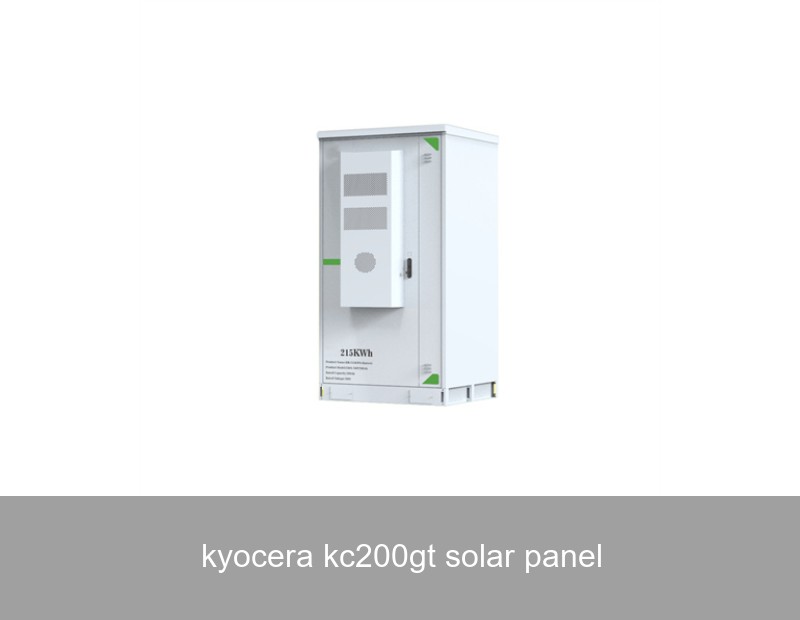
- Intelligent Storage: A 25 kWh Highjoule Lithium-Ion Battery Energy Storage System (BESS) was installed.
- Advanced Management: The entire system was tied together with a Highjoule Energy Management System (EMS), capable of dynamically directing solar power.
| Metric | Before Retrofit (2021) | After Retrofit (2023) |
|---|---|---|
| Self-Consumption of Solar | ~35% | >85% |
| Grid Energy Import | 65% of needs | <15% of needs |
| Energy Cost Savings | Baseline | 68% reduction |
| Backup Power Capability | None | Full farm operations for 12+ hours |
The data speaks for itself. By focusing on system-level intelligence, the farm extended the useful life and financial return of their Kyocera panels by over a decade, while dramatically increasing resilience. This case exemplifies the core principle: value lies in the system, not just the components.
The Highjoule Solution: Intelligent Integration for Legacy & New Tech
At Highjoule, we encounter scenarios like this frequently. Since 2005, our mission has been to provide smart, efficient, and sustainable power solutions that evolve with our clients' needs. Our approach with legacy solar assets, such as arrays built with Kyocera KC200GT panels, is not one of replacement but of optimization and enhancement.
Our product suite is uniquely suited for this task. The Highjoule BESS is designed with versatile input compatibility, allowing it to seamlessly integrate with a wide range of DC and AC-coupled sources, including older solar arrays. The true magic, however, happens in our Energy Management System. The Highjoule EMS uses sophisticated algorithms to:
- Prioritize self-consumption of legacy solar production, charging the battery during the day.
- Provide seamless backup power during outages, a critical feature for both US and European businesses and homeowners.
- Enable potential participation in grid services (where market structures allow), creating a new revenue stream from an existing asset.

For commercial and industrial applications, this is particularly powerful. A factory with a 15-year-old KC200GT installation can layer in Highjoule storage to shave peak demand charges—a major cost in places like Germany and the US—and ensure process continuity. The U.S. Department of Energy emphasizes that storage is the key to unlocking solar's full grid and economic benefits.
The Future of Legacy Solar Assets
The narrative around solar is often focused on the new, the more efficient, the next big thing. But sustainability has a crucial, often overlooked pillar: durability and longevity. The Kyocera KC200GT represents a generation of hardware built to last. The challenge and opportunity for the energy transition lie in our ability to make these legacy assets smarter and more responsive through integration with platforms like Highjoule's.
This isn't just about saving money (though the financial case is strong). It's about a pragmatic approach to decarbonization. It reduces waste from premature panel replacement and maximizes the embodied energy already invested in existing solar infrastructure. As grid dynamics become more complex, the value of a managed and resilient energy asset, regardless of the panel's vintage, will only increase.
So, if you're the owner of a system built with reliable workhorses like the Kyocera KC200GT, what's the first question you should ask yourself to assess your next step towards true energy independence?
 Inquiry
 Online Chat