


Iluminación con Panel Solar: Your Complete Guide to Smart, Sustainable Lighting
Have you ever walked through a park at dusk and noticed how a path gracefully lights up, powered entirely by the day's sun? Or considered the security and aesthetic benefits of garden lights that never add a cent to your electricity bill? This is the practical magic of iluminación con panel solar—solar panel lighting. It's more than just a trend; it's a fundamental shift towards energy independence and intelligent design for homes, businesses, and communities. For nearly two decades, Highjoule has been at the forefront of this shift, engineering advanced battery storage systems that make solar lighting not just possible, but profoundly reliable and efficient. Let's explore how this technology works and why it's becoming the first choice for savvy property owners across Europe and the US.
Table of Contents
- How Does Solar-Powered Lighting Actually Work?
- Key Components of a Reliable Solar Lighting System
- A Real-World Case Study: Lighting Up a Community
- Choosing the Right System: It's All About the Battery
- Highjoule's Role in Advanced Solar Lighting Solutions
- Future Trends in Solar Lighting
How Does Solar-Powered Lighting Actually Work?
The principle is elegantly simple: capture sunlight, convert it into electricity, store it, and use it to power an LED light when needed. A typical iluminación con panel solar setup consists of a photovoltaic (PV) panel, a charge controller, a battery for storage, and an efficient LED luminaire. During the day, the solar panel generates direct current (DC) electricity. The charge controller acts as the brain, regulating the flow of energy to the battery, preventing overcharging and deep discharge. As night falls, a photoresistor or timer triggers the controller to draw power from the battery to illuminate the LED light until dawn.

Image source: Unsplash (Photographer: Andreas Gücklhorn)
Key Components of a Reliable Solar Lighting System
Not all solar lights are created equal. Their performance and longevity hinge on the quality of four core components:
- Solar Panel: Measured in watts (W), its efficiency determines how much sunlight is converted. Monocrystalline panels are typically the most efficient.
- Battery: The heart of the system. This is where energy is stored for nighttime use. The technology here is critical.
- Charge Controller: The system's guardian. A Maximum Power Point Tracking (MPPT) controller can be up to 30% more efficient than older PWM types.
- LED Fixture: Measured in lumens, not watts. Modern LEDs provide bright, high-quality light with minimal energy draw.
The Compelling Benefits: Beyond Saving Money
While reducing or eliminating grid electricity costs for lighting is a major draw, the advantages of solar lighting run much deeper:
- Zero Installation Complexity & Cost: No trenching, no cabling, no connection to the main grid. This makes installation fast, non-invasive, and incredibly cost-effective, especially for remote or large areas.
- Enhanced Resilience & Security: During grid outages caused by storms or other events, solar lights continue to operate, providing crucial safety and security lighting.
- True Sustainability: It's a 100% renewable energy solution that reduces your carbon footprint. According to the International Energy Agency (IEA), solar PV is one of the most cost-effective technologies for new electricity generation in most of the world.
- Smart & Scalable Design: Modern systems can integrate motion sensors, dimming schedules, and remote monitoring via IoT platforms, allowing for intelligent light management.
A Real-World Case Study: Lighting Up a Community
Let's look at a concrete example from the target market. A municipal park in Southern Spain faced rising energy costs and wanted to improve safety along its walking trails without the high expense of extending electrical infrastructure. The city council deployed 50 standalone solar-powered pathway lights.
| Metric | Before Solar Lighting | After Solar Lighting |
|---|---|---|
| Annual Energy Cost for Lighting | ~€2,500 (grid-powered plan) | €0 |
| Installation Cost | Estimated €15,000 (trenching & cabling) | €9,500 (pole & unit only) |
| CO2 Emissions Avoided | N/A | ~1.8 tonnes annually |
| Public Satisfaction (Survey) | N/A | 92% reported feeling safer |
The project paid for itself in avoided infrastructure costs alone within the first year. The lights, equipped with efficient lithium-ion phosphate batteries, provided reliable illumination throughout the night, even during a series of winter storms that caused local power outages. This case underscores how iluminación con panel solar is a pragmatic solution for public spaces.
Choosing the Right System: It's All About the Battery
The most common point of failure in older solar lights is the battery. Traditional lead-acid batteries degrade quickly, especially in temperature extremes, and have limited depth of discharge. The game-changer has been the adoption of lithium-ion technology, particularly Lithium Iron Phosphate (LiFePO4).
Why does this matter for your lighting? A LiFePO4 battery offers:
- Longer Lifespan: 3,000+ cycles vs. 300-500 for lead-acid, meaning years of reliable service.
- Deeper, Safer Discharge: Can be safely discharged to 80-90% of capacity daily without damage, providing more usable energy every night.
- Temperature Resilience: Performs well in both the cold winters of Northern Europe and the hot summers of the Southern US.
- Maintenance-Free Operation: No need for watering or equalization charges.
Highjoule's Role in Advanced Solar Lighting Solutions
This is where Highjoule's expertise becomes directly relevant. While we don't manufacture light fixtures, we are a global leader in the core technology that makes high-performance, commercial-grade iluminación con panel solar possible: the intelligent battery storage system.
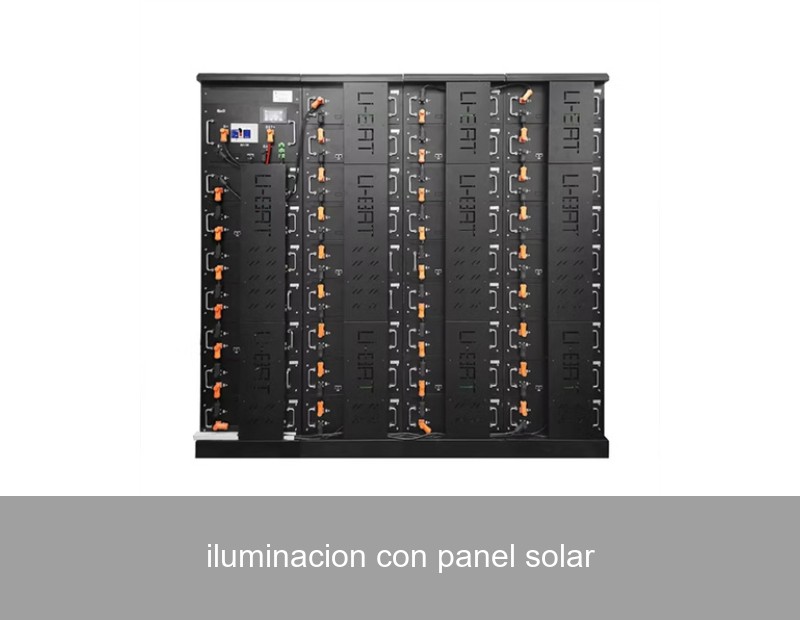
Our H-Joule Cell series, built on stable LiFePO4 chemistry, is engineered for the specific duty cycle of solar lighting—daily charge and discharge. Integrated with a sophisticated Battery Management System (BMS), our units ensure each cell operates within its ideal parameters, maximizing lifespan and safety. For larger-scale lighting projects, like parking lot arrays or microgrid-powered community lighting, our modular H-Joule Cube systems can be scaled to provide hundreds of kilowatt-hours of storage, managed by our proprietary energy management software for optimal performance.
In essence, Highjoule provides the reliable, long-lasting "energy bank" that guarantees solar lights turn on night after night, year after year, fulfilling their promise of off-grid independence.

Image source: Unsplash (Photographer: American Public Power Association)
Future Trends in Solar Lighting
The future is intelligent and integrated. We're moving towards networked systems where each solar light is a node on a mesh network. This allows for central monitoring of battery health, light output, and diagnostics, enabling predictive maintenance. Furthermore, the integration with broader building or campus energy management systems is on the rise. Imagine your warehouse's security lighting not only operating off-grid but also communicating with the main facility's Highjoule storage system to share excess solar energy when fully charged.
The U.S. Department of Energy's Solid-State Lighting program continues to drive advancements in LED efficacy and quality, which will further reduce the energy demand and improve the user experience of solar lighting systems.
So, as you consider iluminación con panel solar for your home's garden, your business's perimeter, or a community project, what specific challenge—be it unreliable grid power, high installation costs, or a sustainability goal—are you looking to solve?
 Inquiry
 Online Chat