


Hybrid vs On-Grid Energy Storage Cabinet: Choosing the Right Power Solution for Your Needs
If you're looking into energy storage, you've likely encountered the terms "on-grid" and "hybrid." It's more than just industry jargon—it's a fundamental choice that determines your energy independence, resilience, and savings. An on-grid energy storage cabinet works in tandem with the public utility grid, while a hybrid energy storage cabinet offers a more versatile, all-in-one solution capable of operating with or without the grid. But which one is right for your home or business? Let's demystify these technologies, explore real-world performance, and see how companies like Highjoule are shaping the future of intelligent power management.
Table of Contents
- The Core Difference: Grid-Dependent vs. Grid-Agnostic
- On-Grid Energy Storage Cabinet: The Grid-Synchronized Partner
- Hybrid Energy Storage Cabinet: The All-in-One Power Hub
- Head-to-Head Comparison: A Detailed Breakdown
- Real-World Application: A Case Study from Southern Europe
- Highjoule's Intelligent Solutions: Engineered for Flexibility
- Making Your Choice: Key Questions to Consider
The Core Difference: Grid-Dependent vs. Grid-Agnostic
Think of it this way: an on-grid system is a specialist, excelling at one primary task—managing energy in sync with a stable grid. A hybrid system is a generalist, adept at handling multiple scenarios, including when the grid fails. The key distinction lies in the inverter, the brain of the operation. An on-grid inverter must shut down during a blackout for safety reasons (a process called anti-islanding). A hybrid inverter, however, has built-in circuitry to safely "island" your property, allowing the system to power critical loads even when the wider grid is dark.

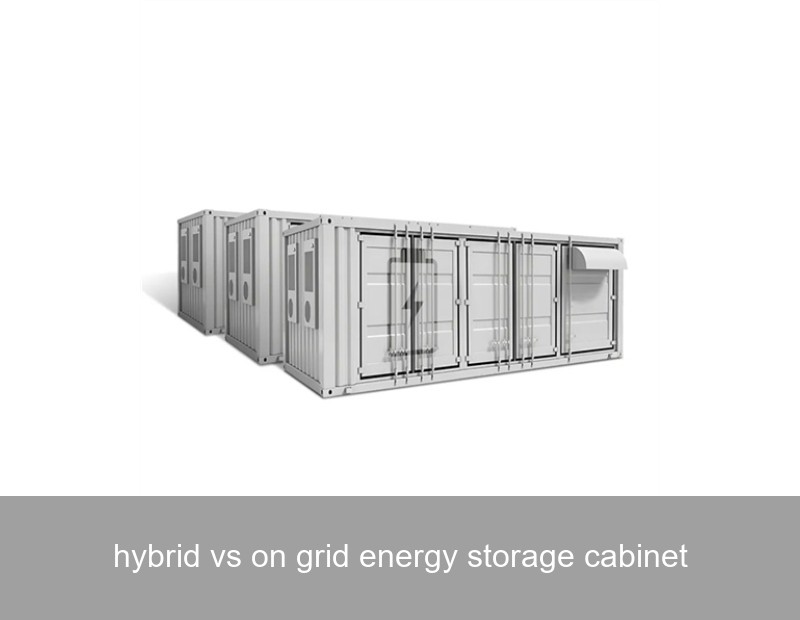
Image: A modern energy storage installation. Choosing the right cabinet type depends on your home's infrastructure and energy goals.
On-Grid Energy Storage Cabinet: The Grid-Synchronized Partner
On-grid, or grid-tied, systems are the established workhorses for maximizing self-consumption and leveraging favorable energy policies. They store excess solar energy for use when the sun isn't shining, reducing your reliance on purchased electricity. Their operation is elegantly simple and highly efficient.
How It Works & Primary Benefits
- Load Shifting: Store cheap solar or off-peak grid energy for use during expensive peak hours.
- Backup Power (Limited): Some advanced on-grid systems can provide backup to designated circuits, but this often requires additional hardware and may not be seamless.
- Grid Services: In some markets, they can participate in demand response programs, providing grid stability.
The major limitation? Its dependence on a stable grid. As the U.S. Energy Information Administration reports, the frequency and duration of power outages are a growing concern, highlighting a key vulnerability of pure on-grid systems.
Hybrid Energy Storage Cabinet: The All-in-One Power Hub
Hybrid systems are the integrated solution for those seeking energy resilience alongside efficiency. They combine a solar inverter, a battery charger, and a grid-tie inverter—often with a backup power source connection—into a single, smart unit. This allows for multiple modes of operation.
The Multimodal Advantage
- Grid-Tied Mode: Functions like an on-grid system, importing and exporting energy.
- Off-Grid/Island Mode: Automatically switches to power your home during an outage, often within milliseconds.
- Smart Energy Management: Can prioritize solar self-consumption, time-based control, and backup reserve based on weather forecasts and usage patterns.

Image: A hybrid system integrates generation, storage, and backup into a single, intelligent network.
Head-to-Head Comparison: A Detailed Breakdown
| Feature | On-Grid Energy Storage Cabinet | Hybrid Energy Storage Cabinet |
|---|---|---|
| Backup Power During Outage | Typically not available or requires complex configuration | Yes, seamless and automatic |
| System Complexity & Cost | Generally lower upfront cost and simpler design | Higher initial investment, but integrated functionality |
| Grid Independence | Low; system shuts down if grid fails | High; can operate independently |
| Optimal Use Case | Areas with very stable grids, focus purely on bill management and feed-in tariffs | Areas with unreliable grids, high energy costs, or a strong desire for energy security |
| Future-Proofing | Limited; may require full upgrade for backup | High; ready for microgrids and advanced energy management |
Real-World Application: A Case Study from Southern Europe
Let's look at a concrete example. A medium-sized winery in Tuscany, Italy, faced two challenges: skyrocketing energy costs during peak irrigation and cooling seasons, and occasional but disruptive grid instability during summer storms. Their old on-grid PV system would shut down during outages, risking spoilage.
The Hybrid Solution & Measurable Results
In 2023, they installed a Highjoule H-Cube 20 Hybrid Energy Storage System. The system includes a 20 kWh lithium iron phosphate (LiFePO4) battery cabinet and a 15 kW hybrid inverter. The results after one year were compelling:
- Energy Independence: Achieved 92% self-consumption of solar energy, up from 65%.
- Cost Savings: Reduced peak demand charges from the grid by 80%, leading to a total energy cost reduction of 40%.
- Resilience: Survived five grid outages, the longest being 8 hours, with zero interruption to critical refrigeration loads.
- ROI: Projected payback period of 6.5 years, factoring in local incentives for resilient energy systems. This real data underscores the tangible value of a hybrid approach for commercial applications in volatile energy markets.
Highjoule's Intelligent Solutions: Engineered for Flexibility
At Highjoule, we understand that one size does not fit all. That's why our product portfolio is designed to cater to both paradigms with a focus on intelligence, safety, and longevity.
For On-Grid Optimization: The Highjoule GridSync Series
Our GridSync cabinets are the pinnacle of grid-harmonized storage. Featuring advanced LiFePO4 battery cells and a modular design scalable from 10 to 100+ kWh, they offer unparalleled efficiency (98.5% round-trip) for pure economic optimization. Their smart energy management software seamlessly integrates with time-of-use rate structures, maximizing ROI in stable grid environments.
For Ultimate Resilience: The Highjoule H-Cube Hybrid Series
The H-Cube series embodies the hybrid philosophy. It's more than a battery cabinet; it's an integrated power management platform. Key features include:
- Multi-Mode Inverter: Built-in hybrid inverter allows for grid-tied, off-grid, and generator-supported operation.
- Uninterruptible Power Supply (UPS)-Grade Switching: Transfers to backup power in less than 20 milliseconds—faster than a light bulb flickers.
- AI-Powered Energy Forecasting: The system learns your consumption patterns and weather data to optimize charge/discharge cycles, preparing for outages or peak rates proactively.
Whether for a home wanting peace of mind or an industrial facility needing process continuity, Highjoule's hybrid solutions are engineered to be the resilient heart of your energy ecosystem. You can explore more about grid resilience studies from the National Renewable Energy Laboratory (NREL).
Making Your Choice: Key Questions to Consider
So, how do you decide? Ask yourself these critical questions:
- What is the primary driver: saving money or ensuring power availability?
- How reliable is my local grid? How often and for how long do outages occur?
- Do I have critical loads (medical equipment, servers, sump pumps, refrigeration) that must never lose power?
- Are there net metering or feed-in tariff policies that make exporting solar energy highly valuable?
- Am I planning to add a generator or electric vehicle charger in the future?

Image: Modern energy management involves monitoring and optimizing system performance in real-time.
Your answers will point you in the right direction. For many in today's climate of increasing weather volatility and energy price fluctuations, the flexibility of a hybrid system offers a compelling, future-proof answer. It’s an upgrade not just in technology, but in mindset—from being a passive consumer to an active manager of your energy destiny.
Given your specific energy profile and goals, which system capability—peak shaving or seamless backup—would bring more immediate value to your daily life or business operations?
 Inquiry
 Online Chat