


How Much Europower Can Your Solar Panels Really Generate?
You're considering solar panels, or maybe you already have them. The sales brochure promised significant savings and clean energy. But when you look at your meter or your energy bill, the pressing, practical question emerges: how much usable power—how much "Europower"—am I actually getting from my roof? It's a fantastic question that moves beyond theoretical wattage and into the realm of real-world performance, energy independence, and return on investment. The answer isn't a single number; it's a fascinating equation involving your location, your equipment, and a critical, often overlooked component: intelligent energy storage.
What is "Europower" in the Solar Context?
Let's define our term. "Europower" here isn't just a play on words. It represents the actual, valuable electrical energy your solar system delivers to your home or business in Europe. It's the kilowatt-hours (kWh) that power your appliances, charge your EV, and reduce your dependence on the grid. This real-world yield is what truly matters for your wallet and your carbon footprint. While a panel's nameplate rating (e.g., 400W) is a lab benchmark, your system's Europower is the tangible result after accounting for real-world inefficiencies like weather, temperature, and most importantly, when you use power versus when you produce it.

Image Source: Unsplash
Key Factors Determining Your Solar System's Output
To estimate your potential Europower, you need to consider this interconnected system. Think of it as a chain where the weakest link limits your final yield.
- Solar Irradiation: This is your starting fuel. A home in Malaga, Spain receives about 1,800 kWh/m² per year, while one in Hamburg, Germany gets around 1,000 kWh/m². This geographical baseline is crucial. Tools like the European Commission's PVGIS provide excellent, free estimates for any European address.
- System Size & Panel Efficiency: More square meters of high-efficiency panels (22%+) capture more sunlight. A typical European home might install a 5 kWp (kilowatt-peak) system.
- Roof Orientation and Tilt: In the Northern Hemisphere, south-facing roofs at a 30-35 degree angle are ideal. East-west splits are common and still highly effective, producing a more balanced daily curve.
- Shading and Local Climate: Even partial shading from a chimney or tree can disproportionately reduce output. Local weather patterns, including seasonal fog or frequent cloud cover, are baked into regional irradiation data.
- The Critical Factor: Consumption Timing. Here's the modern energy dilemma. Solar panels produce most during midday. But the average European household's energy demand peaks in the early morning and evening. Without a solution, you export excess midday power to the grid at low rates and buy expensive power back at night. This mismatch drastically reduces the value of your generated Europower.
A Real-World Case Study: Munich Family Home
Let's make this concrete. Consider the Müller family in a suburb of Munich, Germany. In 2022, they installed a standard 8 kWp solar array on their south-east facing roof.
- Annual Production: Approximately 7,200 kWh (a good yield for Bavaria).
- Self-Consumption Rate (without storage): Only about 30%. This meant they directly used only ~2,160 kWh of their solar power. The remaining ~5,040 kWh was fed into the grid.
- The Financial Reality: With a German feed-in tariff around €0.08/kWh and a grid purchase price soaring to over €0.40/kWh, the economics were challenging. Their high-quality solar system was underutilizing its potential Europower for their direct benefit.
This case is not unique. According to data from the Fraunhofer ISE, increasing self-consumption is the single most effective lever for improving the economic return of residential PV systems in today's energy market.
How to Maximize Your Solar Europower
The goal is simple: use as much of your self-generated, cheap, clean solar power as possible. Here’s the strategic path:
- Right-Size Your System: Don't just max out your roof. Design based on your annual consumption, future plans (like an EV), and local regulations.
- Shift Flexible Loads: Run dishwashers, washing machines, or pool pumps during peak solar hours.
- Integrate an Electric Vehicle: Charging an EV during the day is a fantastic "battery on wheels" that soaks up excess solar.
- Install a Battery Energy Storage System (BESS): This is the game-changer. A battery stores your midday surplus and releases it when you need it—at night, on cloudy days, or during grid outages. This can boost your self-consumption rate to 70% or even 90%, fundamentally transforming the value proposition of your solar investment.
The Highjoule Advantage: From Generation to Intelligent Storage
This is where Highjoule's expertise becomes pivotal. Since 2005, we've moved beyond just providing components to delivering integrated, intelligent energy systems. We understand that maximizing your solar Europower isn't just about the panels; it's about seamless, smart management of that energy.
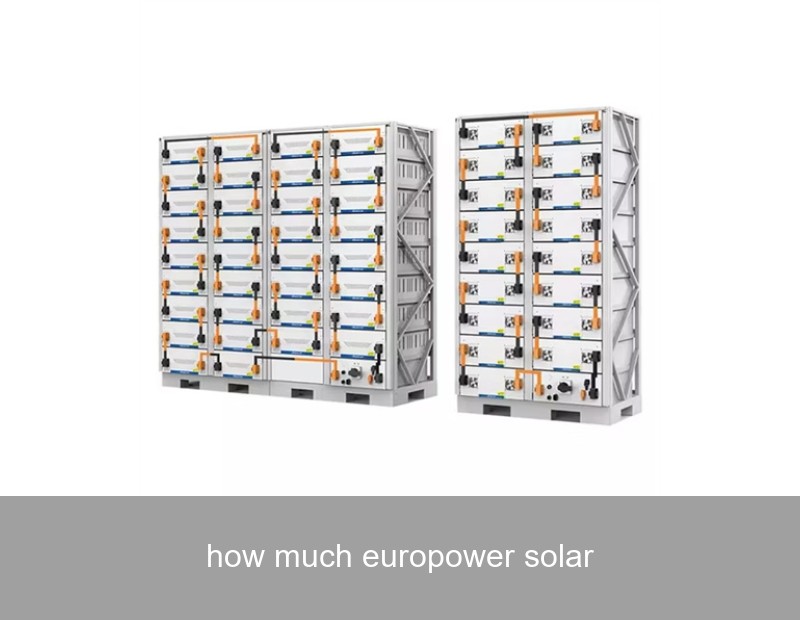
Our HPS Series Residential Energy Storage Systems are designed specifically for this task. With capacities ranging from 5 kWh to 30 kWh, they are scalable to fit any home's needs. What sets them apart is the Highjoule Energy Operating System (HEOS). This AI-driven software doesn't just store and release energy. It learns your consumption patterns, forecasts solar production based on local weather, and intelligently decides when to store, when to discharge, and even when to participate in grid services (where available) to optimize your system's financial return.
For the Müller family in Munich, adding a Highjoule HPS-10 system was transformative. Their self-consumption rate jumped from 30% to over 85%. They now use more than 6,100 kWh of their own solar Europower annually, slashing their grid purchases by over 70%. The system also provides backup power during outages—a growing concern for many. For commercial and industrial clients, our GridMaster C&I solutions offer the same intelligent management at scale, enabling demand charge reduction and enhanced energy resilience.

Image Source: Unsplash
Choosing the Right Partner
Selecting a storage system is a long-term decision. Look for providers with:
| Criterion | Why It Matters |
|---|---|
| Proven Cycle Life & Warranty | Batteries degrade. A 10-year warranty with high throughput guarantees long-term performance for your Europower. |
| Advanced Energy Management | Simple battery boxes are outdated. You need adaptive software that maximizes value daily. |
| System Safety & Certification | Ensure the system has all necessary regional certifications (e.g., VDE, UL). |
| Scalability | Your needs may change. Can the system grow with you? |
Your Energy Independence Journey
So, how much Europower can your solar panels generate? The physical maximum is set by sun and space. But the usable, valuable Europower that strengthens your energy independence and finances is determined by your system's intelligence—specifically, its ability to store and manage energy in harmony with your life.
What's the first step you'll take to move from just generating solar energy to truly owning your power?
 Inquiry
 Online Chat