


How Much Deciwatt Does the Global Energy Transition Need? A New Lens on Power
When we talk about the global energy transition, we often think in grand terms: gigawatt-scale solar farms, terawatt-hours of clean energy, and massive national grid upgrades. But what if the key to a sustainable future lies in a much smaller, often overlooked unit? Let's talk about the deciwatt (dW)—one-tenth of a watt. It's the power used by a small LED night light or a sensor. Now, ask yourself: how much deciwatt global capacity do we need to intelligently manage, store, and utilize to build a truly resilient and efficient energy ecosystem?
The Missing Metric: Why Deciwatts Matter
Our energy systems are becoming vastly more distributed and digital. Every smart thermostat, IoT sensor, battery management system, and power optimizer in a solar panel operates in the realm of deciwatts to watts. While individually insignificant, their collective power consumption and, more importantly, their control over larger energy flows is monumental. Optimizing at the deciwatt level means eliminating phantom loads, enabling precise demand response, and ensuring that not a single joule of precious renewable energy is wasted. It's about granular efficiency.
From Megawatts to Deciwatts: Scaling Our Thinking
Consider the typical energy scale:
| Power Unit | Scale | Example |
|---|---|---|
| Megawatt (MW) | 1,000,000 Watts | Utility-scale solar farm |
| Kilowatt (kW) | 1,000 Watts | Residential rooftop solar |
| Watt (W) | 1 Watt | LED light bulb |
| Deciwatt (dW) | 0.1 Watts | Wireless sensor, standby electronics |
The transition requires us to think across this entire spectrum simultaneously. A 5 MW solar array's output can be drastically improved by systems that optimize at the deciwatt level, mitigating losses from shading or mismatch. This is where intelligent energy management comes in.

Image Source: Unsplash (Representative image of solar technology and micro-control)
The Storage Imperative: Capturing Every Deciwatt
Renewables are intermittent. The sun doesn't always shine, and the wind doesn't always blow. To maximize their value, we must store energy. But effective storage isn't just about capacity; it's about precision. Modern Battery Energy Storage Systems (BESS) must be capable of responding to signals that originate from deciwatt-level intelligence—like a slight dip in grid frequency or a forecasted cloud cover.
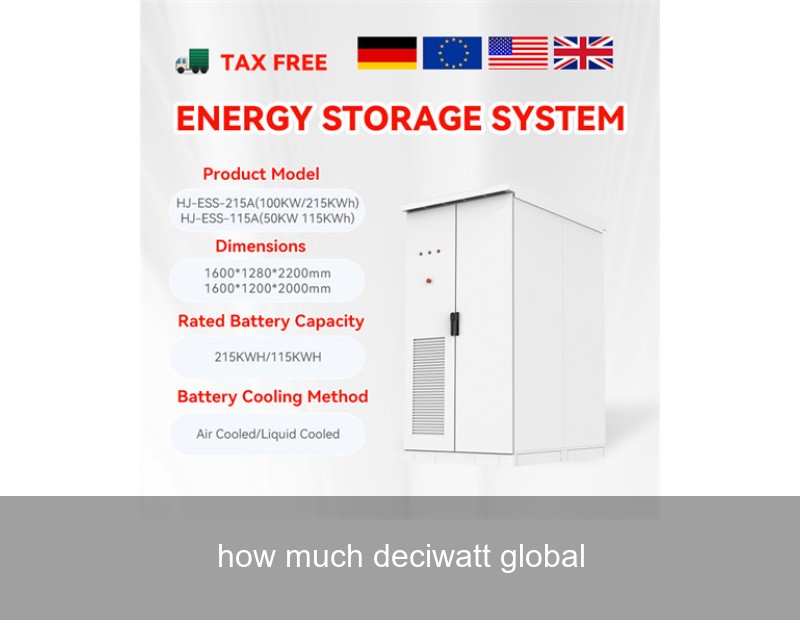
This is a core expertise at Highjoule. Since 2005, we've evolved from providing robust battery systems to delivering fully integrated, AI-driven storage solutions. Our IntelliBESS platform doesn't just store kilowatt-hours; it processes millions of data points from devices across the network, many operating at deciwatt power levels, to make split-second decisions on energy dispatch, self-consumption, and grid support. We ensure that the energy generated, down to its finest granularity, is captured and used optimally.
Case Study: A Berlin Bakery's Deciwatt Journey
Let's make this concrete with a real example from our European operations. A mid-sized artisanal bakery in Berlin with a 100 kW rooftop solar installation faced a challenge. Their ovens, refrigeration, and machinery created large, unpredictable load spikes. Despite having solar, they still relied heavily on the grid during early mornings and cloudy periods, incurring high time-of-use charges.
Highjoule's solution involved more than just adding a battery:
- Granular Monitoring: We installed sub-metering on key circuits (ovens, chillers, lighting), monitoring power flows down to the watt level.
- IntelliBESS Deployment: A 120 kWh / 50 kW Highjoule battery system was integrated with their solar inverters.
- AI-Powered Logic: Our system learned the bakery's patterns. It recognized that the deciwatt-level draw of the building's management system signaled the pre-dawn startup sequence. It then calculated the optimal time to begin drawing from the battery to offset the impending oven load, using solar forecasts.
The Result? Within a year:
- Grid dependence reduced by 75% during peak tariff hours.
- Overall energy costs decreased by 40%.
- The system's precision control extended the projected battery lifespan by optimizing charge/discharge cycles.
This bakery is now a prosumer in the truest sense, actively participating in grid stability by offering controlled load flexibility—all managed by intelligence that started at the deciwatt level of data. You can read more about the importance of demand-side flexibility in grids from the International Energy Agency (IEA).
Highjoule's Role: Intelligent Systems for a Deciwatt World
For commercial, industrial, and residential clients across Europe and North America, Highjoule builds the bridge between macro-generation and micro-efficiency. Our services are designed to harness the value of every deciwatt:
- Highjoule IntelliBESS: Our flagship modular battery systems, scalable from 10 kWh to multi-megawatt hours, feature built-in advanced energy management software (EMS) that reacts to granular signals.
- Highjoule EnergyOS: A cloud-based platform that provides holistic energy asset control, analytics, and enables participation in virtual power plants (VPPs) and grid service markets.
- Custom Microgrid Solutions: We design and deploy resilient microgrids for campuses, communities, and industrial sites, ensuring critical operations can continue by seamlessly islanding and managing distributed resources with extreme precision.
Think of us as providing not just the "muscle" (battery storage) but also the "nervous system" (control intelligence) for modern energy infrastructure. This approach is critical as grid dynamics become more complex, a topic thoroughly explored by researchers at institutions like The National Renewable Energy Laboratory (NREL).

Image Source: Unsplash (Representative image of energy management control systems)
Future Challenges and Opportunities
The road ahead is exciting. The proliferation of electric vehicles (EVs), each with a battery pack that can act as a grid asset, adds another layer of deciwatt-aware devices to the network. The challenge lies in interoperability, cybersecurity, and creating market structures that value small, aggregated contributions. Standards bodies like the IEEE are critical in this evolution.
So, back to our initial, somewhat unconventional question: how much deciwatt global capacity do we need to manage? The answer is: all of it. The sum of all these tiny, intelligent points of control will determine the speed, stability, and equity of our energy transition.
 Inquiry
 Online Chat