


Home Wind Power: How Much Energy Can It Really Generate for You?
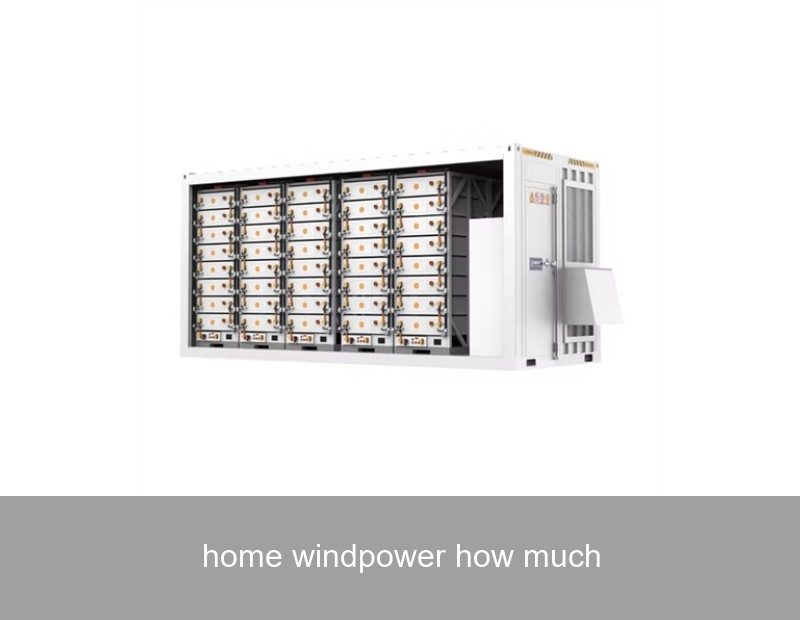
You've seen the sleek, modern turbines on hillsides and maybe even in your neighbor's yard. The idea of harnessing the wind to power your home, reducing your electricity bills and your carbon footprint, is incredibly appealing. But the burning question for most homeowners is practical: Home wind power, how much energy can I actually expect? The answer isn't a simple number; it's a fascinating equation of wind, technology, and smart energy management. As a leader in advanced energy storage, Highjoule has been partnering with renewable installers since 2005 to ensure that every kilowatt-hour generated—by wind or sun—is used to its maximum potential.
Table of Contents
The Wind Reality: It's Not Just About the Turbine
Many homeowners start by looking at a turbine's "rated capacity"—for example, a 5 kW model. That's the power it can produce under ideal, laboratory-like wind conditions. The real world is rarely ideal. Your actual energy harvest depends on a crucial factor: your site's average wind speed.
Think of it like solar: a solar panel's output depends on hours of peak sun. For wind, it's all about wind speed distribution. A small increase in average speed leads to a massive jump in energy because wind power is proportional to the cube of the wind speed. Doubling the wind speed means potentially eight times the power.

Credit: Unsplash / American Public Power Association. A well-sited turbine requires open space and consistent wind.
Key Factors Determining Your "How Much"
- Local Wind Resource: This is king. You need a minimum average of 5-6 meters per second (11-13 mph). Tools like the U.S. Department of Energy's WINDExchange maps can provide initial estimates.
- Tower Height: Winds are stronger and less turbulent at higher elevations. A turbine on a 30-foot tower will perform drastically worse than the same turbine on an 80-foot tower.
- Local Obstacles: Trees, buildings, and hills create turbulence that drastically reduces efficiency and can cause wear and tear.
- Turbine Efficiency: The design, blade size, and generator technology determine how well it converts wind kinetic energy into electricity.
Crunching the Numbers: Potential Output and Real-World Yields
Let's move from theory to practical estimates. A typical residential turbine ranges from 2 kW to 10 kW in capacity. Here’s a simplified table showing estimated annual energy production at different average wind speeds for a well-sited 5 kW turbine.
| Average Wind Speed (at hub height) | Estimated Annual Energy Output* | Equivalent to Powering... |
|---|---|---|
| 5 m/s (11 mph) | ~5,000 kWh | ~40-50% of a typical U.S. home's needs |
| 6 m/s (13 mph) | ~8,000 kWh | ~60-70% of a typical U.S. home's needs |
| 7 m/s (16 mph) | ~12,000 kWh | >100% of a typical U.S. home's needs |
*Outputs are illustrative and vary by specific turbine model and site conditions.
This is where the conversation gets interesting. You might notice a paradox: the wind doesn't blow on demand. Your turbine might be producing 4 kW at 2 AM when your home's demand is only 0.5 kW. Without a way to capture that surplus, it's often sent back to the grid for minimal credit (depending on local net metering policies). This brings us to the most critical component in maximizing your answer to "home wind power, how much"—the storage system.
Case Study: The Smith Family's Journey to Energy Independence
Let's look at a real-world example from coastal Cornwall, UK, where wind resources are favorable. The Smith family installed a 6 kW Bergey Excel turbine on a 24-meter (79-foot) tower in 2021. Their average wind speed at hub height is approximately 6.5 m/s.
- Turbine Annual Generation (2023): 9,800 kWh (measured).
- Home Annual Consumption: 8,200 kWh.
- Initial Challenge: Over 60% of their wind generation occurred during off-peak hours or on very windy days when consumption was low. Under the UK's Smart Export Guarantee (SEG), they were only receiving a low, variable price for exported power.
- Solution (2023): They integrated a Highjoule H2 Series Hybrid Storage System. This 15 kWh lithium iron phosphate (LFP) battery system intelligently stores surplus wind energy instead of exporting it immediately.
- Result (Post-Installation): Their grid import dropped by an additional 75%. They now use over 85% of the wind energy they generate directly, achieving true self-consumption. "The turbine makes the power, but the Highjoule battery gives us control," Mr. Smith noted. "Our 'how much' is now almost entirely for our own use."
Beyond Generation: The Critical Role of Smart Storage
The Smith family's experience highlights a universal truth: generation is only half the story. To truly answer "how much can home wind power do for *me*?", you must plan for storage. This is where Highjoule's expertise becomes pivotal. Our systems are designed to handle the variable, high-power input from wind turbines, which can differ from the more predictable solar PV curve.

Credit: Unsplash / ThisisEngineering. Modern battery storage, like Highjoule's systems, is key to maximizing renewable energy use.
How Highjoule Complements Your Wind Investment
- Maximized Self-Consumption: Our AI-driven energy management system (EMS) learns your consumption patterns and wind generation forecasts to decide in real-time whether to store or use energy, ensuring you get the most value from every gust.
- Grid Stability & Backup: In areas prone to outages, a Highjoule system paired with a compatible inverter can provide seamless backup power, using your stored wind energy to keep essential circuits running.
- Future-Proofing: Whether you start with wind and add solar later, or want to participate in future grid services, our modular systems are designed to scale and adapt. For larger properties or microgrid applications, our commercial-scale Highjoule CORE battery energy storage systems (BESS) offer utility-grade reliability.
According to a 2023 NREL report, pairing renewables with storage can increase the value of generated electricity by 20-40% for homeowners, depending on market structures.
Is Home Wind Power Right for Your Property?
So, how do you move from curiosity to a realistic assessment? Ask yourself these questions:
- Do I have the space and wind? An acre or more is often recommended, especially in suburban areas, to avoid turbulence. A professional site assessment, including an anemometer measurement over several months, is the only way to get a reliable data point for your "how much".
- What are my local regulations? Zoning laws, height restrictions, and noise ordinances vary widely. Permitting can be a significant part of the process.
- What is my total energy goal? Are you aiming for 100% off-grid independence, or a 50% reduction in your carbon footprint? Your goal will define the system size and the essentiality of storage.
- Have I considered a hybrid system? For most homeowners, the most resilient and consistent year-round solution combines wind and solar, backed by a robust storage system like Highjoule's. When the sun isn't shining, the wind might be blowing, and vice versa.
The Highjoule Promise: Intelligent Energy Certainty
At Highjoule, we don't manufacture turbines, but we make the energy they produce infinitely more valuable. Since 2005, our focus has been on building intelligent, efficient, and safe storage solutions that unlock the full potential of renewable investments for homeowners, businesses, and communities. We work with a network of certified installers who can design a holistic system tailored to your unique wind resource and energy profile.
Ready to explore what your specific property could yield? The first step isn't buying a turbine—it's gathering data and speaking with experts who can model your potential generation and consumption. What would your energy landscape look like if you could store the power of a windy night to use throughout the calm day that follows?
 Inquiry
 Online Chat