


ESS Energy Storage System: The Key to Unlocking a Resilient and Sustainable Grid
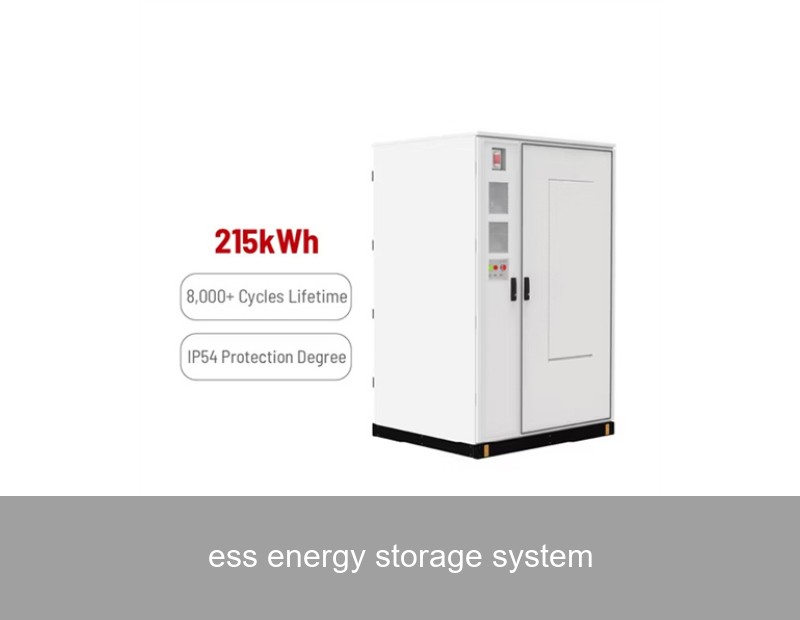
You've likely heard the terms "energy transition" and "grid modernization" frequently. But what's the tangible technology making these concepts a reality? The answer, increasingly, is the ESS (Energy Storage System). More than just a battery, a modern ESS is an intelligent platform that stores electricity for use when it's needed most, transforming how we generate, distribute, and consume power. For businesses, communities, and homeowners, understanding ESS technology is no longer a niche interest—it's a critical step toward energy independence, cost savings, and supporting a cleaner grid.
Table of Contents
- What Exactly is an ESS Energy Storage System?
- The Driving Forces: Why ESS Demand is Skyrocketing
- Core Components of a Modern ESS
- Key Applications: From Homes to Industrial Parks
- Real-World Impact: A California Case Study
- The Future of ESS: Intelligence and Grid Services
- How Highjoule Delivers Advanced ESS Solutions
What Exactly is an ESS Energy Storage System?
At its heart, an Energy Storage System (ESS) is a device or group of devices assembled to store electrical energy for later use. Think of it as a sophisticated "energy bank." The most common type today uses electrochemical storage—lithium-ion batteries—similar to those in your laptop but engineered for massive scale, safety, and decades of daily cycling.
However, a cutting-edge ESS is far more than just battery cells. It's an integrated system comprising power conversion, sophisticated control software, thermal management, and safety mechanisms. This intelligence is what allows an ESS to perform complex tasks automatically, like charging from solar panels during the day and discharging during the expensive evening peak.
The Driving Forces: Why ESS Demand is Skyrocketing
The global surge in ESS adoption isn't accidental. It's a direct response to several powerful, converging trends:
- Renewable Energy Integration: Solar and wind are intermittent. An ESS smooths out their generation, storing excess power for when the sun isn't shining or the wind isn't blowing, making renewables a reliable baseload source.
- Grid Resilience & Stability: With increasing climate-related outages and aging infrastructure, ESS provides backup power and critical grid services like frequency regulation, acting as a shock absorber for the grid.
- Economic Incentives: Time-of-use electricity rates and demand charges can cripple a business's operational budget. An ESS strategically discharges to avoid peak tariffs, delivering substantial savings.
- Policy Support: Governments worldwide, from the U.S. Inflation Reduction Act to EU directives, are providing tax credits and targets to accelerate storage deployment.
Core Components of a Modern ESS
To understand its value, let's break down a typical battery-based ESS:
| Component | Function | Analogy |
|---|---|---|
| Battery Rack | The core storage unit, housing lithium-ion cells. | The fuel tank. |
| Battery Management System (BMS) | Monitors cell voltage, temperature, and health for safety and longevity. | The nervous system. |
| Power Conversion System (PCS / Inverter) | Converts DC battery power to AC for the grid/building, and vice-versa. | The heart and translator. |
| Energy Management System (EMS) | The intelligent brain. Controls when to charge/discharge based on algorithms, weather, and tariffs. | The strategic commander. |
| Thermal Management | Cooling/heating system to keep batteries at optimal temperature. | The climate control system. |
The synergy between these components, especially the intelligence of the EMS, determines the system's overall efficiency, financial return, and reliability.

Image Source: Unsplash. A utility-scale ESS container, showcasing the industrial application of the technology.
Key Applications: From Homes to Industrial Parks
The versatility of ESS technology is one of its greatest strengths. Its applications scale seamlessly:
- Residential: Paired with rooftop solar for self-consumption, backup power during blackouts, and bill management.
- Commercial & Industrial (C&I): Reducing demand charges (which can be 30-70% of a business's electric bill), providing backup for critical operations, and participating in energy arbitrage.
- Utility-Scale: Deferring costly grid upgrades, providing frequency regulation, and integrating large renewable farms into the transmission system.
- Microgrids: Serving as the foundational asset for remote communities, campuses, or military bases to operate independently from the main grid.
Real-World Impact: A California Case Study
Let's look at a concrete example. A mid-sized winery in Napa Valley, California, faced two major challenges: crippling demand charges during its energy-intensive refrigeration and bottling season, and an increasing risk of public safety power shutoffs (PSPS) during wildfire season, which could spoil entire vintages.
The Solution: They installed a 500 kW / 1,000 kWh on-site ESS. The system's EMS was programmed with two primary goals: 1) Peak shaving - automatically discharging the battery when facility load approached its historical peak, and 2) Backup readiness - maintaining a 40% state of charge to provide critical backup power for refrigeration units for up to 4 hours during an outage.
- Cost Savings: Achieved a 28% reduction in monthly demand charges, leading to an annual savings of over $45,000.
- Resilience: Successfully rode through three PSPS events in one year, preventing an estimated $250,000 in potential inventory loss.
- ROI: Combined with state (SGIP) and federal incentives, the project achieved a payback period of under 5 years.
This case, documented in a NREL report on C&I storage, exemplifies the dual financial and resilience value proposition of a well-designed ESS.
The Future of ESS: Intelligence and Grid Services
The next evolution of ESS lies in software and aggregation. We're moving from standalone systems to networked "virtual power plants" (VPPs). In a VPP, hundreds or thousands of distributed ESS units (in homes and businesses) are aggregated via cloud software to act as a single, dispatchable resource for the utility. This allows participants to earn additional revenue while providing immense value to grid stability. Furthermore, advancements in battery chemistry, like lithium iron phosphate (LFP), are enhancing safety and cycle life, making ESS an even more robust long-term investment.

Image Source: Unsplash. A residential ESS installation integrated with solar PV, representing the growing trend of home energy independence.
How Highjoule Delivers Advanced ESS Solutions
As a global leader in advanced energy storage since 2005, Highjoule is at the forefront of this transition. We don't just supply components; we deliver intelligent, turnkey power solutions tailored to each client's unique energy profile and goals.
Our flagship product line, the Highjoule H-Series, embodies this philosophy. These modular, containerized ESS solutions are built with industry-leading LFP battery cells for maximum safety and longevity. What truly sets them apart is the Highjoule Apex™ Energy Management Platform. This proprietary AI-driven software doesn't just react—it forecasts. By integrating local weather data, real-time electricity pricing, and consumption patterns, Apex™ optimizes every charge-discharge cycle to maximize financial return and resilience.
Whether it's for a manufacturing plant in Germany looking to cap its energy costs, a solar-powered community microgrid in Texas, or a residential development in Spain seeking energy security, Highjoule's team of experts provides end-to-end service: from initial feasibility analysis and system design to commissioning, maintenance, and ongoing performance monitoring. Our systems are designed to meet the rigorous standards and grid codes of both the European and North American markets.
The conversation around energy is shifting from mere consumption to active management. An ESS is the tool that enables this shift. As you consider your organization's or community's energy future, what specific challenge—be it unpredictable costs, unreliable supply, or sustainability targets—could an intelligent ESS help you solve first?
 Inquiry
 Online Chat