


Energy Transition Holdings: The Strategic Backbone of a Sustainable Future
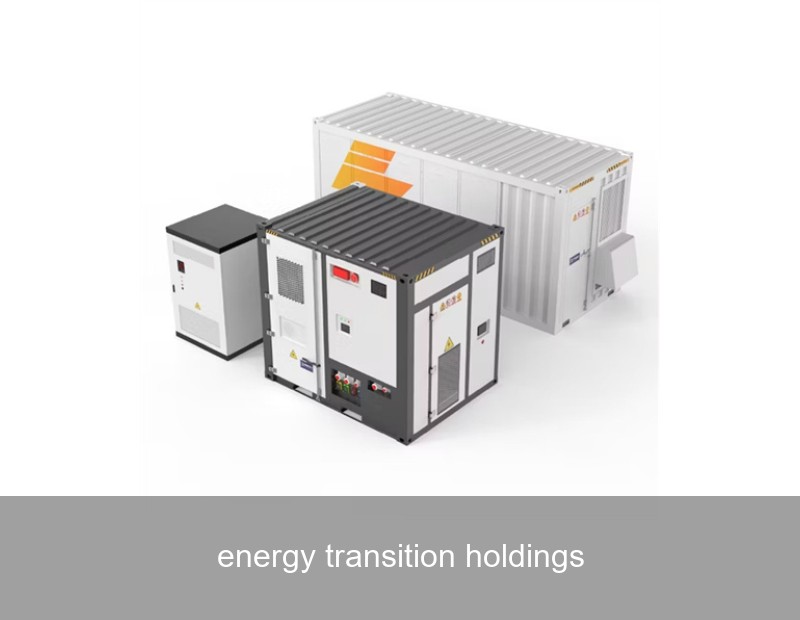
You've likely heard the term "energy transition" countless times. It's the global shift from fossil fuels to renewable energy. But for investors, corporations, and communities, the real question is: how do you build a resilient, profitable position within this monumental shift? The answer increasingly lies in a powerful concept: energy transition holdings. These are not just passive investments; they are strategic portfolios of assets, technologies, and infrastructure that actively drive and benefit from the move to clean energy. At their core, these holdings recognize that the transition's true value is unlocked not just by generating green power, but by intelligently managing and storing it. This is where advanced energy storage becomes the critical, value-creating linchpin.
Table of Contents
- The Phenomenon: From Megatrend to Investment Imperative
- The Data: Quantifying the Storage-Led Transition
- The Case Study: A German Industrial Park's Transformation
- The Architecture of Modern Energy Transition Holdings
- The Role of Intelligent Storage in Portfolio Value
- The Future: What's Next for Strategic Energy Assets?
The Phenomenon: From Megatrend to Investment Imperative
Think of the energy transition not as a single switch, but as a complete rewiring of our global economy. Governments are setting net-zero targets, corporations are facing stakeholder pressure for ESG compliance, and energy prices have shown alarming volatility. For institutional investors, utility companies, and large industrials, simply owning a wind farm is no longer sufficient. The intermittent nature of solar and wind creates a fundamental challenge for grid stability and economic return. This is the pivotal moment where the concept of energy transition holdings emerges. These sophisticated portfolios strategically combine generation (solar PV, wind), consumption (efficient infrastructure), and—most importantly—the connective intelligence of battery energy storage systems (BESS).

Image Source: Unsplash
The Data: Quantifying the Storage-Led Transition
The numbers paint a clear picture of urgency and scale. According to the International Energy Agency (IEA), to meet net-zero goals by 2050, global renewable capacity needs to triple by 2030. However, the IEA also emphasizes that grid-scale storage capacity needs to expand dramatically, by over 40 times from 2021 levels, to support this growth. Let's break down what this means for a holding portfolio:
| Portfolio Component | Challenge Without Storage | Value with Storage |
|---|---|---|
| Solar PV Asset | Over-generation at noon, zero revenue at night. Price cannibalization. | Energy arbitrage: store midday surplus, discharge during high-price evening peaks. |
| Wind Farm | Unpredictable output, often high during low-demand periods. | Grid balancing services, firm capacity provision, reduced curtailment. |
| Industrial Facility | Exposed to volatile time-of-use tariffs and grid instability. | Demand charge management, backup power, enhanced power quality. |
The financial logic is compelling. A study by Lazard shows that the levelized cost of storage (LCOS) for lithium-ion batteries has fallen by over 70% since 2015, making storage + renewables increasingly competitive with, and often cheaper than, conventional peaker plants.
The Case Study: A German Industrial Park's Transformation
Let's move from theory to a real-world European example. A major German industrial holding company, managing a 50-hectare park with multiple manufacturing tenants, faced a dual challenge: rising energy costs and stringent carbon reduction targets. Their existing 8 MW rooftop solar array was covering only 30% of the park's daytime load, and all surplus was fed back to the grid at a low, fixed feed-in tariff.
The Strategy: They reconceptualized the park as an integrated energy transition holding at a micro-scale. The cornerstone was the deployment of a centralized 4 MWh / 2 MW battery energy storage system, coupled with an advanced energy management system (EMS).
The Highjoule Solution: The holding selected Highjoule's H-Series Commercial BESS for its high cycle life, superior safety profile (featuring patented cell-level thermal management), and seamless integration capabilities. Highjoule's GridSync™ EMS was the brain, dynamically optimizing flows based on real-time electricity prices, solar production, and tenant consumption patterns.
The Results (12-month period):
- Self-Consumption of Solar: Increased from 30% to over 85%.
- Energy Cost Savings: Achieved €280,000 through arbitrage and demand charge reduction.
- Grid Revenue: Generated €45,000 by providing secondary frequency response (FCR) services to the German grid.
- Carbon Footprint: Reduced scope 2 emissions for the park by an additional 22%.
This case demonstrates how a strategic storage asset transformed a simple real estate holding into a dynamic, revenue-generating energy transition holding, future-proofing its operations and creating a new profit center.

Image Source: Unsplash
The Architecture of Modern Energy Transition Holdings
So, what does a robust holding portfolio look like? It's a layered, intelligent ecosystem:
- Generation Layer: Diversified renewables (solar, wind, potentially hydro or geothermal).
- Storage & Integration Layer (The Critical Enabler): This is the heart of the system. Scalable battery storage, like Highjoule's modular systems ranging from residential PowerWall solutions to utility-scale MegaJoule containers, provides flexibility. This layer includes smart inverters and control software.
- Management & Optimization Layer: A sophisticated software platform (like Highjoule's AegisAI platform) that uses weather forecasts, market signals, and load predictions to autonomously maximize financial and operational outcomes.
- Consumption & Electrification Layer: Efficient buildings, EV charging networks, and industrial processes that can flex their demand in response to grid or price signals.
The Strategic Role of Intelligent Storage in Portfolio Value
As a technology provider at the forefront of this shift, Highjoule sees storage as the active asset that breathes life into a energy transition holding. Our systems do more than just store electrons; they create optionality and resilience. For a commercial building owner, our CommStore system slashes demand charges. For a microgrid developer in the US, our GridMax series ensures reliability with black-start capabilities. For a utility-scale holder, our systems provide essential grid services that stabilize the network and open new revenue streams.
The expertise lies in selecting the right storage technology, sizing it correctly for both today's needs and tomorrow's expansion, and integrating it with an EMS that can navigate complex market rules in regions like the PJM Interconnection in the US or the National Grid in the UK. This turns a capital expenditure into a strategic, appreciating asset within the holding.
The Future: What's Next for Strategic Energy Assets?
The evolution is towards ever-greater intelligence and interconnection. We're moving into the era of virtual power plants (VPPs), where thousands of distributed assets—including those within disparate energy transition holdings—are aggregated to act as a single, grid-stabilizing power plant. The integration of vehicle-to-grid (V2G) technology will see electric fleets become mobile storage assets. The frontier is no longer just hardware; it's the data and algorithms that optimize across multiple value streams simultaneously.
For a pension fund investing in infrastructure, a municipality owning its utility, or a corporation safeguarding its supply chain, the question is no longer if to build an energy transition holding, but how to build it most effectively. The differentiating factor will be the choice of partners who provide not just equipment, but long-term performance intelligence and adaptability.
Is your current energy strategy a collection of disparate projects, or is it a cohesive, intelligent portfolio designed to thrive in the new energy economy? What single asset could you add to your holdings today that would unlock the most value across your entire energy ecosystem?
 Inquiry
 Online Chat