


Energia Solar para Industria: Powering Productivity with Sustainable Energy
Let's talk about a quiet revolution happening on factory roofs and industrial parks across Europe and the U.S. Industrial leaders are no longer just asking about energy costs; they're asking about energy control. This is where energia solar para industria (solar energy for industry) transitions from an alternative concept to a core business strategy. It's not merely about installing panels; it's about building a resilient, intelligent, and cost-predictable energy infrastructure. For nearly two decades, Highjoule has been at the forefront of this shift, empowering businesses to transform their energy footprint from a volatile expense into a strategic asset.
The Phenomenon: Rising Costs and Conscience
If you manage an industrial facility, you feel it every quarter: the volatility of energy markets. Geopolitical tensions, supply chain issues, and regulatory changes can send your operating expenses soaring without warning. Simultaneously, stakeholders—from investors to customers—are demanding tangible sustainability commitments. Corporate Power Purchase Agreements (PPAs) and ESG reporting are now boardroom topics. This creates a powerful convergence: the financial imperative to control costs meets the ethical imperative to reduce carbon footprint. Energia solar para industria directly addresses this dual challenge, offering a path to lock in energy costs for 25+ years while dramatically slashing Scope 2 emissions.

Image: Industrial-scale solar installations turn unused rooftop space into a power generator. Source: Unsplash
The Data: Solar Power by the Numbers
The business case is underpinned by compelling data. According to the International Energy Agency (IEA), renewable capacity additions soared by almost 50% in 2023, with solar PV accounting for three-quarters of this growth. But let's get more specific to industry:
- Cost Reduction: The levelized cost of electricity (LCOE) from utility-scale solar has plummeted by over 90% since 2010, making it highly competitive with, and often cheaper than, grid power in most regions.
- ROI & Payback: Modern industrial solar projects often achieve payback periods of 4-7 years in sun-rich areas of Europe and the U.S., thanks to high self-consumption rates and favorable policies.
- Capacity Factors: While variable, solar now achieves capacity factors of 15-25% in many industrial locations, a figure that is perfectly viable when integrated with smart energy management and storage.
These aren't just "green" numbers; they're hard financial metrics that CFOs appreciate.
The Case Study: A European Success Story
Consider the case of a mid-sized automotive parts manufacturer in northern Spain. Facing annual electricity costs exceeding €500,000 and pressure from its parent company to meet aggressive carbon neutrality goals, they embarked on a comprehensive energia solar para industria project in 2022.
| Metric | Before Installation | After Installation (with Highjoule system) |
|---|---|---|
| Annual Grid Consumption | 2.1 GWh | 1.0 GWh |
| Annual Energy Cost | ~€520,000 | ~€280,000 (incl. system financing) |
| CO2 Emissions Reduction | Baseline: 780 tons/year | ~460 tons/year avoided |
| System Configuration | 850 kWp rooftop solar PV + 400 kWh Highjoule H-Stack Commercial Battery + Energy Management System | |
The key to their success was not just the solar panels, but the integrated Highjoule H-Stack battery system. It stores excess midday solar generation to power machinery during the evening peak rate periods and provides critical backup for sensitive CNC machines. This intelligent storage turned a simple solar array into a 24/7 energy optimization tool.
The Insight: Beyond Panels, The Storage Imperative
This brings us to the most critical insight for modern industrial energy planning: solar generation is only half the solution. The sun doesn't shine on a night shift, and grid prices spike when demand is high. To truly achieve energy independence and maximize savings, you must be able to store and dispatch your solar power on demand. This is where advanced Battery Energy Storage Systems (BESS) become non-negotiable. They transform your solar installation from a intermittent supplier into a reliable, dispatchable power plant that can also provide grid services and backup power.
Highjoule: Your Intelligent Energy Partner
Since 2005, Highjoule has specialized in this exact synergy. We don't just sell components; we deliver intelligent, efficient, and sustainable power solutions. For our industrial clients, this means a holistic approach to energia solar para industria:
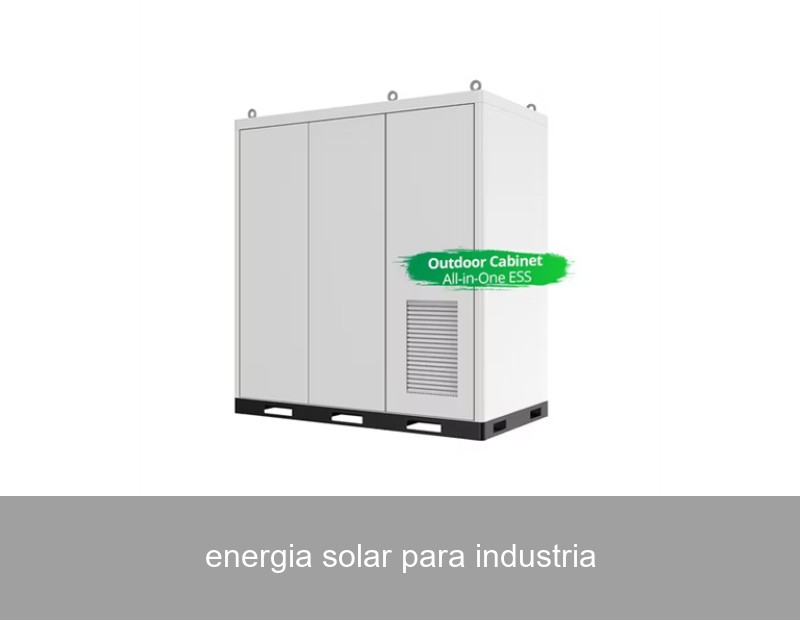
- Highjoule H-Series Commercial BESS: Our scalable, containerized or rack-mounted battery systems feature lithium iron phosphate (LFP) chemistry for superior safety and longevity. They are seamlessly integrated with solar inverters for optimal self-consumption.
- Orion Energy Management Platform (EMP): The brain of the system. Our proprietary software uses AI and real-time data to make autonomous decisions—when to charge from solar, when to discharge to avoid peak tariffs, and when to sell excess power back to the grid, all while ensuring your operational power needs are always met.
- End-to-End Project Mastery: From initial site assessment and financial modeling to engineering, procurement, construction (EPC), and long-term performance monitoring, Highjoule provides a single point of accountability.
Our systems are designed for the rigorous demands of industrial environments, ensuring reliability where it matters most.

Image: A modern, safe Battery Energy Storage System (BESS) for industrial applications. Source: Unsplash
Key Components of a Robust Industrial Solar System
Understanding the system architecture helps in making an informed decision. A top-tier industrial solar-plus-storage solution comprises:
- High-Efficiency Photovoltaic (PV) Panels: Maximizing energy yield per square meter of your roof or land.
- Industrial-Grade Inverters: Converting DC solar power to AC power for your facility, with high efficiency and grid-support functions.
- Battery Energy Storage System (BESS): Like Highjoule's H-Series, for storing excess energy and providing power stability.
- Energy Management System (EMS): The intelligent control layer that optimizes energy flows for economic and operational goals.
- Robust Monitoring & Analytics: Providing full visibility into system performance, savings, and environmental impact.
The Future of Industrial Energy Independence
The journey towards energia solar para industria is accelerating. With innovations like virtual power plants (VPPs), where aggregated industrial batteries can support the wider grid, and the continued drop in storage costs, the value proposition only deepens. The question is no longer "if" but "how and when."
What specific energy challenge—be it unpredictable peak demand charges, backup power requirements for critical processes, or a looming corporate sustainability target—could a tailored solar-plus-storage solution solve for your operation in the next 18 months?
 Inquiry
 Online Chat