


Do I Need a Battery for My Solar Panels? A Homeowner's Guide to Energy Independence
You've made a smart choice by installing solar panels. They're silently converting sunlight into electricity, slashing your energy bills, and reducing your carbon footprint. But as you watch your meter spin backwards on a sunny afternoon, a question might start to form: Do I need a battery for my solar panels? The short answer is, it's not mandatory, but it fundamentally transforms how you use solar energy. Let's explore why adding a battery storage system, like those from Highjoule, is increasingly becoming the key to true energy resilience and maximizing your investment.
Table of Contents
- The Limitation of Solar-Only Systems
- Crunching the Numbers: Is a Battery Worth It?
- A Real-World Case: The Smith Family in California
- Choosing the Right System for Your Needs
- Highjoule's Smart Energy Storage Solutions
- What's Your Energy Priority?

Image: A modern home integrating solar panels and a wall-mounted battery storage system. Source: Unsplash
The Limitation of "Solar-Only" Systems
Here’s the core issue: solar panels only generate electricity when the sun is shining. Your home consumes energy around the clock—in the morning, at night, and on cloudy days. Most homes with solar-only setups are connected to the traditional power grid to cover these gaps. This is called a grid-tied system.
Under net metering policies, you can export your excess solar power to the grid in exchange for credits. This sounds ideal, but the landscape is changing rapidly. Utility rates and net metering rules are evolving, often reducing the financial benefits of exporting power. The Solar Energy Industries Association (SEIA) tracks these policy shifts, which show a trend toward less favorable compensation for solar exports in some regions. This means you might be giving away your valuable, self-produced solar energy for pennies, only to buy it back from the utility at full price at night.
The "Duck Curve" Phenomenon
Grid operators face a challenge known as the "duck curve"—a steep drop in net electricity demand during midday (when solar floods the grid) followed by a sharp ramp-up in the evening as the sun sets and people return home. This volatility makes grid management harder and can lead to less stable policies for solar owners.
The Battery Advantage: More Than Just Backup
This is where a home battery storage system changes the game. Think of it as a personal energy reservoir for your home. Instead of sending excess solar energy out, you store it for your own use later. Here’s what that unlocks:
- Energy Self-Consumption: Use your solar power on your terms. Power your home with the sun's energy even after it sets, dramatically increasing your energy independence from the grid.
- Backup Power: During a grid outage, while your solar-only system would typically shut off for safety, a battery system can keep your critical loads (lights, fridge, internet) running seamlessly.
- Financial Optimization: In areas with time-of-use (TOU) rates, where electricity is more expensive during peak evening hours, you can use stored battery power instead of buying expensive grid power. Some programs even allow you to provide grid services.
- Increased Resilience: With increasing extreme weather events, having a reliable backup power source provides peace of mind.
Crunching the Numbers: Is a Battery Worth It?
The economics depend heavily on your location, utility rates, and goals. Let's break it down with a simple table comparing two scenarios for a typical home with a 8kW solar system:
| Factor | Solar-Only System | Solar + Battery System |
|---|---|---|
| Daytime Energy Use | Powered directly by solar. | Powered directly by solar. |
| Evening Energy Use | Powered by grid (purchased at peak rates). | Powered by stored solar energy from battery. |
| Grid Outage | Home loses power (solar shuts off). | Critical loads continue running from battery. |
| Financial Benefit | Reduces bill via net metering credits (value varies). | Maximizes bill savings via self-consumption; may qualify for incentives. |
| Primary Value | Bill reduction, environmental. | Energy independence, resilience, bill optimization. |
According to data from the National Renewable Energy Laboratory (NREL), the levelized cost of energy from solar-plus-storage continues to fall, making it competitive with retail electricity in many parts of the U.S. and Europe, especially when resilience is valued.
A Real-World Case: The Smith Family in California
Let's look at a concrete example. The Smith family in Sacramento, California, installed a 10kW solar system in 2020. With the state's transition to Net Billing Tariff (NBT), the compensation for their exported solar energy dropped significantly. During summer, they were exporting 60% of their daily solar production to the grid for low credit, only to pay high peak rates (over $0.45/kWh) from 4-9 PM.
In 2023, they added a Highjoule HES-13 residential battery system (13.5 kWh usable capacity). The results after one year:
- Grid Independence: Increased their self-consumption of solar power from 40% to over 85%.
- Bill Savings: Reduced their monthly electricity bill from an average net cost of $50 to nearly $0 year-round.
- Backup Security: Experienced two planned Public Safety Power Shutoff (PSPS) events, totaling 18 hours. Their home's essential circuits remained powered without interruption.
- ROI Estimate: Combined with the federal Investment Tax Credit (ITC) for storage, they project a payback period of 7-8 years on the battery addition, well within its warranty period.
For the Smiths, the battery wasn't just an add-on; it became the core component that secured their investment and delivered reliable, low-cost power.

Image: An energy monitoring dashboard visualizing solar production, home consumption, and battery usage. Source: Unsplash
Choosing the Right System for Your Needs
Not all battery systems are created equal. When evaluating, consider these key features:
- Usable Capacity (kWh): How much energy it can store. A typical home might need 10-15 kWh to cover evening and nighttime loads.
- Power Rating (kW): How much power it can deliver at once. This determines how many appliances you can run simultaneously during an outage.
- Depth of Discharge (DoD): The percentage of the battery's capacity you can safely use. A higher DoD means more usable energy.
- Chemistry: Most modern systems use Lithium Iron Phosphate (LFP), which is known for its safety, long cycle life, and stability.
- Integrator & Software: The system's intelligence is crucial. It should seamlessly manage solar charging, grid interaction, and backup power without you lifting a finger.
Engineered for Resilience: Highjoule's Smart Energy Storage Solutions
At Highjoule, with nearly two decades of experience since 2005, we design our battery systems to address the very challenges discussed here. Our products are built for the diverse needs of homeowners in Europe and North America.
Our flagship HES Series for residential use is built with durable LFP chemistry and features a modular design. Starting with a base unit, you can expand capacity as your needs grow. What truly sets it apart is the Highjoule EnergyOS—an intelligent software platform. EnergyOS constantly learns your home's energy patterns and automatically optimizes storage and discharge to maximize self-consumption, leverage time-of-use rates, and ensure backup power is always ready.
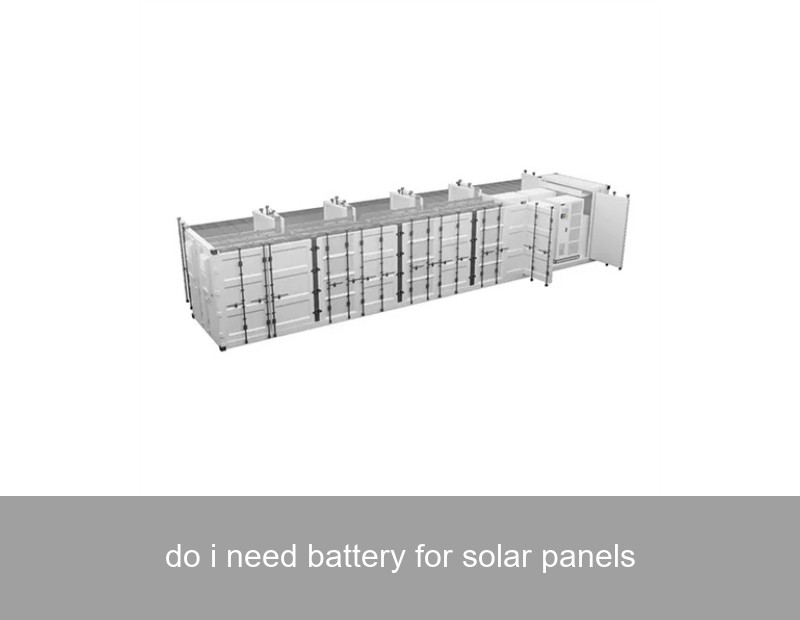
For larger installations, such as commercial buildings or microgrids, our CubeGrid containerized solutions provide utility-scale storage in a compact, plug-and-play format. Whether it's a remote community seeking energy independence or a factory aiming to shave peak demand charges, Highjoule delivers robust, smart, and sustainable power solutions.
So, Do You Need a Battery for Your Solar Panels?
The question evolves from "Do I need it?" to "What do I want to achieve?" If your goal is simply to lower your bill under favorable net metering, solar alone may suffice for now. But if you seek control—over your costs in a changing utility landscape, over your power supply during outages, and over your personal contribution to a more resilient grid—then pairing solar with a battery is the definitive answer.
It transforms your solar array from a passive generator into an active, intelligent home energy ecosystem. With policies shifting and extreme weather becoming more common, the value of resilience is increasingly quantifiable.

Image: A family enjoying evening hours with the security of backup power from a home battery. Source: Unsplash
What's Your Biggest Priority for Your Home's Energy Future: Maximizing Financial Savings, Ensuring Uninterrupted Power, or Achieving Total Energy Independence?
We invite you to explore how Highjoule's tailored energy storage systems can help you meet that priority. The journey to full energy independence starts with a single, powerful step.
 Inquiry
 Online Chat