


Understanding and Mitigating Degradation in Batteriespeicher: A Guide for Sustainable Energy Storage
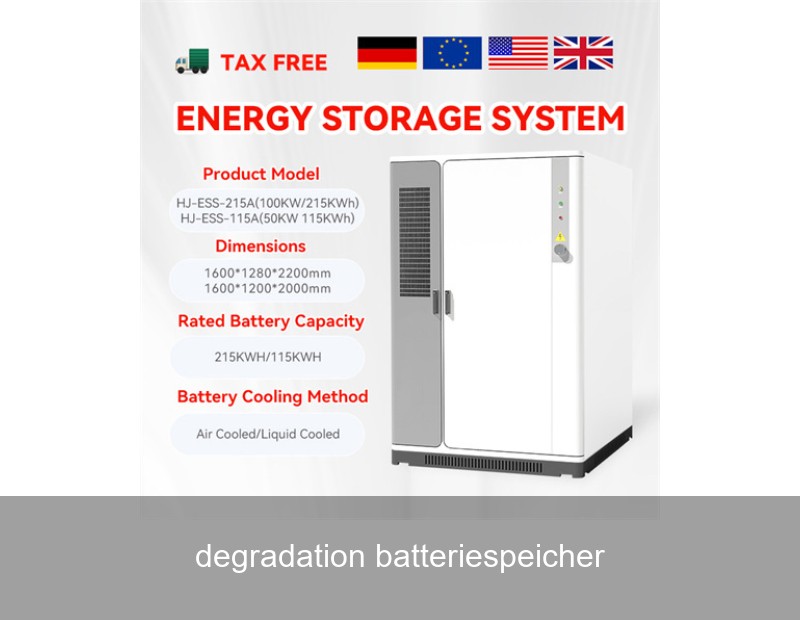
If you've invested in a solar array and a battery storage system—a Batteriespeicher—you're already ahead in the energy game. But have you ever wondered what happens to that battery over the years? You might notice a slight decrease in the amount of energy it can hold, or perhaps it doesn't seem to power your home for as long as it used to. This isn't a flaw in your system; it's a natural process called battery degradation. For homeowners and businesses across Europe and the U.S., understanding this phenomenon is key to maximizing the return on your energy investment and ensuring a reliable power supply for decades. Let's demystify battery degradation and explore how modern technology, like the solutions from Highjoule, is designed to combat it.
Table of Contents
- What is Battery Degradation?
- The Main Culprits: What Causes Batteriespeicher Degradation?
- Measuring the Impact: Capacity, Power, and Efficiency
- A Real-World Case: Grid Support in Bavaria
- How Highjoule Combats Degradation in Its Battery Systems
- Your Role: Best Practices to Maximize Your Battery's Lifespan
- The Future of Battery Longevity
What is Battery Degradation?
In simple terms, battery degradation is the gradual, irreversible loss of a battery's ability to store and deliver energy at its original performance level. Think of it like a smartphone battery. When new, it lasts a full day, but after two years, you might need to charge it by afternoon. The same principle applies to the much larger Batteriespeicher in your home or business. It's a chemical process, not a mechanical one. Over countless charge and discharge cycles, and with the passage of time, the internal materials of the battery slowly undergo physical and chemical changes that reduce their effectiveness.
The good news? The lithium-ion technology used in modern home and commercial storage systems is far more resilient than older battery types. Industry standards typically guarantee a certain performance level after 10 years. For instance, many premium batteries are warranted to retain 60-70% of their original capacity after a decade or a specified number of cycles. The goal of leading providers like Highjoule is not to eliminate degradation—that's currently impossible—but to dramatically slow it down and ensure predictable, long-term performance.
The Main Culprits: What Causes Batteriespeicher Degradation?
Degradation isn't caused by one single factor, but by a combination of stresses on the battery's chemistry. The two primary degradation modes are:
- Cyclic Aging: This results from the repeated charging and discharging of the battery. Each cycle causes tiny, irreversible changes in the battery's electrodes.
- Calendar Aging: This occurs simply due to the passage of time, even if the battery is sitting idle. Chemical reactions slowly occur within the cell, reducing its capacity.
Several key factors accelerate both aging processes:
| Factor | Impact on Degradation | Ideal Management |
|---|---|---|
| State of Charge (SoC) | Keeping a battery constantly at 100% or letting it drop to 0% creates high stress. | Operating within a moderate SoC window (e.g., 20%-90%). |
| Temperature | High temperatures are the #1 accelerator of chemical degradation reactions. | Maintaining a stable, cool operating temperature (approx. 20-25°C). |
| Charge/Discharge Rate (C-rate) | Consistently charging or discharging at very high power strains the battery. | Using a system sized correctly for the load, avoiding constant maximum power draws. |
| Depth of Discharge (DoD) | Regularly using 100% of the battery's capacity is more stressful than using 80%. | Limiting the daily Depth of Discharge through intelligent software settings. |
Measuring the Impact: Capacity, Power, and Efficiency
Degradation manifests in three measurable ways:
- Capacity Fade: The most noticeable effect. This is the reduction in the total energy (kWh) the battery can store. A 10 kWh battery with 20% capacity fade can only store 8 kWh.
- Power Fade: The battery's ability to deliver high power (kW) diminishes. This might affect its performance during short, high-demand events like starting large motors.
- Increased Internal Resistance: This leads to reduced round-trip efficiency (more energy lost as heat during charging/discharging) and can cause voltage drops under load.

Image Source: Unsplash (Representative image of battery cells)
A Real-World Case: Grid Support in Bavaria
Let's look at a concrete example from Germany. A commercial-scale battery storage system was installed at a medium-sized industrial park in Bavaria in 2018. Its primary functions were peak shaving (reducing grid power draw during expensive peak times) and providing primary frequency regulation (PFR) services to the grid—a service that requires very rapid charge and discharge responses.
The Data After 5 Years: Initial system capacity was 1 MWh/500 kW. By 2023, operational data analysis showed:
- Capacity Retention: 92% of original capacity (920 kWh remaining).
- Key Stressor: The frequent, shallow cycles for PFR services caused less degradation than anticipated, while the thermal management system kept average operating temperature at 24°C ±3°C.
- Performance Insight: The system's advanced software actively managed State of Charge to avoid high-stress zones, proving that intelligent operation is as critical as hardware quality. This aligns with findings from the National Renewable Energy Laboratory (NREL) on battery lifespan optimization.
This case demonstrates that with proper system design, thermal management, and intelligent cycling algorithms, degradation can be kept well within predictable and economically viable limits.
How Highjoule Combats Degradation in Its Battery Systems
At Highjoule, our engineering philosophy is built around longevity and total cost of ownership. We don't just sell batteries; we deliver long-term energy resilience. Our approach to minimizing Batteriespeicher degradation is multi-layered:
- Cell Selection & Grading: We source premium LiFePO4 (LFP) cells for our residential and commercial systems. LFP chemistry is inherently more stable and has a longer cycle life than other lithium-ion types. Each cell is rigorously graded to ensure consistency, preventing weaker cells from causing imbalance and accelerated aging.
- Advanced Thermal Management: Our proprietary liquid cooling system is a game-changer. Unlike simple air cooling, it maintains a uniform, optimal temperature across every cell block, effectively eliminating hot spots—the primary enemy of battery life. This system is so effective it allows our Highjoule H-Series commercial units to operate at full power in a wide ambient temperature range without derating.
- AI-Powered Battery Management System (BMS): The brain of our system. Our BMS doesn't just monitor voltage and temperature; it uses predictive algorithms to manage each cell's State of Charge and health. It actively balances cells, optimizes charge/discharge rates in real-time based on load and temperature, and prevents operations in high-stress zones, all to extend service life.
- Warranty Backed by Data: Our confidence in this technology is reflected in our warranties. For example, our residential EcoHome 10 battery is warranted to retain 70% of its nominal capacity after 10 years or 10,000 cycles, providing our customers in Europe and the U.S. with clear, long-term performance expectations.

Image Source: Unsplash (Representative image of a large-scale BESS)
Your Role: Best Practices to Maximize Your Battery's Lifespan
While the technology does the heavy lifting, your system settings and usage patterns play a supporting role. Here’s what you can do:
- Trust the Defaults: Highjoule systems are pre-configured with optimal charge/discharge limits. Avoid setting your system to constantly "max out" at 100% charge or drain to 0% unless absolutely necessary for emergency backup.
- Ensure Proper Installation: A well-ventilated, temperature-controlled location (like a garage or utility room) is crucial. This allows the built-in thermal management system to work most efficiently.
- Leverage Smart Modes: Use smart, grid-interactive modes like "Time-Based Control." These modes are designed to optimize cycles for economic benefit and battery health, avoiding unnecessary shallow cycles.
- Review System Reports: Regularly check your system's dashboard via the Highjoule app. Monitor long-term capacity trends and overall health metrics. Proactive awareness is key.
For more on general battery science, reputable resources like the U.S. Department of Energy's Battery FAQs provide excellent background.
The Future of Battery Longevity
Research is continuously pushing the boundaries. Solid-state batteries, improved electrolyte additives, and even more sophisticated AI-driven health prediction models are on the horizon. The industry goal is to create a Batteriespeicher that not only lasts the lifetime of your solar panels (25+ years) but does so with minimal capacity loss. At Highjoule, our R&D team is actively engaged in these advancements, ensuring our future products deliver even greater sustainability and value.
Ready to Invest in a Storage System Built for the Long Haul?
Choosing an energy storage system is a significant decision. When you evaluate options, the conversation must go beyond upfront cost and peak power. The true question is: How will this system perform, and what will it be worth, in year 10 and beyond? We invite you to explore the detailed specifications of our EcoHome and H-Series products and speak with our energy consultants. What specific energy resilience goals are you hoping to achieve for your home or business over the next decade?
 Inquiry
 Online Chat