


Crystalline Silicon Photovoltaic Modules: The Workhorse of Solar Energy Explained
You see them on rooftops, in vast solar farms, and powering remote installations worldwide. Crystalline silicon photovoltaic modules are, without a doubt, the undisputed champions of the solar revolution. But what exactly makes this technology so dominant, and how can you ensure you're getting the most out of your solar investment? This article dives deep into the science, performance, and real-world application of these ubiquitous solar panels, exploring how they pair with modern energy storage to create truly resilient and efficient power systems.
Table of Contents
- What Are Crystalline Silicon Photovoltaic Modules?
- Why Do They Dominate the Market? The Data Speaks
- Real-World Performance: A Case Study from Germany
- Beyond Generation: The Critical Role of Energy Storage
- Future Trends & Your Energy Independence
What Are Crystalline Silicon Photovoltaic Modules?
Let's break down the name. Crystalline silicon refers to the structured, lattice-like form of silicon used as the semiconductor material. Photovoltaic means the conversion of light (photo) into electricity (voltaic). A module is the finished, weatherproof panel you install. Essentially, these modules are made from silicon cells that absorb sunlight, knocking electrons loose to create a flow of direct current (DC) electricity.
There are two main types you'll encounter:
- Monocrystalline Silicon: Made from a single, pure crystal structure. They are typically more efficient (often 20% and above) and have a uniform dark appearance.
- Polycrystalline Silicon: Made from fragments of silicon crystals melted together. Slightly less efficient (typically 15-17%) with a blue, speckled look, but often more cost-effective.
Both types have proven to be incredibly reliable, with most manufacturers offering performance warranties of 25 years or more. Their longevity is a key reason they've become the default choice for both residential and utility-scale projects across Europe and the United States.
Why Do They Dominate the Market? The Data Speaks
The phenomenon is clear: crystalline silicon technology commands over 95% of the global solar market share. The reasons are rooted in a powerful combination of physics, economics, and decades of refinement.
First, silicon is abundant—it's the second most abundant element in the Earth's crust. This has allowed for massive scale manufacturing, driving costs down an incredible 90% over the last decade. Second, the efficiency has steadily climbed. While laboratory records push beyond 26%, commercial modules now reliably deliver efficiencies that make rooftop solar a no-brainer for millions of homeowners and businesses.
But here's a crucial insight many overlook: High module efficiency is just the starting point. The true measure of a solar power system is the amount of usable electricity it delivers to your appliances, day and night. This is where system design and integration become paramount. A top-tier crystalline silicon module will underperform if paired with a poor inverter or, more importantly, without a strategy for managing its intermittent output.

Image: A close-up view of modern crystalline silicon photovoltaic modules on a rooftop. Source: Unsplash
Real-World Performance: A Case Study from Germany
Let's look at concrete data. A 2022 analysis by the Fraunhofer Institute for Solar Energy Systems (ISE) tracked a 50 MW solar farm in Bavaria using high-efficiency monocrystalline modules. The system achieved an average annual yield of 1,150 kWh per installed kWp. However, the study highlighted a critical challenge: over 60% of the generation occurred during a 6-hour midday window, often exceeding local grid demand and leading to curtailment (wasted energy).
This "duck curve" phenomenon is common in markets with high solar penetration. The solution isn't less solar—it's smarter energy management. The farm's operators integrated a large-scale battery energy storage system (BESS). This storage captured the midday surplus and discharged it during the evening peak, increasing the system's usable output by 35% and significantly improving grid stability and project economics.
This case perfectly illustrates the next evolution in solar: moving from simple generation to intelligent, dispatchable power plants. This is precisely where Highjoule's expertise transforms a good solar investment into a great one. Our IntelliBESS commercial storage systems are engineered to seamlessly integrate with crystalline silicon photovoltaic arrays, optimizing self-consumption, providing backup power, and enabling advanced grid services.
Beyond Generation: The Critical Role of Energy Storage
So, you've chosen high-quality crystalline silicon photovoltaic modules. What's next? To unlock their full potential, pairing them with intelligent storage is no longer a luxury—it's a strategic necessity. Think of it this way: your solar panels are an excellent source of income (energy), but without a bank (battery), you can't save for a rainy day—or a cloudy evening.
Highjoule specializes in this synergy. Our product suite is designed to make solar power reliable and controllable:
- Residential PowerStack Series: Scalable lithium-ion battery systems that work with any inverter, allowing homeowners to store excess solar energy and achieve true energy independence.
- Commercial & Industrial IntelliBESS: Containerized or modular storage solutions that manage energy demand, reduce peak charges, and provide backup power for businesses, directly enhancing the ROI of their solar installations.
- Microgrid Controllers: The "brain" that orchestrates solar, storage, and other distributed energy resources to create resilient off-grid or grid-tied community power systems.
By integrating a Highjoule storage system, the value proposition of your crystalline silicon modules shifts dramatically. You're not just exporting power at low rates; you're using it on your terms, protecting against outages, and stabilizing the wider grid.

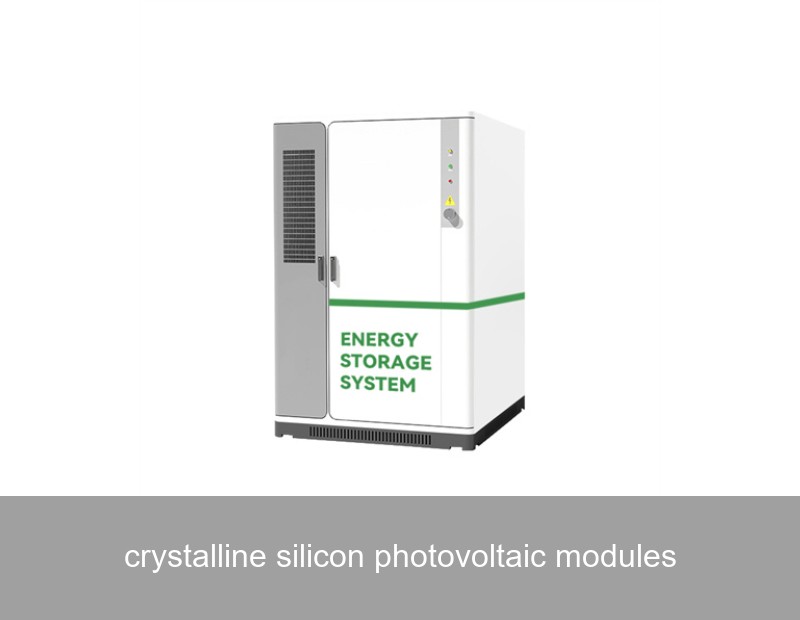
Image: A Highjoule IntelliBESS containerized storage system enables reliable solar power usage. Source: Unsplash
Future Trends & Your Energy Independence
The technology of crystalline silicon photovoltaic modules continues to advance. We're seeing trends like half-cut cells, bifacial modules (which capture light from both sides), and advanced passivating contacts that push efficiencies even higher. According to the National Renewable Energy Laboratory (NREL), these incremental improvements will continue to drive performance gains for years to come.
However, the most significant leap will come from how we system-integrate these modules. The future is in smart, self-optimizing energy ecosystems. Imagine a system where your rooftop solar, your home battery, your EV charger, and even your major appliances communicate in real-time to maximize efficiency and cost savings. This isn't science fiction; it's the direction of the industry, and it's built on the reliable foundation of crystalline silicon generation paired with sophisticated storage and controls.
As a global leader founded in 2005, Highjoule is at the forefront of this integration. We don't just sell batteries; we provide complete, intelligent power solutions that ensure the excellent DC energy produced by your photovoltaic modules is converted into reliable, usable AC power whenever and wherever you need it.
Your journey with solar energy is unique. What specific challenge—be it rising energy costs, backup power concerns, or sustainability goals—is motivating you to look at crystalline silicon photovoltaic modules today, and how do you envision storage playing a role in your solution?
 Inquiry
 Online Chat