


How to Calculate Solar Panel Capacity for Your Home: A Practical Guide
Thinking about harnessing the sun's power for your home? You're not alone. Across Europe and the US, homeowners are increasingly turning to solar energy to reduce electricity bills, gain energy independence, and contribute to a sustainable future. But the first, and perhaps most crucial, step is answering a fundamental question: How do I calculate the solar panel capacity I need for my home? It's not about simply covering your roof with panels. It's about a precise calculation that balances your energy needs, your location's solar potential, and your long-term goals. Let's demystify the process together.
Table of Contents
What Does "Solar Panel Capacity" Really Mean?
When we talk about calculating solar panel capacity for a home, we're primarily referring to the size of the solar photovoltaic (PV) system, measured in kilowatts (kW). A 5 kW system, for instance, under ideal conditions (bright midday sun), will generate 5 kilowatts of electricity at that moment. However, the more important figure for your calculations is kilowatt-hours (kWh) – the unit of energy your system produces over time, which is what your utility company bills you for.
Think of it this way: Capacity (kW) is the size of the engine, while energy production (kWh) is the distance you travel. Your goal is to size the engine correctly to cover your daily travel distance (energy consumption) given the road conditions (sunlight at your location).
Key Factors in Your Solar Calculation
Accurately calculating your required solar panel capacity isn't guesswork. It hinges on several concrete data points:
- Your Annual Electricity Consumption: This is your starting point. Gather 12 months of utility bills to find your average monthly kWh usage. A typical US home uses about 10,632 kWh per year (approx. 886 kWh/month), while European averages vary significantly by country.
- Your Location's Solar Resource (Peak Sun Hours): Not all sunlight is equal. A "peak sun hour" equals one hour of sunlight at 1,000 watts per square meter. Southern Spain or California gets far more peak sun hours than Northern Germany or Seattle. Resources like the Global Solar Atlas provide precise data for your address.
- Roof Characteristics: The direction (south-facing is ideal in the Northern Hemisphere), tilt angle, and any shading from trees or chimneys dramatically impact production.
- System Efficiency and Losses: Inverters, wiring, dust, and temperature cause energy losses. Professionals typically factor in a 10-20% buffer.
- Your Future Goals: Are you planning an electric vehicle, a heat pump, or simply aiming to offset 100% of your current bill?

Image: Proper roof assessment is critical for an accurate solar capacity calculation. Credit: Unsplash.
Step-by-Step Guide to Calculate Your Needs
Let's put this into a simple, actionable formula. Here’s a basic method to estimate the solar panel system capacity you need:
| Step | Action | Example Calculation |
|---|---|---|
| 1. Find Daily Energy Need | Annual kWh usage ÷ 365 days | 10,632 kWh ÷ 365 = 29.1 kWh/day |
| 2. Find Daily Peak Sun Hours | Use solar data for your city (e.g., from NREL or EU databases) | For Munich, Germany: ~ 3.2 hours |
| 3. Calculate Raw System Size | Daily kWh need ÷ Peak Sun Hours | 29.1 kWh ÷ 3.2 h = 9.1 kW |
| 4. Adjust for System Losses (~20%) | Raw Size ÷ (1 - 0.20) | 9.1 kW ÷ 0.8 = ~11.4 kW |
This simplified calculation suggests a home in Munich with average US consumption would need roughly an 11.4 kW solar panel system to meet its annual energy needs. The final number of panels depends on their individual wattage (e.g., 400W panels would require 29 panels: 11,400W / 400W).
A Real-World Case Study: The Smith Residence, California
Let's look at concrete data. The Smith family in Sacramento, CA, wanted energy independence. Their annual consumption was 12,500 kWh. Sacramento enjoys about 5.2 peak sun hours daily on average.
- Daily Need: 12,500 kWh / 365 = 34.2 kWh
- Raw System Size: 34.2 kWh / 5.2 h = 6.6 kW
- Adjusted for Losses: 6.6 kW / 0.8 = 8.25 kW System
They installed an 8.5 kW system with 21 high-efficiency panels. In its first year, it produced 13,100 kWh, exceeding their needs and allowing them to earn credits through net metering. Their key to success? They paired their solar array with a battery storage system from the outset. This allowed them to store excess daytime energy to power their home in the evening, maximizing self-consumption and providing critical backup during the region's public safety power shutoffs.
Thinking Beyond Panels: The Role of Energy Storage
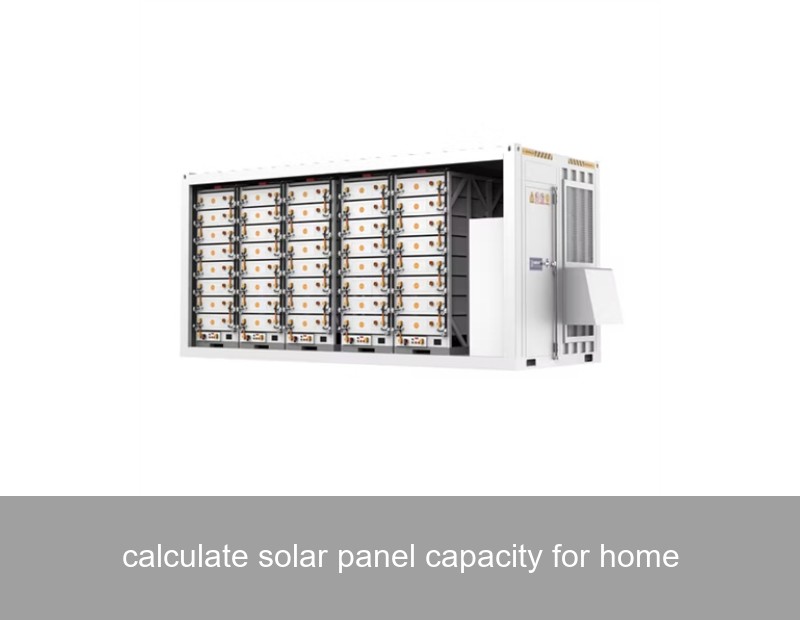
This brings us to a vital modern consideration. Simply calculating solar panel capacity for your home is no longer the whole story. To truly maximize your investment and achieve resilience, integrating an advanced battery energy storage system (BESS) is becoming the new standard. Why?
- Maximizes Self-Consumption: Store your surplus solar energy instead of selling it back to the grid at low rates, using it when the sun isn't shining.
- Provides Backup Power: Keeps essential loads running during grid outages—a growing concern in many regions.
- Enables Time-of-Use Optimization: In areas with variable electricity pricing, store energy when it's cheap (from your panels or the grid) and use it when rates are high.
When you calculate your solar needs, consider what percentage of your nighttime and outage energy usage you also want to cover. This will determine the capacity of the battery storage you need alongside your solar panels.
Highjoule's Tailored Solutions: From Calculation to Complete System
This is where Highjoule, as a global leader in advanced energy storage since 2005, adds immense value. We understand that calculating solar panel capacity is just the first step in a journey towards a smarter, more resilient home energy ecosystem.
Our approach goes beyond just selling hardware. We offer comprehensive energy assessments that analyze your historical consumption, local weather patterns, and future goals to provide a precise system sizing recommendation—for both solar and storage. Our HES Series of residential battery systems are designed to seamlessly integrate with new or existing solar installations. With intelligent energy management software, our systems don't just store power; they optimize its flow, ensuring you get the most out of every kilowatt-hour your panels produce.
For homeowners who want a truly turnkey solution, Highjoule partners with certified installers across Europe and North America to deliver and commission integrated solar-plus-storage systems. We ensure that the theoretical capacity you calculate performs optimally in the real world, on your specific roof, and for your unique lifestyle.

Image: A modern home energy storage unit, like those in Highjoule's HES Series, installed in a residential garage. Credit: Pexels.
Your Next Step Towards Energy Independence
You've now got the framework to start calculating the solar panel capacity for your home. You've seen the factors at play and understood why pairing solar with storage is the intelligent path forward. But the most accurate calculation will always come from a personalized analysis of your home and needs.
So, here's our question for you: What's the primary driver for your solar exploration—is it reducing your next electricity bill, ensuring your family's comfort during a storm, or taking a definitive step towards a sustainable household? Understanding your "why" is the most important part of the equation.
 Inquiry
 Online Chat