


Baterie Solarni for Sale: Your Ultimate Guide to Solar Batteries in 2024
You've seen your electricity bills climb, you're aware of grid instability, and you've likely already considered solar panels. But there's a crucial piece missing in the quest for true energy independence: the solar battery. If you're searching for "baterie solarni for sale", you're on the right path to unlocking the full potential of your renewable energy system. This guide will demystify solar batteries, helping you understand not just what to buy, but why and how the right choice can transform your energy profile.
Table of Contents
- What is a Solar Battery? Beyond Simple Storage
- Key Metrics: How to Compare Baterie Solarni for Sale
- Market Trends: Why Europe and the US Are Rapidly Adopting Storage
- A Real-World Case Study: Resilience in Practice
- Choosing Your System: Integration is Everything
- Highjoule's Smart Solutions: Engineered for Performance
- Your Next Step Towards Energy Autonomy
What is a Solar Battery? Beyond Simple Storage
Think of a solar battery not just as a tank for your solar energy, but as the intelligent manager of your personal microgrid. When your panels produce more electricity than your home or business consumes, instead of sending it all back to the grid for minimal compensation, a baterie solarni stores that excess. You then use it at night, during peak tariff hours, or when the grid fails. This simple shift—from export to self-use—is the cornerstone of modern energy economics and resilience.
The Core Benefit: Control
The primary driver for purchasing a solar battery is regaining control. Control over costs, by maximizing self-consumption of cheap solar power. Control over reliability, by having backup power during outages. And control over your carbon footprint, by relying more on your own clean generation.
Key Metrics: How to Compare Baterie Solarni for Sale
Not all batteries are created equal. When evaluating options, look beyond just price and capacity.
| Metric | What It Means | Why It Matters |
|---|---|---|
| Usable Capacity (kWh) | The actual amount of energy you can store and use. | Determines how long you can power your essential loads during an outage or at night. |
| Power Rating (kW) | The rate at which the battery can deliver electricity. | Defines how many appliances you can run simultaneously. A high power rating is crucial for starting heavy loads like pumps or air conditioners. |
| Round-Trip Efficiency (%) | The percentage of energy put into the battery that you can get back out. | Higher efficiency (e.g., 95%+) means less energy is lost as heat, giving you more value from every solar kilowatt-hour. |
| Depth of Discharge (DoD) | The percentage of the battery's capacity that can be safely used. | A 90% DoD means you can use 90% of the rated capacity without significantly harming battery life. |
| Cycles & Warranty | The number of charge/discharge cycles or years the battery is guaranteed for. | This is a key indicator of longevity and total value. Look for warranties that guarantee a high percentage of capacity retention (e.g., 70%) after 10 years. |
Market Trends: Why Europe and the US Are Rapidly Adopting Storage
The demand for baterie solarni for sale is skyrocketing, and it's not without reason. In Europe, soaring natural gas prices and a strong political push for energy sovereignty post-2022 have made storage a strategic investment. In the US, the Inflation Reduction Act (IRA) offers a direct 30% federal tax credit for qualifying battery installations, even if they're added to existing solar arrays. Furthermore, utilities are shifting to time-of-use (TOU) rates, making it financially savvy to avoid grid power during expensive peak periods.
According to the International Energy Agency (IEA), global energy storage capacity is set to multiply exponentially this decade, with residential and commercial segments leading the charge in mature markets.

A modern home energy system integrates solar generation with wall-mounted battery storage for seamless backup.
A Real-World Case Study: Resilience in Practice
Let's move from theory to a concrete example. Consider a medium-sized winery in Northern California, a region prone to seasonal wildfires and utility-initiated Public Safety Power Shutoffs (PSPS).
- Problem: Multi-day grid outages threatened to halt refrigeration, spoiling valuable inventory and disrupting business entirely.
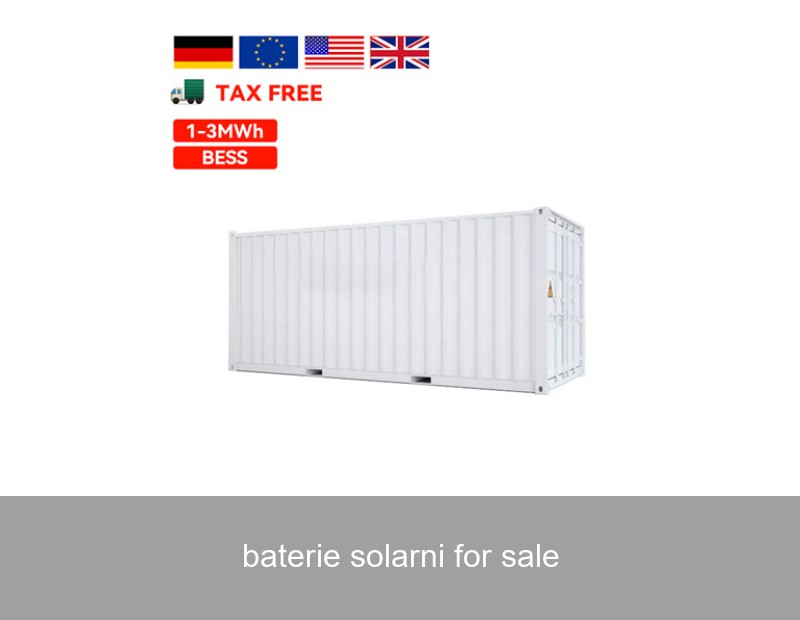
- Solution: The winery installed a 250 kW solar canopy paired with a 500 kWh containerized battery energy storage system (BESS).
- Outcome: During a 60-hour PSPS event, the system kept critical refrigeration and facility operations running entirely on solar and stored power. The winery not only avoided tens of thousands in potential loss but continued limited operations. The system paid for itself in avoided losses and demand charge savings in under 4 years.
This case underscores that a baterie solarni is not just a residential product; it's a critical business continuity asset for commercial and industrial operations.
Choosing Your System: Integration is Everything
The battery itself is only one component. Its integration with your solar inverter is paramount. You primarily have three choices:
- AC-Coupled Systems: The battery has its own inverter. This is often ideal for retrofitting to existing solar systems, as it offers great flexibility.
- DC-Coupled Systems: The battery is connected on the DC side of the solar inverter, which can be slightly more efficient for new installations.
- Hybrid Inverter Systems: A single unit manages both solar production and battery charging/discharging, simplifying the setup.
The "best" choice depends entirely on your specific context: new build vs. retrofit, budget, and desired features.
Highjoule's Smart Solutions: Engineered for Performance
At Highjoule, with nearly two decades of experience since 2005, we understand that every energy profile is unique. Our approach goes beyond simply offering baterie solarni for sale. We provide intelligent, integrated storage solutions designed for durability, safety, and maximum return on investment.
Our Product Ecosystem
- Residential H-Joule HomeStack: A modular lithium iron phosphate (LFP) battery system known for its exceptional safety and long cycle life. With a compact design and high power output, it can seamlessly back up essential home circuits or, when stacked, the entire household. Its smart energy management software learns your usage patterns to optimize self-consumption.
- Commercial & Industrial H-Joule PowerStore: Scalable containerized or skid-mounted BESS solutions. These systems are engineered to tackle demanding applications like peak shaving, demand charge reduction, and backup power for facilities like factories, data centers, and agricultural operations. They feature advanced thermal management and grid-forming capabilities.
- Microgrid Controllers: The true brain behind complex systems. For projects involving multiple generation sources (solar, wind, generator) and storage, our controllers ensure optimal, stable, and autonomous operation, whether grid-connected or islanded.
Our systems are designed with the European and North American markets in mind, complying with stringent safety standards like UL 9540 and IEC 62619, and are compatible with a wide range of major inverter brands.

Industrial-scale battery storage solutions, like Highjoule's PowerStore, provide critical power management for businesses and communities.
Why Highjoule Stands Out
Our expertise lies in system-level thinking. We don't just sell hardware; we provide a complete service—from initial energy analysis and financial modeling to system design, commissioning, and remote monitoring. Our batteries are built with a focus on cycle life and real-world performance under diverse climatic conditions, ensuring they deliver value for decades. For a deeper dive into battery chemistry and safety, resources like the U.S. Department of Energy provide excellent foundational knowledge.
Your Next Step Towards Energy Autonomy
The journey to finding the right baterie solarni for sale starts with asking the right questions. What are your non-negotiable loads during a power outage? What does your daily and seasonal energy consumption curve look like? How does your utility bill you—are there demand charges or unfavorable net metering policies?
The market is full of options, but the optimal solution is one tailored to your specific energy fingerprint. What single energy challenge—be it cost, reliability, or sustainability—is most urgent for you to solve in the next 12 months?
 Inquiry
 Online Chat