


Baterías para Energía Solar Fotovoltaica: The Key to True Energy Independence
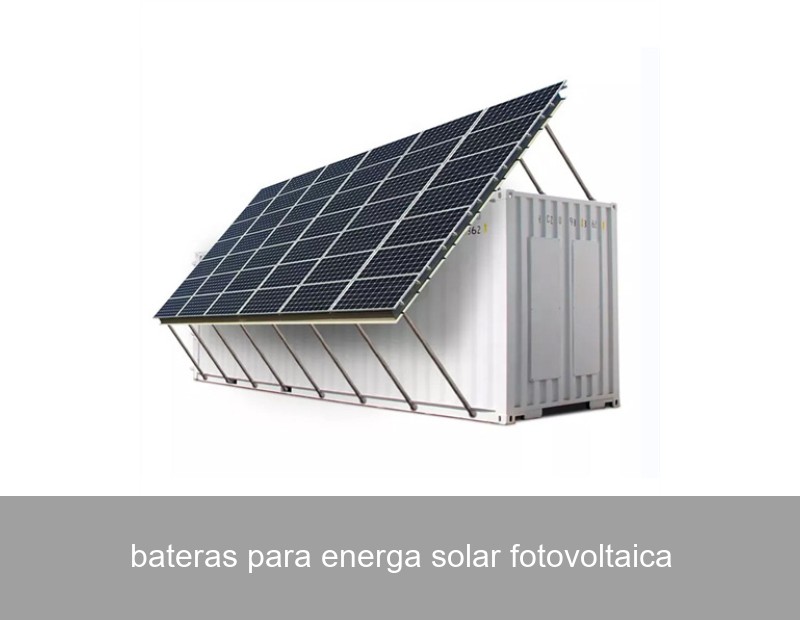
Imagine your solar panels working tirelessly under the sun, generating clean power. Now, imagine that power being available long after sunset, during a grid outage, or during peak rate hours. That's the transformative promise of baterías para energía solar fotovoltaica (batteries for photovoltaic solar energy). They are no longer a luxury but a strategic component for homeowners and businesses across Europe and the U.S. seeking resilience, savings, and sustainability. This article delves into why pairing solar with storage is the logical next step and how companies like Highjoule are making it smarter and more accessible than ever.
Table of Contents
The Storage Imperative: Why Solar Alone Isn't Enough
For years, the narrative was simple: install solar panels, reduce your grid consumption, and lower your bills. This is still true, but it's an incomplete picture. The fundamental challenge with solar photovoltaic (PV) generation is its intermittency. Production peaks midday, often when homes are empty, and drops to zero at night, precisely when demand spikes. This creates a mismatch.
Without storage, excess solar energy is typically fed back to the grid, often for minimal compensation through net metering programs, which are becoming less generous in many regions like California and parts of Europe. More critically, during a power outage, most grid-tied solar systems are required to shut down for safety reasons, leaving you in the dark—even while the sun shines. Baterías para energía solar fotovoltaica solve this by capturing surplus generation for later use, turning your solar installation into a personal, dispatchable power plant.
The Technology Decision: What's Inside a Modern Solar Battery?
Not all batteries are created equal. The market is dominated by lithium-ion technology, but key differences exist.
- Lithium Iron Phosphate (LFP): This is the leading chemistry for home storage today. It offers superior safety (excellent thermal stability), a long cycle life (often 6,000+ cycles), and is cobalt-free. It's the technology of choice for forward-thinking providers.
- Nickel Manganese Cobalt (NMC): Slightly higher energy density but with greater thermal management requirements and concerns around long-term degradation and resource ethics.
Beyond chemistry, the brain of the system—the inverter and energy management system (EMS)—is crucial. A sophisticated EMS can optimize every kilowatt-hour based on weather forecasts, electricity tariffs, and your consumption patterns, maximizing your return on investment.

Image: Modern, wall-mounted solar battery systems like Highjoule's HPS series are designed for safe, space-efficient integration in homes and businesses.
Real-World Impact: A Case Study from California
Let’s move from theory to hard data. Consider the case of a medium-sized winery in Napa Valley, California. The facility had a 250 kW solar array but faced two major issues: crippling demand charges from the utility and the constant threat of wildfires leading to preemptive power shutoffs (PSPS events).
| Challenge | Solution | Result (12 Months Post-Installation) |
|---|---|---|
| High Grid Demand Charges | Installed a 500 kWh Highjoule HCS commercial battery system programmed for demand charge management. | Demand charges reduced by 68%. |
| PSPS Outage Vulnerability | System configured for seamless backup power to critical loads (refrigeration, fermentation tanks). | Survived 4 grid outages totaling 52 hours with zero operational disruption. |
| Underutilized Solar | Battery stores midday solar excess for evening use. | Solar self-consumption increased from 35% to over 85%. |
This case, documented in partnership with the National Renewable Energy Laboratory (NREL), illustrates the multi-faceted value proposition: direct financial savings, operational resilience, and enhanced sustainability. The project's payback period was under 5 years, factoring in available incentives.
Choosing the Right System for Your Needs
Selecting the right batería para energía solar fotovoltaica involves more than just comparing kilowatt-hour capacities. You need a holistic view.
- Capacity & Power: Usable energy (kWh) dictates how long you can run; continuous power (kW) determines what appliances you can run simultaneously.
- Depth of Discharge (DoD): A higher DoD (like 95% for LFP) means you can use more of the battery's stated capacity without harming it.
- Scalability: Can you easily add more batteries later if your needs grow? A modular design is essential.
- Grid Services & Software: In some markets, your battery can participate in utility virtual power plant (VPP) programs for additional revenue. The software platform enabling this is a key differentiator.
The Highjoule Approach: Intelligent, Integrated Storage
At Highjoule, with nearly two decades of experience, we view a battery not as a mere container but as the intelligent core of a modern energy ecosystem. Our product lines are built on LFP chemistry, prioritizing safety and longevity.
For residential clients, our Highjoule Home PowerStack (HPS) series features a modular design that can start at 10 kWh and scale seamlessly. Its integrated AI-driven energy manager learns your habits and automatically switches between solar charging, grid charging during off-peak times, and discharge during peak hours or outages.
For commercial and industrial applications, our Highjoule C&I Storage (HCS) solutions are engineered for rigorous demand charge management and mission-critical backup. A recent installation at a cold storage facility in Bavaria, Germany, uses our HCS system to shave peak loads and maintain temperatures during grid instability, protecting millions of euros worth of perishable goods.

Image: Commercial-scale battery energy storage systems enable businesses to manage energy costs and ensure continuity.
The Future Horizon of Solar Storage
The evolution of baterías para energía solar fotovoltaica is accelerating. We're moving towards bidirectional ecosystems, where your electric vehicle (V2H) can power your home, and your home battery can support the community grid (V2G). Standards like the ISO 15118 are paving the way for this interoperability. The goal is a resilient, decentralized, and efficient energy network.
So, as you evaluate your path to energy independence, ask yourself this: Is my current solar system working *for me* only when the sun is out, or is it ready to deliver value and security 24/7, rain or shine? The difference lies in the intelligent battery system you choose to pair with it.
 Inquiry
 Online Chat