


Your Home's Silent Guardian: The Modern Backup Power Bank for Home
a storm knocks out the grid just as you're about to start dinner, your home office router blinks off, and the fridge falls silent. This scenario, once a rare inconvenience, is becoming a more frequent reality for homeowners in both Europe and the US. From extreme weather events straining aging infrastructure to the exciting shift towards renewable energy, the need for reliable home power has never been greater. This is where the humble "backup power" concept gets a 21st-century upgrade: the intelligent backup power bank for home. Far more than a simple generator, these modern battery energy storage systems (BESS) are the cornerstone of a resilient, efficient, and sustainable household.
Table of Contents
- The New Normal: Why Home Power Resilience is No Longer Optional
- Beyond Generators: How a Home Battery System Works
- Key Benefits of an Integrated Home Energy Bank
- A Real-World Case: The Schmidt Family in Bavaria
- Choosing Your System: What to Look For
- The Highjoule Solution: Engineered for Peace of Mind
- Your Home's Energy Future: What's the First Step?
The New Normal: Why Home Power Resilience is No Longer Optional
Let's look at the data. In the United States, power outage frequency and duration have been increasing. According to a report from the U.S. Energy Information Administration (EIA), the average U.S. electricity customer experienced just over eight hours of interruptions in 2020. More tellingly, major events—like severe storms—are the primary drivers. Similarly in Europe, grid stability faces challenges from heatwaves, floods, and the rapid integration of variable renewable sources. The phenomenon is clear: grid vulnerability is a growing concern.
Simultaneously, a powerful counter-trend is emerging: the rise of rooftop solar. Homeowners are becoming prosumers—both producing and consuming energy. But solar panels only generate when the sun shines. Without a way to store that excess midday energy, you're still vulnerable at night or during cloudy outages. This gap between production and consumption creates the perfect use case for a dedicated backup power bank for home use.
Beyond Generators: How a Home Battery System Works
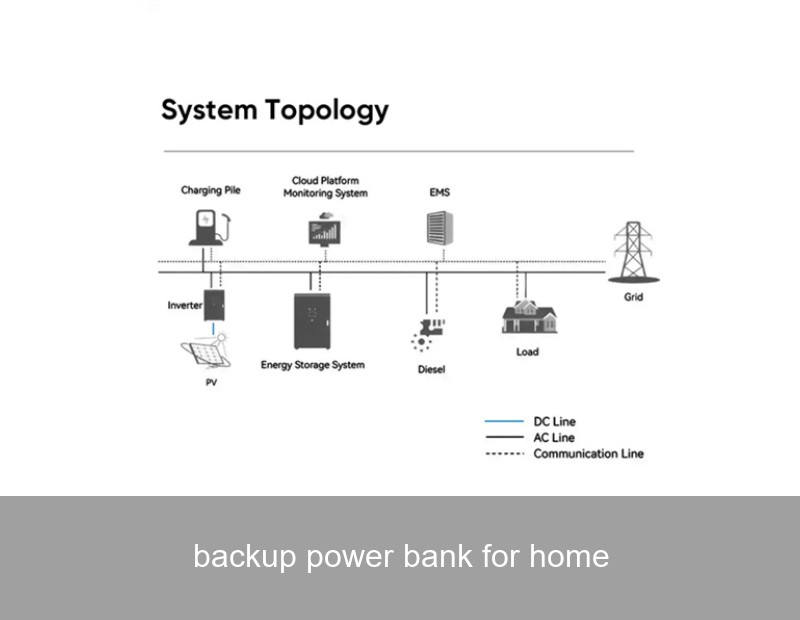
Think of a modern home battery system as a sophisticated, automated energy savings account for your house. Here’s the basic architecture:
- The Battery Pack: The core, typically using Lithium Iron Phosphate (LiFePO4) chemistry for its safety, longevity, and stability.
- The Inverter/Charger: The brain. It converts DC power from the battery or solar panels to AC for your home, and vice-versa for charging.
- The Energy Management System (EMS): The intelligence. This software decides when to store energy, when to power your home, and when to draw from the grid, optimizing for cost or resilience.

Image Source: Unsplash - A modern, wall-mounted home battery system.
Unlike noisy, fuel-dependent fossil fuel generators that must be manually started, a home battery backup is silent, instant, and automatic. When the grid fails, the system islanding function kicks in within milliseconds—often so fast that your computers and lights won't even flicker.
Key Benefits of an Integrated Home Energy Bank
Investing in a home battery system delivers a multi-layered return:
| Benefit | Description | Impact |
|---|---|---|
| Uninterrupted Power Supply (UPS) | Keeps critical loads (fridge, lights, internet, medical equipment) running during outages. | Safety, comfort, and continuity of work/study. |
| Solar Self-Consumption Optimization | Stores excess solar energy for use later, instead of selling it cheaply to the grid. | Can increase the use of your own solar power from ~30% to 70% or more. |
| Bill Management & Load Shifting | Uses stored battery power during peak evening rate periods when grid electricity is most expensive. | Significant reduction in monthly utility bills. |
| Grid Support & Sustainability | Reduces strain on the public grid during peak times, supporting the broader energy transition. | Contributes to a more stable and greener community grid. |
A Real-World Case: The Schmidt Family in Bavaria
Let's make this tangible. The Schmidt family, living in a detached house in Bavaria, Germany, installed a 10 kWp solar array in 2020. They were frustrated that most of their solar energy was exported to the grid while they still bought expensive power at night. In early 2023, they decided to integrate a backup power bank for home resilience and efficiency.
Their System: They added a 13.8 kWh battery storage system to their existing solar setup. The system was configured to guarantee backup power for essential circuits (kitchen, home office, heating circulation pump, and lighting).
One-Year Results:
- Self-Consumption Rate: Increased from 35% to 82%.
- Grid Independence During Outage: In December 2023, a winter storm caused a 14-hour local blackout. The family's home battery seamlessly powered their essential loads for the entire duration without interruption.
- Financial Impact: Their annual electricity procurement costs from the grid dropped by approximately 65%. Combined with the security during the outage, the ROI projection improved significantly.
This case underscores the dual value proposition: economic gain through intelligent energy management and priceless peace of mind during emergencies.
Choosing Your System: What to Look For
Not all home battery solutions are created equal. When evaluating a backup power bank for home, consider these critical factors:
- Usable Capacity & Power Rating: Capacity (kWh) tells you how much energy is stored; Power (kW) tells you how much it can deliver at once. Ensure it can start motors (like your fridge compressor) and run multiple devices simultaneously.
- Depth of Discharge (DoD) & Warranty: A battery with a 90% DoD and a 10-year warranty (with a guaranteed end-of-warranty capacity) offers far more long-term value than one with a 70% DoD.
- Scalability & Integration: Can you easily add more battery modules later? Does it seamlessly integrate with both new and existing solar installations?
- Software & Monitoring: The intelligence is key. Look for user-friendly apps that allow you to monitor production, consumption, storage, and set preferences (e.g., "Storm Watch" mode).
The Highjoule Solution: Engineered for Peace of Mind
At Highjoule, with nearly two decades of expertise in advanced energy storage, we've engineered our ResiCore Home Energy System to meet and exceed these exact criteria. We understand that a backup power bank for home isn't just a product—it's a vital part of your home's infrastructure.
The Highjoule ResiCore system is built around our proprietary, market-proven LiFePO4 battery modules. We focus on:
- Safety by Design: Our battery chemistry is inherently non-combustible, and each module features integrated, multi-layered protection systems.
- Adaptable Resilience: With modular capacities from 10 kWh to over 30 kWh, the system can be tailored to your home's specific needs and expanded over time. Our hybrid inverters provide instant, automatic backup power the moment the grid fails.
- Intelligent Energy Arbitrage: Our AI-driven energy management software doesn't just react—it learns. It forecasts weather and your consumption patterns to optimize when to charge from solar or the grid (during low-cost periods) and when to discharge, maximizing your savings and self-sufficiency.
- Global Support: Whether you're in suburban Texas or the German countryside, our network of certified installers and our robust remote monitoring platform ensure your system performs optimally for years to come.

Image Source: Unsplash - Homeowner monitoring their home energy storage system.
Your Home's Energy Future: What's the First Step?
The transition from a passive electricity consumer to an empowered, resilient prosumer is more accessible than ever. The technology is proven, the economic case is strengthening, and the need for reliability is clear. Your home's energy system should be as smart and dependable as the other technology in your life.
So, we leave you with this question to ponder: What would uninterrupted power protection for your essential home loads, coupled with significantly lower energy bills, allow you to achieve, create, or stop worrying about starting today?
 Inquiry
 Online Chat