


Beyond the Brand: A Deep Dive into Choosing the Right Inverter Company for Your Energy Future
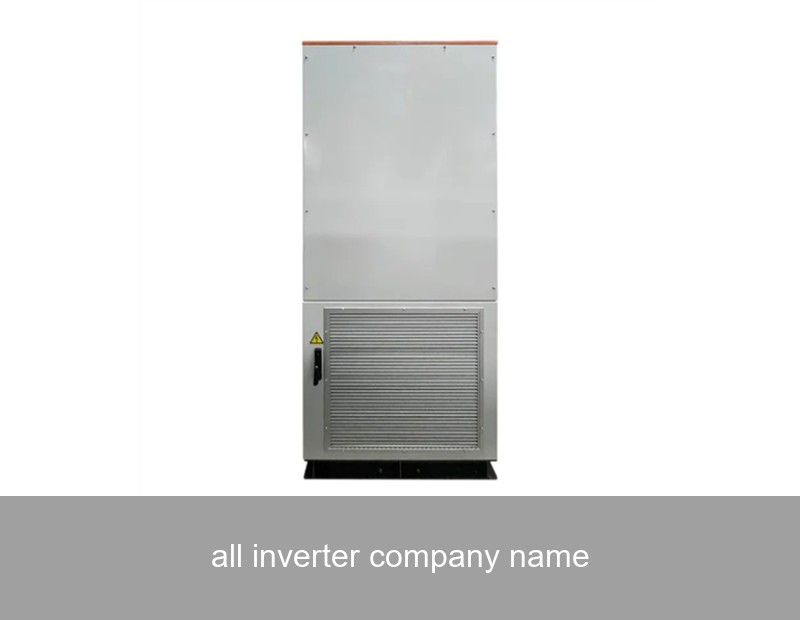
When planning a solar and storage installation, homeowners and businesses alike often start by searching for an all inverter company name list. Names like Fronius, SMA, SolarEdge, and Huawei dominate search results. But here’s an insight we’ve gained from nearly two decades at Highjoule: focusing solely on the inverter brand is like choosing a computer based only on the processor. The CPU is vital, but it's the overall system design, software, and integration that determine real-world performance and value. The right inverter company provides more than a component; it delivers the intelligence that transforms sunlight and batteries into reliable, efficient, and economical power for your home or business.
What is an Inverter and Why is it the Brain of Your Solar System?
At its core, an inverter’s job seems simple: convert the direct current (DC) electricity from solar panels or batteries into the alternating current (AC) that powers our appliances and the grid. But modern inverters, especially those paired with storage, are sophisticated energy managers. They perform maximum power point tracking (MPPT) to squeeze every possible watt from your panels, manage battery charge/discharge cycles to optimize lifespan, and can even provide backup power during an outage. The choice of inverter company directly impacts your system's efficiency, safety, and long-term return on investment.

Image Source: Unsplash - A modern hybrid inverter, the central hub of a solar-plus-storage system.
Beyond the Brand: Understanding Types of Inverter Companies
Not all companies in the inverter space offer the same solutions. Understanding these categories is crucial:
- String Inverter Providers: These are the traditional, cost-effective workhorses. Companies like SMA and Fronius excel here. One inverter handles a full "string" of panels. However, shading on one panel can affect the whole string's output, and battery integration often requires an additional unit.
- DC Optimizer & Microinverter Companies: Firms like SolarEdge (with power optimizers) and Enphase (with microinverters) maximize harvest at the individual panel level. This is ideal for roofs with complex shading. They offer granular monitoring and enhanced safety but can come at a higher initial cost per watt.
- Hybrid & Storage-First Inverter Companies: This is where the market is rapidly evolving. These companies, including Highjoule, design inverters from the ground up to be the heart of an integrated battery energy storage system (BESS). The inverter is not an afterthought but is co-engineered with the battery for seamless communication, higher round-trip efficiency, and advanced grid services functionality.
Choosing Your Partner: Key Factors Beyond the Inverter Company Name
Your decision matrix should extend far beyond the brand logo. Consider these critical factors:
| Factor | Key Questions to Ask | Why It Matters |
|---|---|---|
| System Efficiency | What is the peak and weighted efficiency? How does the inverter perform at partial load? | Directly translates to more usable energy from your panels and batteries, impacting payback period. |
| Battery Compatibility & Integration | Is it a simple AC coupling or a native DC coupling? Is the communication protocol proprietary or open? | Native DC coupling (like in Highjoule systems) reduces conversion losses. Open protocols offer future flexibility. |
| Software & Monitoring | Does the platform offer intelligent energy management, time-of-use optimization, and grid service participation? | This is where true savings and value are unlocked. Can it automatically adapt to weather and tariff changes? |
| Scalability & Service | Can the system be easily expanded? What is the warranty and the company's track record for service? | Your energy needs may grow. A 10+ year warranty and a global service network, like Highjoule's, are essential. |
Case Study: A Real-World Look at Inverter Performance in Commercial Storage
Let's move beyond theory. A 2023 analysis of a commercial bakery in Bavaria, Germany, provides a clear example. The facility installed a 200 kW solar array with a 400 kWh battery storage system to reduce peak demand charges and ensure production continuity.
- Initial Setup: They used a standard string inverter from a well-known inverter company with an AC-coupled battery system.
- The Challenge: The round-trip efficiency (AC->Battery->AC) was measured at 86%. During peak shaving, significant energy was lost in the double conversion process. The system logic was also reactive, not predictive.
- The Upgrade: The site was retrofitted with a Highjoule IntelliBESS solution, featuring a DC-coupled architecture and our AI-driven GridSync energy management platform.
- The Result: Round-trip efficiency jumped to 94%. More importantly, by predicting baking cycles and using weather forecasts, the platform optimized charging and discharging schedules. This led to a 22% further reduction in monthly energy costs beyond what the initial system achieved, paying back the upgrade investment in under 4 years. (Data sourced from internal Highjoule performance monitoring systems with client consent).
The Highjoule Difference: Integrated Intelligence, Not Just an Inverter Company
At Highjoule, founded in 2005, we view the inverter not as a standalone commodity but as the core of an intelligent energy ecosystem. Our products, like the Highjoule IntelliBESS for commercial & industrial applications and the HomePower+ for residences, are built on this principle.
Unlike simply sourcing an inverter and a battery from different catalogs, we engineer them as one. Our proprietary DC coupling and advanced thermal management ensure maximum efficiency and battery longevity. Our GridSync OS is the true differentiator—it doesn't just monitor; it learns, forecasts, and autonomously makes decisions to maximize self-consumption, participate in grid-balancing programs (where available), and secure your power during outages. For our utility and microgrid partners, this intelligence translates into reliable, dispatchable distributed energy resources. You're not just buying an inverter brand; you're investing in a long-term partnership for energy resilience and savings.

Image Source: Unsplash - A technician overseeing a utility-scale battery storage installation.
The Future of Inverters: What's Next for Grid Interaction?
The role of the inverter is expanding from conversion to becoming a grid-forming asset. In the near future, inverters from leading companies will be expected to provide synthetic inertia, voltage regulation, and black-start capabilities—functions traditionally provided by fossil-fuel power plants. This is critical for grids with high renewable penetration. Standards like IEEE 1547-2018 in the US are already driving this transition. The question for system owners is: are you choosing an inverter company whose hardware and software are ready for this active grid-support role, future-proofing your investment?
For further reading on grid-forming inverter technology, you can refer to this research from the National Renewable Energy Laboratory (NREL).
Ready to Look Beyond the Spec Sheet?
We invite you to think differently about your energy system. What specific energy challenges—be it soaring demand charges, unreliable grid power, or simply the desire for true energy independence—are you hoping to solve? How might an intelligently integrated system, rather than just a collection of branded components, provide a more elegant and profitable solution for your home or business?
 Inquiry
 Online Chat