


1MW Solar Off-Grid Energy Storage Cabinet: The Powerhouse for Energy Independence
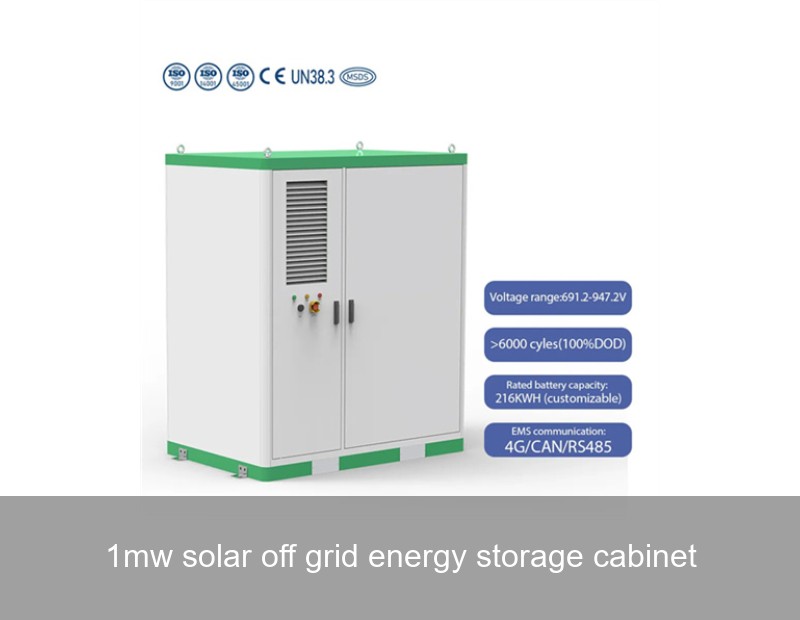
Imagine a remote industrial site, a bustling agricultural processing plant, or a critical community facility, all operating entirely on clean, self-generated power—completely disconnected from the traditional grid. This isn't a futuristic dream; it's a reality made possible today by robust, megawatt-scale energy solutions. At the heart of these powerful off-grid systems lies a critical component: the 1MW solar off-grid energy storage cabinet. This comprehensive guide will explore why this specific solution is becoming a cornerstone for large-scale energy independence, how it works, and what you need to consider for a successful deployment.
Table of Contents
- What is a 1MW Solar Off-Grid Energy Storage Cabinet?
- The Off-Grid Imperative: Why Large-Scale Solar-Plus-Storage is Booming
- Key Components of a Reliable 1MW Off-Grid System
- The Highjoule Solution: Engineered for Off-Grid Resilience
- A Real-World Case Study: Powering a Remote Mine
- Critical Considerations for Your 1MW Off-Grid Project
- Looking Ahead: The Evolving Role of Large-Scale Storage
What is a 1MW Solar Off-Grid Energy Storage Cabinet?
Let's break down the name. A 1MW solar off-grid energy storage cabinet is a centralized, containerized unit—or a series of interconnected cabinets—designed to store a massive amount of electrical energy, typically in the range of several megawatt-hours (MWh). Its primary function is to integrate with a large-scale solar photovoltaic (PV) array (often 1-2MWp or more) to form a self-sufficient power plant. Unlike grid-tied systems that supplement utility power, this setup is designed to be the sole, reliable power source for a significant load, 24/7, without any connection to the public electricity grid.
Think of it as the beating heart and backup brain of an off-grid operation. The solar panels are the "muscle," generating power when the sun shines. The 1MW energy storage cabinet is the vital organ that stores excess solar energy and intelligently dispatches it throughout the night, during cloudy weather, or during peak demand periods, ensuring a continuous and stable power supply.

Credit: Photo by American Public Power Association on Unsplash - Containerized energy storage solutions are key for large-scale deployments.
The Off-Grid Imperative: Why Large-Scale Solar-Plus-Storage is Booming
The demand for megawatt-scale off-grid solutions is accelerating, particularly in Europe and North America, driven by powerful economic and environmental forces.
The Phenomenon: Businesses and communities are increasingly seeking autonomy from volatile energy markets and aging grid infrastructure. The desire for sustainability, coupled with the need for absolute power reliability, is pushing projects off-grid.
The Data: According to the U.S. Energy Information Administration, the levelized cost of solar PV has plummeted by nearly 90% since 2009. Simultaneously, the cost of lithium-ion battery storage has fallen by over 80% in the last decade (EIA, Annual Energy Outlook). This convergence makes a 1MW solar off-grid system not just technically feasible but often the most cost-effective long-term solution for remote operations.
The Case Drivers:
- Remote Industrial & Mining Sites: New projects in isolated locations where grid extension is prohibitively expensive (often exceeding $1 million per mile).
- Agricultural & Food Processing: Large farms, greenhouses, and processing plants that require reliable power for irrigation, cooling, and operations.
- Microgrids for Communities & Islands: Towns or islands aiming to replace expensive and polluting diesel generators with a clean, resilient energy source.
- Critical Infrastructure Backup: For facilities like water treatment plants or communications hubs where grid failure is not an option.
Key Components of a Reliable 1MW Off-Grid System
A successful system is more than just panels and a big battery box. It's a sophisticated, integrated ecosystem.
| Component | Role in the 1MW Off-Grid System | Key Considerations |
|---|---|---|
| Solar PV Array (1.5-2.5MWp) | Primary energy generator. Sized larger than the cabinet's power rating to account for low-light days and charge the batteries. | Durability, tracking vs. fixed-tilt, O&M access in remote areas. |
| 1MW Energy Storage Cabinet | The core. Houses battery racks, Battery Management System (BMS), thermal management, and safety systems. | Battery chemistry (LFP preferred for safety), cycle life, depth of discharge, cooling method. |
| Power Conversion System (PCS) | The "translator." Manages DC-AC (inverter) and AC-DC (rectifier) conversion, grid-forming capability is essential for off-grid. | Efficiency (>98%), grid-forming/black start capability, harmonic distortion. |
| Energy Management System (EMS) | The "brain." Intelligently controls energy flow between PV, storage, and loads, optimizing for cost and reliability. | Forecasting algorithms, load-shedding capabilities, user interface, remote monitoring. |
| Backup Generator (Optional) | Provides security during extended periods of poor weather. Operates as a last-resort backup. | Size, fuel type (often diesel or biofuel), automated start/stop integration. |
The Highjoule Solution: Engineered for Off-Grid Resilience
At Highjoule, with nearly two decades of experience since 2005, we understand that a 1MW off-grid energy storage cabinet isn't a commodity; it's a mission-critical asset. Our H-IOS (Highjoule Integrated Off-Grid System) is specifically engineered for this demanding application.
Our cabinet solution is built around Lithium Iron Phosphate (LFP) battery technology, chosen for its superior safety profile, long cycle life (typically over 6,000 cycles), and excellent thermal stability—crucial for remote, unattended operation. Each Highjoule H-IOS cabinet is a pre-integrated, containerized unit featuring:
- Proprietary Adaptive BMS: Monitors every cell for voltage, temperature, and current, ensuring balance and preventing dangerous conditions.
- Liquid Cooling System: Maintains optimal battery temperature in all climates, from desert heat to alpine cold, maximizing lifespan and performance.
- Grid-Forming Inverters: Built-in power conversion that can create a stable, clean "grid" from scratch (black start), essential for off-grid operation.
- Cybersecurity Hardened EMS: Our system includes a robust Energy Management System that can be remotely monitored and tuned from our global support centers, but is designed to operate autonomously even if communications are temporarily lost.
We don't just sell cabinets; we provide a complete turnkey service—from initial site assessment and financial modeling to system design, installation, commissioning, and long-term remote performance management.
A Real-World Case Study: Powering a Remote Mine in Nevada, USA
Let's look at a tangible example. A mid-sized silver mining operation in a mountainous region of Nevada faced a dilemma. Their grid connection was unreliable and costly, and expanding operations would require a multi-million dollar grid extension. Diesel generators were their only backup, creating high fuel costs, noise, and emissions.
The Solution: Highjoule deployed a 1.2MW solar array coupled with a 1MW/3.2MWh H-IOS energy storage cabinet system. The system was designed to provide over 85% of the site's annual energy needs, with legacy generators retained only for extreme, prolonged winter conditions.
The Results (after 18 months of operation):
- Fuel Savings: Diesel consumption reduced by approximately 140,000 gallons per year.
- Cost Savings: Levelized cost of energy (LCOE) reduced by an estimated 40% compared to the previous grid-diesel mix.
- Reliability: Zero unplanned power outages related to the energy supply since commissioning, despite several regional grid disturbances.
- Emission Reduction: Carbon footprint from site power reduced by roughly 1,500 metric tons of CO2e annually.

Credit: Photo by Zbynek Burival on Unsplash - Renewable energy is increasingly powering remote industrial operations.
Critical Considerations for Your 1MW Off-Grid Project
Embarking on such a significant project requires careful planning. Here are the key questions you must answer:
1. Load Profiling and Sizing:
How much energy do you consume hourly, daily, and seasonally? An undersized system fails; an oversized one wastes capital. Detailed load analysis is step one.
2. Solar Resource Assessment:
What is the actual solar irradiance at your specific site? Historical weather data and on-site measurements are critical for predicting generation, especially during the "worst-case" season (e.g., winter in the north).
3. Days of Autonomy:
How many consecutive cloudy days must you be able to power through without sun? This directly determines your required battery storage capacity (MWh). More autonomy means a larger, more costly battery bank.
4. Operational Expertise:
Who will monitor and maintain the system? Partnering with a provider like Highjoule, who offers 24/7 remote monitoring and predictive maintenance services, is often the difference between a system that thrives and one that becomes a burden.
Looking Ahead: The Evolving Role of Large-Scale Storage
The technology behind the 1MW solar off-grid energy storage cabinet continues to advance. We're seeing trends towards higher energy density (more storage in a smaller footprint), integration of second-life EV batteries for cost-sensitive applications, and the use of AI to further optimize energy dispatch and predict maintenance needs.
The fundamental shift, however, is in perception. These systems are no longer seen as exotic alternatives but as the default, rational choice for new developments in remote areas and for critical infrastructure seeking true resilience. They represent a convergence of economic pragmatism and environmental stewardship.

Credit: Photo by ThisisEngineering RAEng on Unsplash - Advanced monitoring is key for managing large-scale off-grid systems.
Is your organization currently evaluating the true total cost of grid dependence or diesel generation for a remote site? What specific energy security or sustainability goal is driving your exploration of a 1MW off-grid energy storage solution today?
 Inquiry
 Online Chat